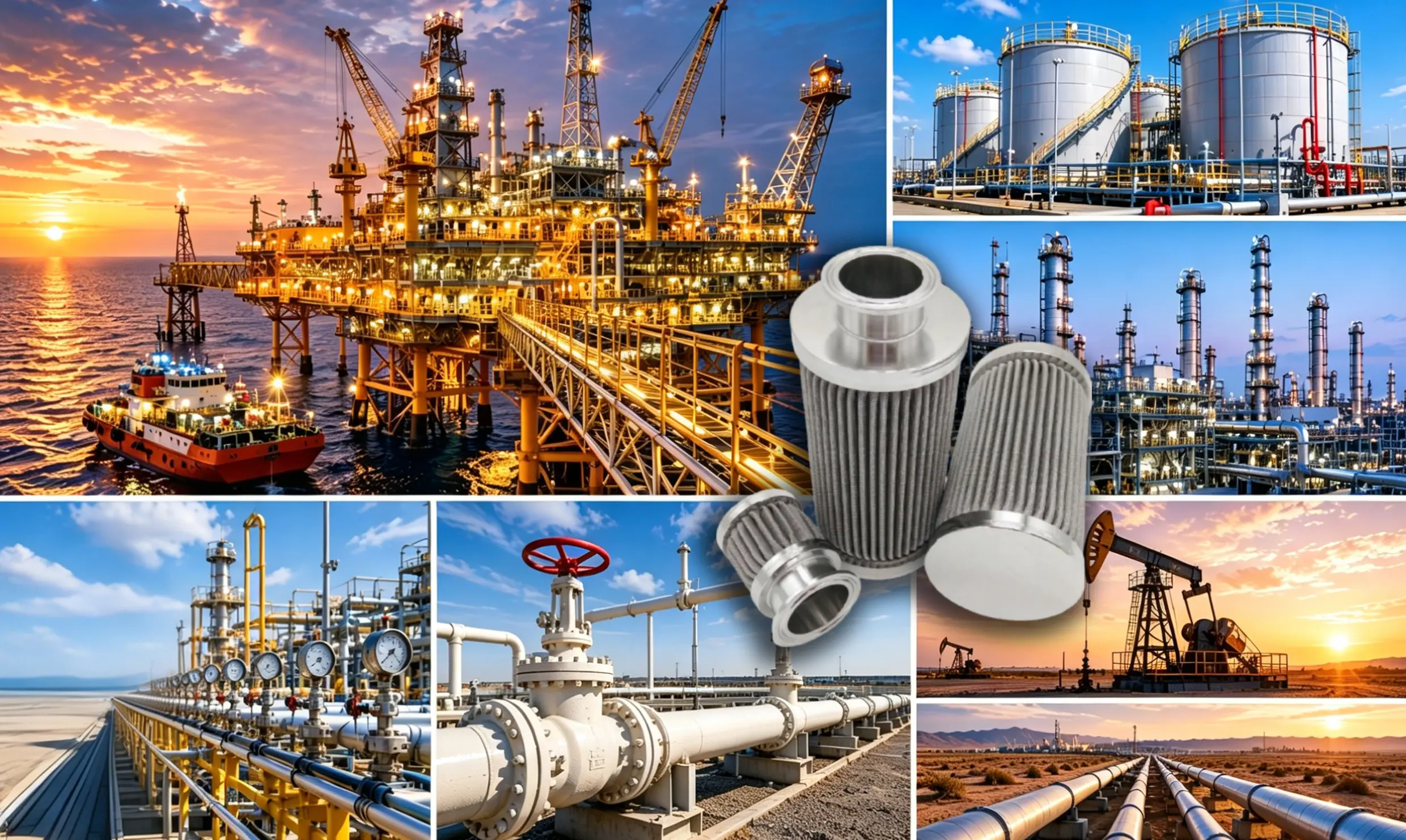
Stainless Steel Pleated Filter Cartridges for Petrochemical Industry
High-temperature, corrosion-resistant 316L / 904L / Hastelloy pleated filter cartridges built for FCC, hydrocracking, HDS, ethylene cracking, aromatics, polymer melts and amine systems.
Industry Characteristics
Why Petrochemical Demands Premium-Grade Stainless Pleated Filtration
Compared with upstream oil & gas, petrochemical service runs even higher temperatures (80–600 °C), more aggressive corrosion chemistry, and protects catalysts whose replacement value can exceed millions of dollars. A single contaminated batch or unplanned shutdown justifies the entire filtration spend many times over.
Higher Temperature
80–600 °C across FCC, hydrocracking, ethylene cracking — beyond the limit of polymer media.
Aggressive Corrosion
H₂S, organic acids, amines, hot hydrocarbons — 316L, 904L and Hastelloy resist pitting and stress corrosion.
High-Value Catalyst Protection
FCC, HDS and hydrocracking catalysts cost USD millions — particulate poisoning shortens cycle life dramatically.
Long Continuous Cycles
Refinery and polyolefin units run 24×7×365. Filters must outlast multi-month run lengths between turnarounds.
High Downtime Cost
An unplanned trip on a refinery or ethylene unit costs USD $500K–$2M+ per day.
Higher Precision Filtration
Catalyst protection and polymer-melt service often require sub-10 µm absolute ratings — well beyond pipeline service.
Application Coverage
12 Typical Petrochemical Applications — Equipment, Conditions & Recommended Cartridge
From FCC and hydrocracking to polyolefin polymer melts and amine treatment — each unit has a distinct combination of temperature, pressure, contaminant and corrosion profile. The right cartridge construction depends on which factor dominates.
← Scroll horizontally to view all columns →
| Application Equipment | Install Location | Protected Equipment | Working Conditions | Contaminants | Customer Pain Point | Consequence Without Filter | Recommended Cartridge |
|---|---|---|---|---|---|---|---|
| FCC Catalytic Cracking Unit | Catalyst circulation, slurry oil filter | Circulation pumps, nozzles, control valves | 180–450 °C; 5–40 bar | Catalyst fines, coke, iron oxide | Catalyst-induced wear of equipment | Valve seizure, pump wear, shutdown | 316L Sintered Mesh Pleated |
| Hydrocracking Unit | Recycle oil filter | Catalyst bed, recycle pumps | 150–380 °C; 50–200 bar | Iron sulfide, scale, catalyst particles | Catalyst bed plugging | Rising dP, lower reaction efficiency | 316L Sintered Mesh Pleated |
| HDS (Hydrodesulfurization) Unit | Feed filter | Reactor catalyst | 180–420 °C; 30–180 bar | Rust, iron sulfide particles | Catalyst poisoning | Shortened catalyst cycle life | 316L / 904L Pleated |
| Ethylene Cracking Unit | Cracked gas filter | Compressors, heat exchangers | 100–450 °C | Coke fines, scale | Compressor impeller wear | Heat exchanger fouling | 316L Sintered Mesh Pleated |
| Aromatics Unit (PX/PTA Feed) | Feed filtration | Transfer pumps, reactor | 80–250 °C | Crystal solids, rust | Product purity decline | Lower product grade | 316L Sintered Felt Pleated |
| PTA Production Line | Slurry filter | Purification system, nozzles | 120–300 °C | Crystal solids, catalyst residue | Nozzle plugging | Quality drop | Sintered Felt Pleated |
| Polypropylene (PP) Plant | Polymer melt filter | Melt pumps, die head | 220–300 °C; 50–250 bar | Gels, carbon particles | Black specks, fish-eyes | Product downgrade | Sintered Fiber Felt Pleated |
| Polyethylene (PE) Plant | Melt filtration | Extruder, die head | 200–300 °C | Gels, unmelted particles | Surface defects | Higher reject rate | Sintered Felt Pleated |
| Amine Circulation System | Amine filter loop | Amine pumps, heat exchangers | 50–120 °C | Iron sulfide, corrosion products | Amine foaming | Heat exchanger blockage | 316L / 904L Pleated |
| Solvent Recovery System | Solvent filter | Pumps, evaporators | 60–180 °C | Resin particles, oxides | Reduced heat-transfer efficiency | Equipment fouling | 316L Sintered Mesh Pleated |
| Catalyst Recovery System | Recovery filter | Catalyst handling | High temperature & corrosion | Catalyst powder | Catalyst loss | Higher production cost | 316L Sintered Mesh Pleated |
| Flare Gas Recovery System | Flare gas filter | Compressor | High-flow gas duty | Rust, dust, droplets | Compressor wear | Equipment failure | 316L Sintered Mesh Pleated |
Operating Conditions
Why Stainless Steel Pleated — Mapped to Petrochemical Conditions
| Condition Type | Working Conditions | Why Stainless Steel Pleated Filter |
|---|---|---|
| High Temperature | 200–600 °C | Polymer and resin-bonded media fail at these temperatures; metal media remain stable. |
| High Pressure | 50–200 bar | All-metal pleated construction provides high mechanical strength. |
| Catalyst Protection | High-value catalyst inventory | Prevents particulate contamination of the catalyst bed. |
| Continuous Production | 24 h × 365 d | Long-life cartridges minimize unplanned change-out stoppages. |
| High-Viscosity Media | Polymer melt | Large effective filtration area enables high throughput at acceptable dP. |
| Corrosive Media | Amines, acids | 316L, 904L and Hastelloy materials selectable per fluid chemistry. |
| High Flow | Hundreds of tons/hour | Pleated geometry minimizes baseline dP across high-flow streams. |
| Cleanable / Long Cycle | Long run lengths between turnarounds | Supports backwash and chemical cleaning for extended service life. |
Customer Concerns
Top 5 Questions from Petrochemical Customers
1. Why does our catalyst life keep shortening?
add
Particulate contaminants — iron sulfide, scale, and fines — physically blanket and chemically poison the catalyst bed, reducing active sites and shortening run length. SINFT pleated cartridges installed upstream of the reactor remove these particles before they reach the catalyst, protecting both activity and pressure drop.
2. Why does pressure drop rise so fast across our filters?
add
Cylindrical surface filters have very limited dirt-holding area. SINFT pleated cartridges deliver 3–8× more effective filtration area in the same footprint, giving significantly longer time-to-terminal-dP and fewer change-outs.
3. Why do we need to change cartridges so often?
add
High dirt-holding pleated geometry combined with optimized mesh layering significantly extends service intervals. Many SINFT customers report 2–3× longer change-out cycles versus the cartridge they replaced.
4. Our cartridges fail in high-temperature service — why?
add
Polymer or resin-bonded cartridges degrade above ~150 °C. SINFT cartridges are all-metal construction (316L core, mesh, end caps), rated for continuous service at 200–600 °C without loss of integrity.
5. Corrosion is destroying our cartridges — what materials do you offer?
add
SINFT offers 316L for general service, 904L for higher chloride / H₂S environments, and Hastelloy (C-276, C-22) for severe corrosion. Material selection is matched to your fluid analysis and operating envelope.
Related Products & Applications
Explore Related Solutions
Pleated Filter Cartridges
Back to the full product overview, specs and downloads.
Sintered Fiber Felt
For polymer melt and high-viscosity petrochemical service.
Oil & Gas Application
Upstream gas, LNG, offshore and pipeline filtration.
Petrochemical Overview
Full petrochemical application portfolio.
Request a Quote — Petrochemical Pleated Filtration
Tell us your process unit, fluid analysis, temperature, pressure and flow — our engineering team replies with a tailored cartridge specification within 24 hours.