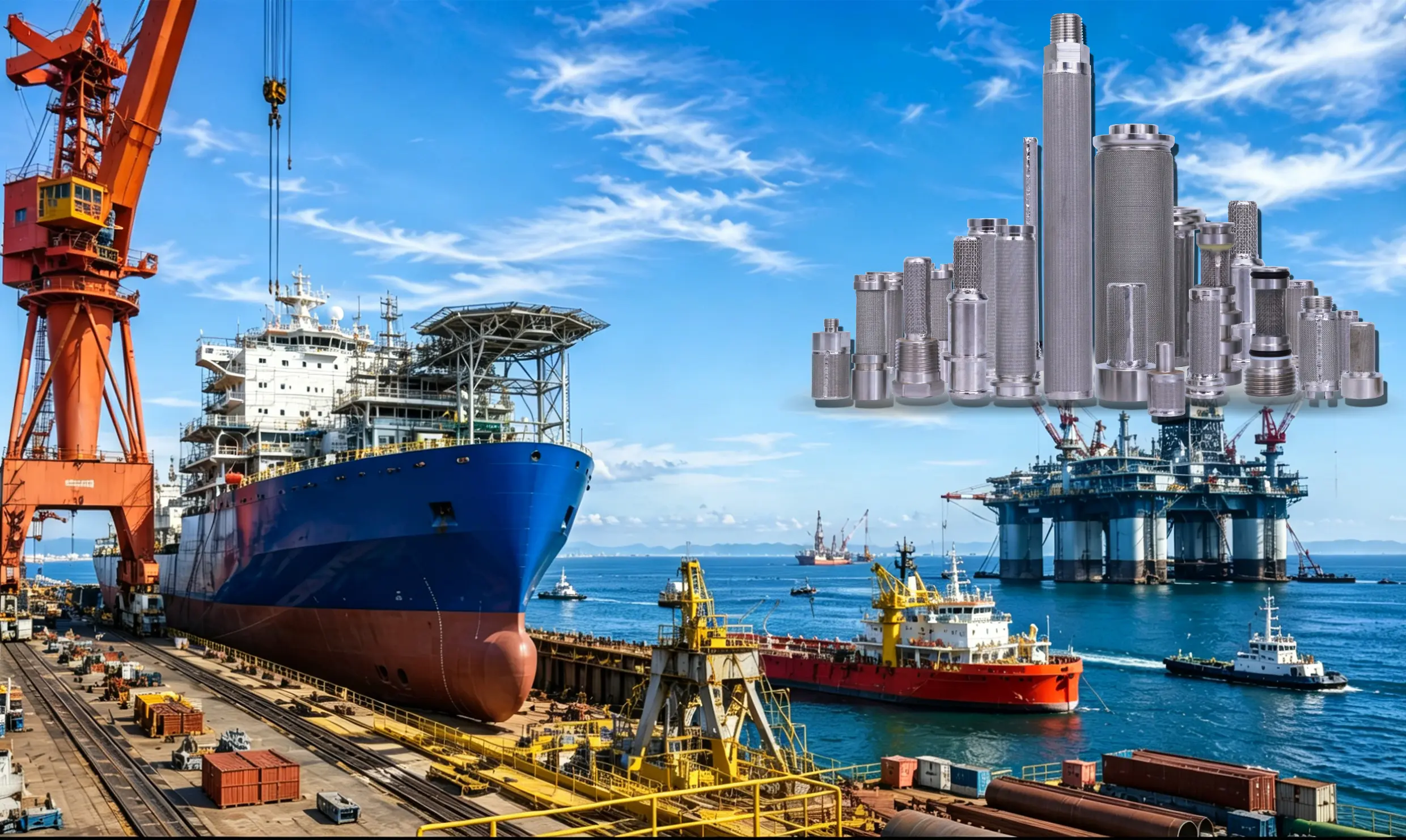
Sintered Mesh Filters for Marine & Offshore Engineering
5-layer 316L & duplex stainless sintered mesh for marine main engine fuel injection (cat fines), LNG dual-fuel FGSS, steering gear hydraulics, FPSO process gas, offshore platform gas compression and safety-critical BOP control service.
Industry Characteristics
Why Marine & Offshore Demands CPFE-Grade Sintered Mesh
Marine and offshore engineering combines the harshest filtration environment in industry with the highest stakes per fault. Main engine fuel injection at 2200 bar. LNG cryogenic at −163 °C. BOP control hydraulics at 1500 bar safety-critical. FPSO sour gas at 250 °C. All operating in salt spray, vibration and remote-site supply chains. Sintered mesh is the only media that survives — which is why it’s treated as a Critical Process Filter Element for the vessel and platform’s most important systems.
Cat Fines Capture
Modern HFO / VLSFO contain abrasive cat fines that destroy fuel injectors. 5-layer sintered mesh captures them.
LNG Cryogenic
−163 °C dual-fuel FGSS — 316L cryogenic-grade sintered mesh has the toughness.
Safety-Critical BOP
700–1500 bar BOP control hydraulics. Reinforced 7-layer construction. SIL-rated documentation.
Chloride Corrosion
Duplex 2205 / Super Duplex 2507 for seawater cooling, BWTS and SWRO service.
Sour FPSO Service
904L per NACE MR0175 / ISO 15156 for H₂S-bearing produced gas.
Vibration Survival
Fully-welded diffusion-bonded construction tolerates main-engine vibration and wave impact.
Application Coverage
15 Typical Marine & Offshore Applications — Equipment, Conditions & Recommended Structure
From marine main and auxiliary engine fuel and lube oil, to steering gear and deck crane hydraulics, seawater cooling and fire-fighting, BWTS, LNG fuel gas supply (FGSS) and gas engine, FPSO crude processing, offshore platform gas compression, all the way to safety-critical BOP control hydraulics.
← Scroll horizontally to view all columns →
| Application System | Install Location | Protected Equipment | Working Conditions | Contaminants | Customer Pain Point | Consequence Without Filter | Recommended Structure |
|---|---|---|---|---|---|---|---|
| Marine Main Engine Fuel | Day Tank Outlet Filter | Fuel injector, fuel pump | 40–150 °C | Cat fines, rust | Injector wear | Main engine failure | 5-Layer 316L Sintered |
| Marine Aux Engine Fuel | Generator Fuel Filter | Generator injector | Continuous duty | Sludge, particles | Generator stoppage | Full vessel blackout risk | 316L Sintered |
| Main Engine Lube Oil | Lube Oil Circulation Filter | Bearings, crankshaft | Heavy load | Metal wear particles | Bearing wear | Main engine overhaul | Sintered Mesh |
| Gearbox Lubrication | Lubrication Filter | Gearbox | Long-cycle service | Metal particles | Gear wear | Gearbox replacement | Sintered Mesh |
| Marine Hydraulic Station | Return Filter | Hydraulic pump, valve banks | 150–350 bar | Iron chips, seal debris | Valve seizure | Hydraulic system failure | 5-Layer Sintered |
| Steering Gear Hydraulics | Pressure Line Filter | Steering hydraulic cylinder | High-frequency pulse | Metal wear particles | Steering fault | Loss of vessel control | Reinforced Sintered |
| Deck Crane Hydraulics | Return Filter | Hydraulic motor | High-impact load | Metal particles | Crane fault | Cargo operations stoppage | Sintered Mesh |
| Seawater Cooling | Seawater Filter | Plate heat exchanger | High-salinity seawater | Shells, algae, silt | Exchanger plugging | Main engine over-temperature alarm | 2205 Sintered |
| Ballast Water Treatment (BWTS) | Pre-Filter | UV system | Seawater service | Marine organisms, silt | Cartridge corrosion | System shutdown | 2205 / 2507 Sintered |
| Seawater Fire-Fighting | Inlet Filter | Fire pump | Seawater medium | Shellfish, silt | Pump impeller wear | Fire-fighting system failure | Duplex Sintered |
| LNG Fuel Gas Supply (FGSS) | Gas Filter | Vaporizer, regulator valve | −163 °C ~ 50 °C | Ice crystals, rust | Valve plugging | LNG system shutdown | 316L Cryogenic Sintered |
| LNG Gas Engine | Fuel Gas Filter | Gas injection valve | Ultra-clean gas | Metal particles | Gas injection fault | Engine stoppage | High-Precision Sintered |
| FPSO Crude Processing | Process Filter | Separator | High-temp / high-pressure | Catalyst powder | Equipment wear | Production stoppage | Sintered Mesh |
| Offshore Platform Gas | Gas Filter | Compressor | 50–200 bar | Rust, droplets | Compressor fault | Platform shutdown | 5-Layer Sintered |
| Offshore Drilling BOP Control | HPU Hydraulic Filter | BOP control system | Safety-critical system | Metal wear particles | Control failure | Major safety incident | Reinforced 7-Layer Sintered |
Material Selection
Material Selection Guide — Service to Recommended Construction
Construction is matched to fluid chemistry, operating envelope and class society requirement. Use this as a starting reference; we tailor per analysis and IMO / NACE compliance.
| Service Environment | Recommended Material | Rationale |
|---|---|---|
| Fuel oil filtration | 316L Sintered | Resistance to HFO / VLSFO corrosion. |
| Lube oil filtration | 316L Sintered | Long service life with periodic cleaning. |
| Hydraulic system | 5-Layer 316L Sintered | High mechanical strength for pressure cycling. |
| Seawater filtration | Duplex 2205 Sintered | Chloride pitting resistance. |
| High-salinity wastewater | Super Duplex 2507 | Maximum chloride resistance. |
| LNG cryogenic system | 316L Cryogenic Grade | Resistance to low-temperature embrittlement. |
| Natural gas system | 316L Sintered | Stable filtration in gas service. |
| Sour natural gas (H₂S) | 904L | Sulfide stress cracking resistance per NACE MR0175. |
| Offshore platform | Duplex 2205 / 2507 | Marine atmosphere chloride and biofouling resistance. |
| Automatic backwash system | 5-Layer Sintered | Long-life cycling under pulse backwash. |
Operating Conditions
Why Sintered Mesh — Mapped to Marine & Offshore Conditions
| Condition Type | Working Conditions | Why Stainless Steel Sintered Mesh |
|---|---|---|
| Seawater Service | High-chloride environment | Duplex stainless resists pitting corrosion. |
| Salt-Spray Atmosphere | Marine atmospheric exposure | Long corrosion-resistance life. |
| High-Pressure Hydraulics | 150–420 bar | Sintered mesh withstands high pressure differential. |
| LNG Cryogenic Service | −163 °C | 316L retains excellent low-temperature toughness. |
| Long-Cycle Operation | 24 h continuous duty | Cleanable, reusable across many cycles. |
| Online Back-Flush | In-line backwash | Sintered mesh tolerates indefinite backwash. |
| Hazardous Area | Offshore explosion-rated zone | All-metal construction is intrinsically safe. |
| High-Vibration Service | Main engine vibration | Welded structure resists fatigue cracking. |
Customer Concerns
Top 5 Questions from Marine & Offshore Customers
1. Why is sintered mesh required for marine main engine fuel injection?
add
Modern marine main engines run at 1500–2200 bar common-rail fuel injection. The fuel contains catalytic fines (cat fines) from refinery residue that aggressively erode injector tips and fuel pumps at these pressures. SINFT 5-layer 316L sintered mesh delivers permanent micron rating to capture cat fines without media drift — protecting the most expensive component on the vessel. Field-proven on ME-GI, ME-LGI, MAN B&W and Wärtsilä dual-fuel engines.
2. What makes sintered mesh suitable for LNG fuel gas supply (FGSS)?
add
LNG FGSS service spans −163 °C cryogenic (liquid) to 50 °C vaporized fuel gas, with potential ice-crystal contamination. SINFT 316L cryogenic-grade sintered mesh retains toughness throughout this range, with all-metal diffusion-bonded construction that has no fasteners or polymer parts to fail at cryogenic temperature. Standard on dual-fuel LNG carriers, LNG container ships and FSRU regasification units.
3. How does sintered mesh protect BOP control systems on offshore drilling platforms?
add
BOP (Blowout Preventer) hydraulic control is safety-critical — failure means catastrophic blowout. SINFT 7-layer reinforced 316L sintered mesh delivers permanent micron rating at 700–1500 bar with zero fiber migration. NACE MR0175 / ISO 15156 compliance for sour service. SIL-rated documentation available on request. Field-proven on subsea BOPs across the Gulf of Mexico, North Sea and South China Sea.
4. Can SINFT supply filters compliant with class society and IMO Tier III?
add
Yes. SINFT marine sintered mesh filters can be supplied to CCS, ABS, DNV, BV, LR, RINA and NK class society requirements. For IMO Tier III SCR systems, our 316L sintered mesh elements protect SCR catalyst from urea solution particulates and engine fuel cat fines, ensuring catalyst run-length and emission compliance.
5. Which material for FPSO produced water and sour offshore service?
add
For general FPSO process gas: 316L sintered mesh. For sour service with H₂S (oil produced gas containing acid gases): 904L sintered mesh per NACE MR0175. For high-chloride produced water: Duplex 2205 or Super Duplex 2507. For severely sour service (high H₂S, high chloride, high temperature): Hastelloy C-276. Material is matched per fluid analysis and FPSO class society requirements.
Related Products & Applications
Explore Related Solutions
Sintered Mesh Filter
Back to the full product overview, specs and downloads.
Pleated · Marine & Offshore
Bulk pleated fuel, lube oil & BWTS service.
Basket & Tube · Marine & Offshore
Seawater intake & sea chest strainers.
Sintered · Natural Gas
LNG, PSA H₂ and 900 bar refueling service.
Request a Quote — Marine & Offshore Sintered Mesh
Tell us your vessel or platform (commercial ship, LNG carrier, FPSO, semi-sub drilling rig…), system (main engine fuel, LNG FGSS, hydraulics, BOP, seawater cooling…), operating envelope and class society — our engineering team replies with a tailored specification within 24 hours.