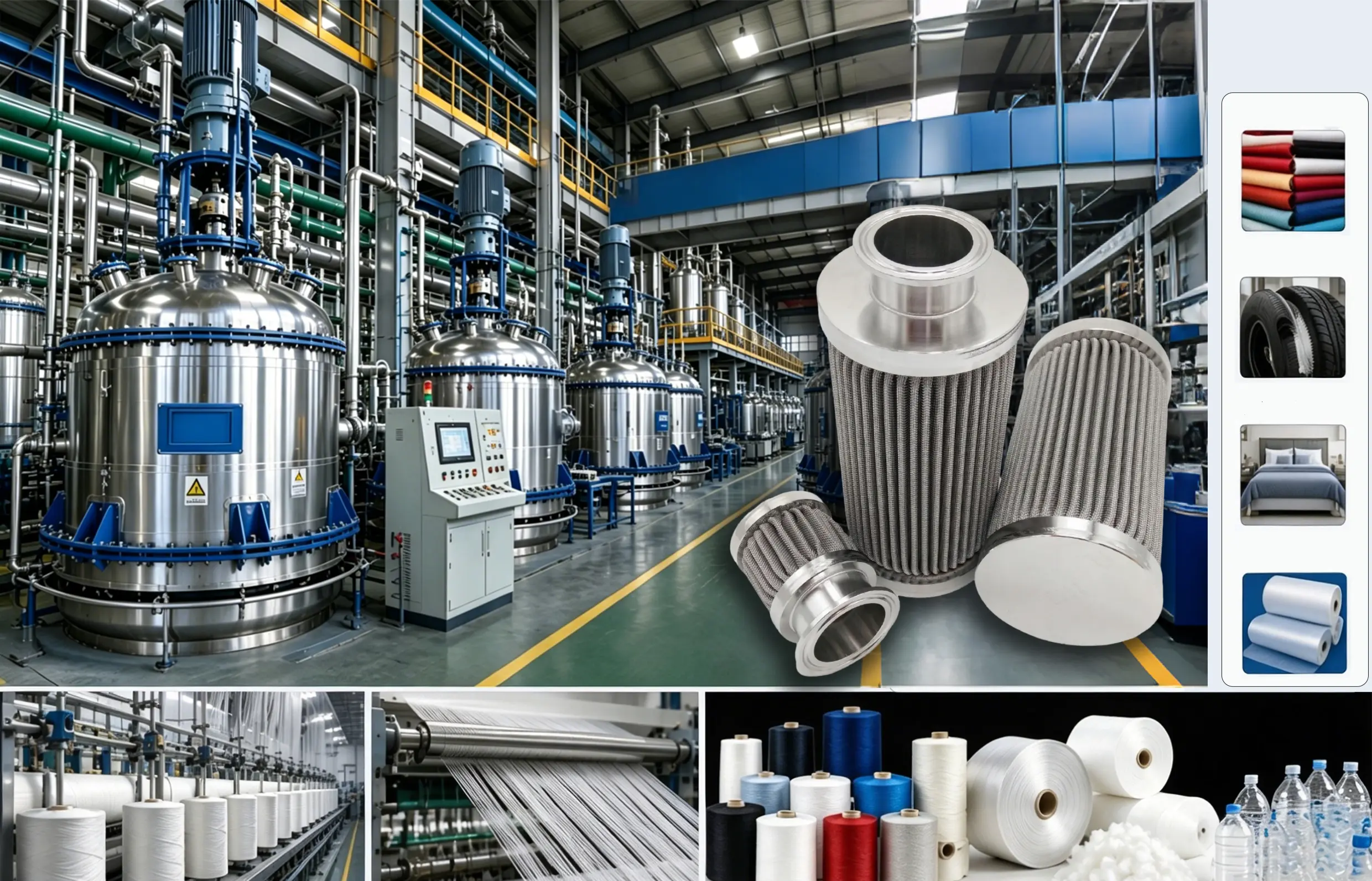
Stainless Steel Pleated Filter Cartridges for Polymer & Synthetic Fiber Industry
Sintered fiber felt pleated cartridges engineered for polymer melt filtration — PET, nylon, BOPET, BOPP, polyolefin films, POY, FDY and spandex production. Black-spec, gel and filament-break control at scale.
Industry Characteristics
Why Polymer & Fiber Demands Sub-Micron-Grade Pleated Filtration
In polyester, nylon, BOPET, BOPP, PP and PE production, a single 100 µm contaminant can scrap an entire film roll. Polymer-grade filtration requirements are far more demanding than hydraulic-oil or even refinery service — what matters here is product quality, black-spec control, gel control, filament-break rate and screen-change cycle.
Product Quality First
Optical films and industrial yarn demand defect-free output. Every reject batch costs more than the filter program.
Black-Spec Control
Carbonized residue and degradation particles must be removed before they reach the die head or spinneret.
Gel Control
Gels cause fish-eyes in film and breaks in fiber. Sintered fiber felt captures both gels and microparticles.
Filament Break Rate
Spinneret plugging is the dominant mechanical cause of broken filaments in POY, FDY and PSF.
Screen Change Cycle
Every screen change = downtime + lost throughput. Longer cycles directly increase plant output.
Continuous Production
PET, BOPET and BOPP lines run 24×7. Cartridges must outlast the campaign between scheduled turnarounds.
Application Coverage
13 Typical Polymer & Fiber Applications — Equipment, Conditions & Recommended Cartridge
From PET polymerization and POY/FDY spinning, to BOPET/BOPP biaxial film, to PP/PVC/ABS sheet extrusion — each polymer process has its own temperature, pressure and gel-particle profile. The right pleated construction depends on which factor dominates.
← Scroll horizontally to view all columns →
| Application Equipment | Install Location | Protected Equipment | Working Conditions | Contaminants | Customer Pain Point | Consequence Without Filter | Recommended Cartridge |
|---|---|---|---|---|---|---|---|
| PET Polyester Melt Filter | Reactor outlet, upstream of spin beam | Melt pumps, metering pumps, spinneret | 260–310 °C; 50–250 bar | Gels, black specks, carbon, catalyst residue | Filament breaks, black specks, frequent screen changes | Spinneret plugging, product downgrade | Sintered Fiber Felt Pleated |
| POY Production Line | Melt line to spin beam | Spinneret, metering pumps | 270–300 °C; 80–150 bar | Gels, degradation products | High POY breakage rate | Lower product quality | Sintered Felt Pleated |
| FDY Production Line | Upstream of spin pack | Spinneret | 280–310 °C | Black specks, micro-gels | Higher reject rate on high-end fiber | Lower Grade-A yield | Ultra-Fine Sintered Felt Pleated |
| Polyester Staple Fiber (PSF) Line | Spin beam inlet | Distribution plate, spinneret | 280–310 °C; 80–180 bar | Gels, degradation products | Frequent filament breaks | More downtime | Sintered Felt Pleated |
| Nylon (PA6/PA66) Line | Melt filtration | Metering pumps, spinneret | 250–290 °C | Unmelted particles, black specks | Fiber defects | Lower product grade | Sintered Fiber Felt Pleated |
| Spandex Production Line | Polymer filter | Precision spin pack | High temp, high viscosity | Micro-gels, contaminants | Filament breaks | Product scrap | High-Precision Sintered Felt |
| BOPET Film Line | After melt pump, before T-die | Die head system | 270–310 °C | Gels, black specks | Optical defects | Film downgrade | Sintered Felt Pleated |
| BOPP Film Line | Downstream of extruder | Melt pump, die head | 220–280 °C | Fish-eyes, gels | Film crystal defects | Entire roll scrap | Sintered Felt Pleated |
| CPP Cast Film Line | Upstream of die head | T-die | 220–280 °C | Unmelted particles | Surface defects | Lower yield | Sintered Felt Cartridge |
| PE Blown Film Line | Extruder filter | Blown film die | 180–260 °C | Contaminants, gels | Film pinholes | Product scrap | Sintered Mesh Pleated |
| PP Sheet Line | Melt filter | Die head | 220–280 °C | Gels, black specks | Appearance defects | Sold as downgrade | Sintered Felt Pleated |
| PVC Sheet Line | Extruder outlet | Die head system | 180–240 °C | Carbonized particles | Yellowing, black specks | Off-spec product | Sintered Mesh Pleated |
| ABS Board Line | Melt filter | Die head | 220–280 °C | Unmelted particles | Surface blemishes | Customer complaints | Sintered Felt Pleated |
Operating Conditions
Why Stainless Steel Pleated — Mapped to Polymer & Fiber Conditions
| Condition Type | Working Conditions | Why Stainless Steel Pleated Filter |
|---|---|---|
| High-Temperature Melt | 220–350 °C | Polymer or resin-bonded media degrade — only all-metal media survives. |
| High-Pressure Melt | 50–300 bar | All-metal pleated construction delivers the required mechanical strength. |
| High-Viscosity Media | Polyester, nylon melts | Pleated geometry provides much larger filtration area to keep dP manageable. |
| Long Production Cycle | 24 h continuous | High dirt-holding capacity extends screen-change intervals significantly. |
| Optical / High-Purity | Optical film, industrial yarn | Sintered fiber felt captures micron-scale particles and gels. |
| High Throughput | Large-flow melt streams | Pleated geometry minimizes baseline dP across high-flow units. |
| Regenerable / Reusable | Pyrolytic cleaning ovens | All-metal construction tolerates repeated pyrolysis regeneration cycles. |
| Precision Spinning | FDY, POY, spandex | Ultra-fine sintered felt prevents spinneret hole plugging. |
Customer Concerns
Top 5 Questions from Polymer & Fiber Customers
1. Why are there so many black specks in our product?
add
Black specks come from gels, carbonized residue and polymer degradation products in the melt. SINFT sintered fiber felt pleated cartridges remove gels and carbon particles down to single-digit micron levels, eliminating black-spec rejects and lifting first-pass yield.
2. Why do we have to change screens so frequently?
add
Conventional flat screens have very limited dirt-holding area. SINFT pleated cartridges deliver 3–8× more effective filtration area in the same housing, dramatically extending time between screen change-outs and reducing line stoppages.
3. Filament break rate is too high — how does filtration help?
add
Spinneret plugging by gels and microparticles is the leading mechanical cause of filament breakage in POY, FDY and PSF lines. High-precision sintered fiber felt cartridges upstream of the spin pack prevent plugging at the source and stabilize the spinning process.
4. Pressure drop rises too fast — what can we do?
add
High-porosity sintered fiber felt construction combined with deep pleat geometry minimizes baseline dP and gives a much slower rise curve, even on viscous polyester and nylon melts.
5. Filter cost is too high per change-out — any options?
add
SINFT pleated cartridges are all-metal construction and can be regenerated by pyrolytic cleaning (vacuum or air pyrolysis ovens). Many polymer producers achieve 3–5 reuse cycles, dramatically lowering total cost per shift.
Related Products & Applications
Explore Related Solutions
Pleated Filter Cartridges
Back to the full product overview, specs and downloads.
Sintered Fiber Felt
The core media for polymer melt — high porosity, micron-scale capture.
Petrochemical Application
FCC, hydrocracking, ethylene and refinery service.
Oil & Gas Application
Upstream gas, LNG, offshore and pipeline filtration.
Request a Quote — Polymer Melt Pleated Filtration
Tell us your polymer (PET, nylon, BOPP, BOPET, PE, PP, PVC…), throughput, temperature and target micron rating — our engineering team replies with a tailored cartridge specification within 24 hours.