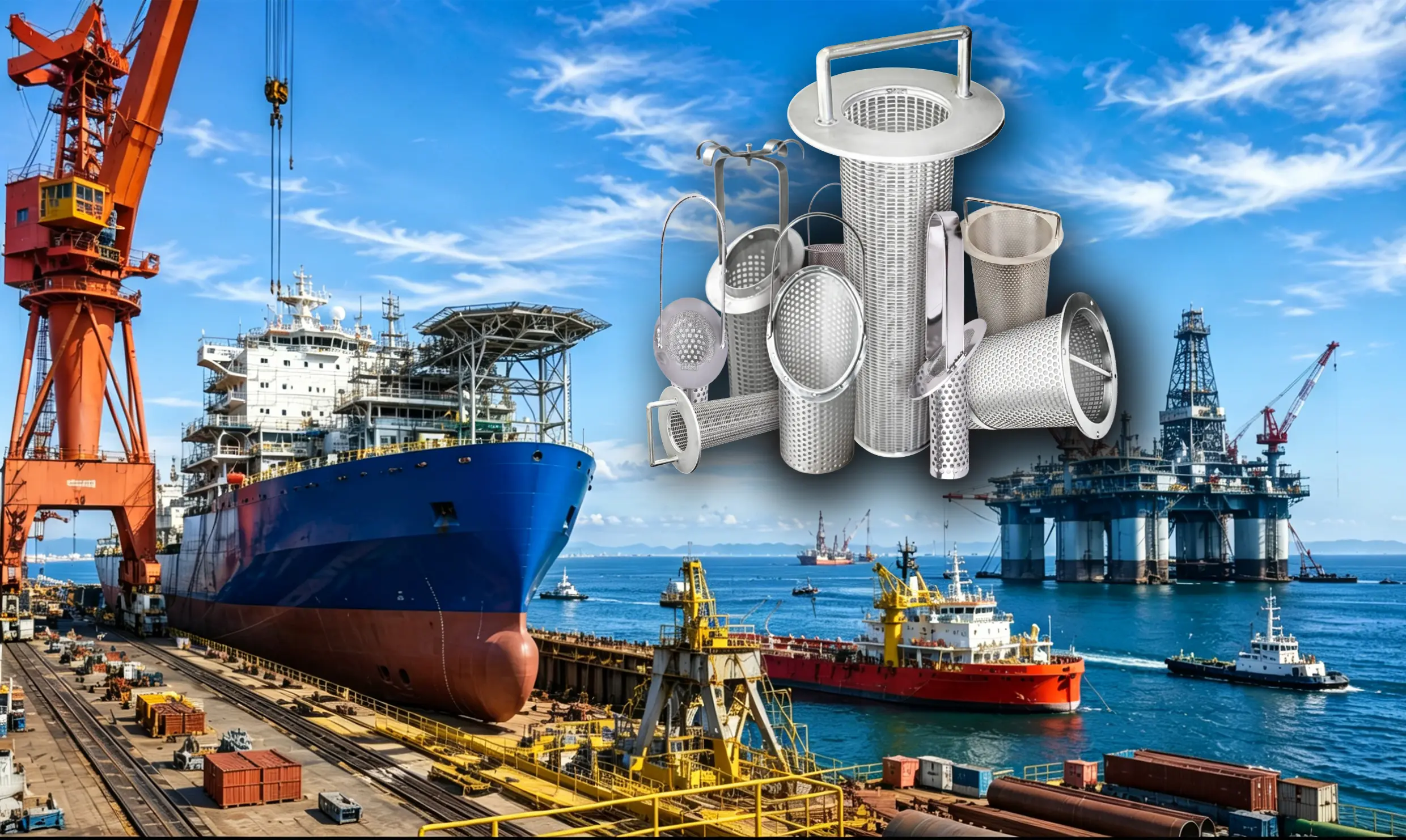
Stainless Steel Basket & Tube Filters for Marine & Offshore Engineering
Sea-chest strainers, central-cooling baskets, BWTS pre-filters, fuel oil and lube oil baskets, fire main strainers, FPSO produced-water and seawater-injection tube filters — engineered in 316L, 904L, Duplex 2205 / 2507 and Hastelloy C-276.
Industry Characteristics
Why Marine & Offshore Demands Duplex-Grade Basket Filtration
Vessels and platforms operate in the harshest filtration environment in industry: continuous chloride attack, year-round 24-hour duty, gross marine biofouling (shells, seaweed, sand), variable fuel quality, severe vibration and extremely expensive at-sea or offshore replacement. Baskets and tube filters do the heavy lifting — intercepting bulk debris ahead of seawater pumps, heat exchangers, BWTS, fire pumps and main-engine fuel and lube oil systems.
Chloride Corrosion
Continuous seawater contact destroys carbon steel quickly. 316L, 904L and Duplex grades are mandatory.
Marine Biofouling
Shells, seaweed and sand load the sea chest constantly. Coarse baskets (500–3000 µm) intercept it all.
High Replacement Cost
Supply-vessel logistics, helicopter time, at-sea labor — change-outs are expensive. Long-life duplex pays back.
Class Society Compliance
CCS, ABS, DNV, BV, LR, RINA, NK — material certificates and pressure tests issued with every shipment.
Vibration & Shock
Main-engine vibration and wave impact demand fully-welded all-metal construction.
Online Backwash
Duplex housing configurations keep cooling water flowing during cleaning — zero stoppage at sea.
Application Coverage
15 Typical Marine & Offshore Applications — Equipment, Conditions, Filtration Rating & Material
Covering main and central cooling, main and aux engine lube oil, HFO and MGO fuel oil, ballast water, fire main, deck hydraulics, RO desalination, FPSO produced water, seawater injection, LNG fuel gas and offshore wind hydraulic power units. Each combination of fluid, salinity and contaminant maps to a specific material, micron rating and structure.
← Scroll horizontally to view all columns →
| Application System | Equipment | Install Location | Service Medium | Working Conditions | Contaminants | Customer Pain Point | Consequence Without Filter | Rating | Type |
|---|---|---|---|---|---|---|---|---|---|
| Main Seawater Cooling | Main Sea Water Pump | Pump inlet (sea chest) | Seawater | Continuous, high-salinity | Seaweed, shells, silt | Marine biofouling | Seawater pump damage | 500–3000 µm | Basket |
| Central Cooling | Plate Heat Exchanger | Heat exchanger inlet | Seawater | High flow | Shell debris, silt | Exchanger plugging | Lower cooling efficiency | 500–2000 µm | Basket |
| Main Engine Lube Oil | Main Engine Lubrication System | Coarse filter | Lube oil | 60–90 °C | Metal particles, carbon | Lube pump wear | Main engine bearing damage | 100–300 µm | Tube |
| Aux Engine Lube Oil | Generator Lubrication Unit | Lube oil inlet | Lube oil | Continuous | Iron powder, copper powder | Generator bearing wear | Blackout risk | 100 µm | Tube |
| Fuel Oil Supply | Fuel Oil Booster Unit | Fuel pump inlet | HFO / MGO | High-temp heavy oil | Rust, cat-fines | Fuel pump wear | Injector damage | 50–200 µm | Tube |
| Fuel Oil Transfer | Transfer Pump | Transfer pump inlet | Heavy oil | High viscosity | Rust, sludge | Transfer pump seizure | Bunkering interruption | 100–500 µm | Basket |
| Ballast Water System | Ballast Water System | Ballast pump inlet | Seawater | IMO BWTS compliance | Marine organisms, silt | UV / electrolysis plugging | Cannot pass certification | 50–500 µm | Basket |
| Fire Fighting | Fire Fighting System | Fire pump inlet | Seawater | Emergency duty | Shells, seaweed | Fire pump fails on demand | Safety risk | 1000 µm | Basket |
| Deck Machinery Hydraulics | Deck Hydraulic Unit | Hydraulic pump inlet | Hydraulic oil | High pressure | Metal particles | Hydraulic pump damage | Crane / winch downtime | 50–100 µm | Tube |
| Marine Air Compressor | Air Compressor | Compressor inlet | Air | Continuous | Rust, weld slag | Compressor wear | Pneumatic system failure | 25–100 µm | Tube |
| RO Desalination | RO Desalination Plant | HP pump inlet | Seawater | High-salinity service | Shells, silt, suspended solids | RO membrane fouling | Shorter membrane life | 50–200 µm | Basket |
| FPSO Produced Water | Produced Water System | Process pump inlet | Oily produced water | Highly corrosive | Sand, corrosion products | Pump & valve wear | Platform production loss | 50–500 µm | Basket |
| Seawater Injection | Seawater Injection System | Injection pump inlet | Seawater | High-pressure injection | Shells, silt | Injection pump wear | Lower well productivity | 50–200 µm | Tube |
| LNG Fuel Gas | LNG Fuel Gas System | Upstream of compressor | Natural gas | HP cryogenic | Metal particles | Compressor damage | Gas system shutdown | 10–50 µm | Tube |
| Offshore Wind Hydraulics | Hydraulic Power Unit | Hydraulic station inlet | Hydraulic oil | Unmanned operation | Metal wear particles | Difficult maintenance access | Turbine downtime | 50 µm | Tube |
Material Selection
Material Selection Guide — Environment to Recommended Alloy
Material is matched to chloride load, temperature and corrosive species. Use this guide as a starting reference; we tailor to your fluid analysis.
| Service Environment | Recommended Material | Rationale |
|---|---|---|
| Commercial vessel seawater systems | 316L | Cost-effective default for general marine seawater service. |
| High-salinity routes | 904L | Higher Cr, Ni, Mo content resists chloride pitting. |
| FPSO platforms | Duplex 2205 | High mechanical strength combined with chloride corrosion resistance. |
| Offshore drilling platforms | Duplex 2205 | Excellent pitting resistance in harsh offshore environments. |
| Seawater injection systems | Super Duplex 2507 | Maximum resistance to seawater corrosion at high pressure. |
| H₂S offshore environment | Hastelloy C-276 | Resists sulfide stress cracking and pitting. |
| LNG cryogenic system | 316L | Excellent low-temperature toughness down to −196 °C. |
| Ballast water system | Duplex 2205 | Resists marine biological corrosion and chloride attack. |
Technical Specifications
SINFT Marine Basket & Tube Filter — Key Parameters
Engineering targets we hit on every marine and offshore project.
Open Area
40 – 75%
High open area for maximum flow capacity.
Flow Capacity
Maximized
Sized to deliver pump-rated flow at clean dP.
Pressure Drop
Minimized
Pleat and mesh geometry tuned for low baseline dP.
Seawater Corrosion
Required
Duplex / Super-Duplex grades available.
Pressure Rating
High
Reinforced construction for HP injection & hydraulics.
Welding
Fully Welded
No fasteners — vibration-proof construction.
Maintenance Cost
Lowest
Cleanable, reusable, long lifecycle.
Class Society
CCS · ABS · DNV
Cert-ready: BV, LR, RINA, NK on request.
Customer Concerns
Top 5 Questions from Marine & Offshore Customers
1. Why use basket filters instead of pleated cartridges in marine seawater service?
add
Marine seawater contains shells, seaweed, sand and large biological debris that would instantly blind a pleated cartridge. Basket strainers at 500–3000 µm intercept this gross debris ahead of seawater pumps, heat exchangers and BWTS modules. Pleated cartridges deliver finer micron rating but at much lower flow — they protect downstream of the basket.
2. What micron rating do I need for marine and offshore service?
add
Coarsest for raw seawater: 500–3000 µm at sea chest and main seawater pump inlet. Fire main: 1000 µm. Ballast water pre-filter: 50–500 µm (IMO BWTS compliance). HFO fuel oil booster: 50–200 µm. Lube oil coarse filter: 100–300 µm. Hydraulics: 25–100 µm. The application table above maps each marine system to its recommended rating.
3. Which material should I select for seawater service?
add
316L for general commercial vessels (cost-effective). 904L for high-salinity routes. Duplex 2205 for FPSO, offshore platforms, drilling rigs and ballast water service. Super Duplex 2507 for seawater injection at high pressure. Hastelloy C-276 for H₂S-bearing offshore service. 316L is also fine for LNG cryogenic service thanks to excellent low-temperature toughness.
4. Are SINFT basket filters compliant with IMO and class society requirements?
add
Yes — SINFT marine basket strainers can be supplied to class society requirements (CCS, ABS, DNV, BV, LR, RINA, NK). For BWTS pre-filtration, our duplex stainless baskets are designed to IMO D-2 compliant operating envelopes. Material certificates, dimensional inspection reports and pressure-test certificates are issued with every shipment.
5. How easy is at-sea cleaning and replacement?
add
All SINFT marine baskets feature fully-welded all-metal construction and can be regenerated by backwash, ultrasonic or chemical cleaning. Duplex housing configurations support continuous online operation — one element in service, one in standby — eliminating shutdown for cleaning. This is the standard practice on commercial vessels and offshore platforms.
Related Products & Applications
Explore Related Solutions
Basket Filters & Strainers
Back to the full product overview, specs and downloads.
Pleated Cartridges · Marine
Fine-polish filtration downstream of the basket — fuel, lube oil, LNG, BWTS.
Basket & Tube · Petrochemical
FCC, hydrocracking, ethylene and refinery service.
Sintered Mesh Filter
Core media for HDS, LNG and high-pressure gas service.
Request a Quote — Marine & Offshore Basket / Tube Filters
Tell us your vessel or platform (commercial ship, FPSO, drilling rig, LNG carrier…), system (seawater cooling, BWTS, fuel oil, lube oil…), flow rate and class society — our engineering team replies with a tailored specification within 24 hours.