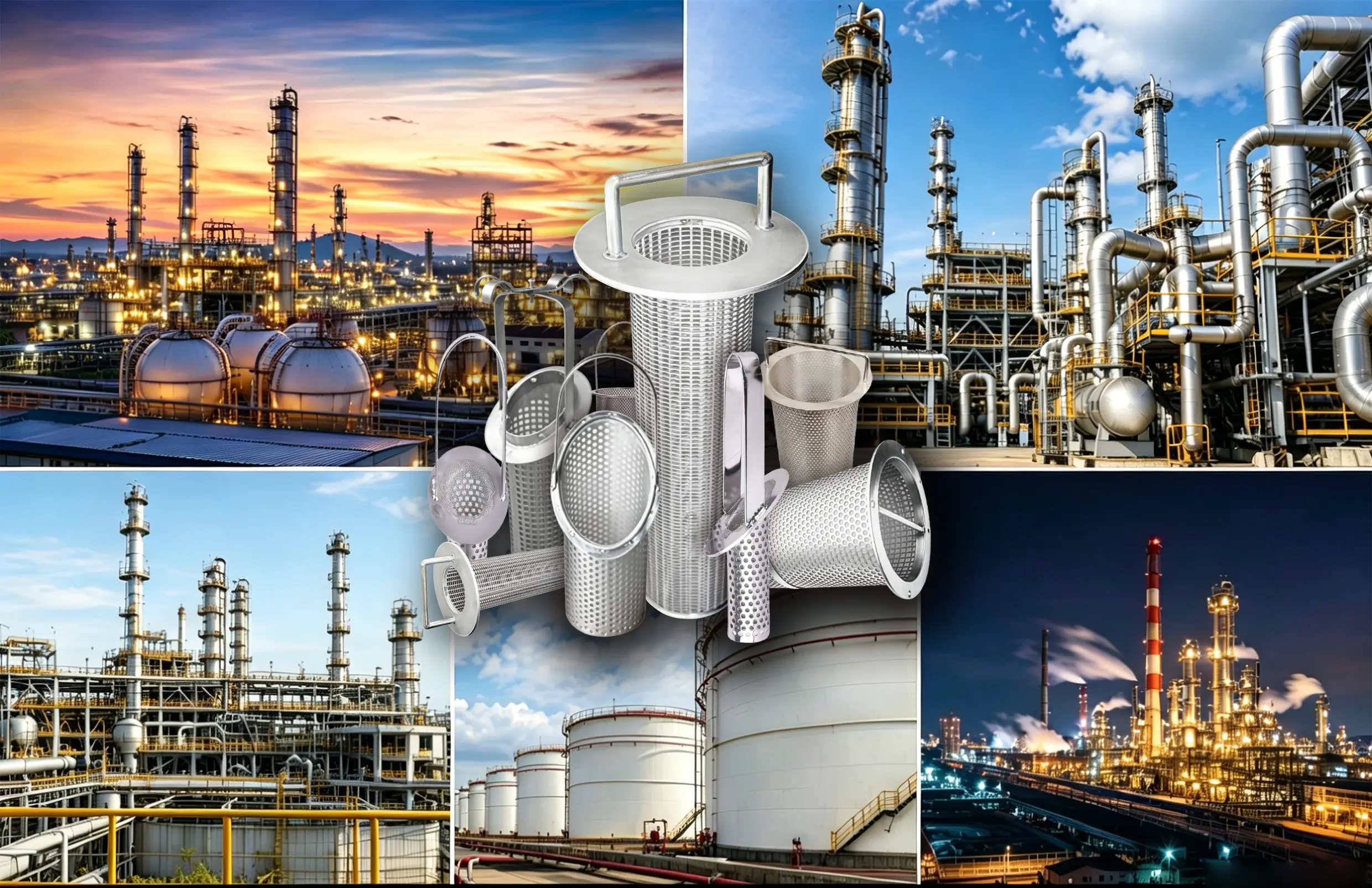
Stainless Steel Basket & Tube Filters for Petrochemical Industry
Large-flow inline strainers and tubular precision filters engineered for crude transfer, FCC, hydrocracking, HDS, ethylene cracking, aromatics, PTA, polyolefin, LNG and ammonia synthesis — protecting pumps, valves, heat exchangers and catalyst beds.
Industry Characteristics
Why Petrochemical Needs Basket & Tube Pre-Filtration
Petrochemical plants combine high temperature (up to 600 °C), high pressure, aggressive corrosion chemistry, very high flow rates and extraordinarily valuable downstream equipment — pumps, valves, heat exchangers and multi-million-dollar catalyst beds. Basket and tube filters provide the large-flow first-stage protection that intercepts construction debris, rust, scale, catalyst fines and coke before they reach those assets.
Large Flow Service
Crude transfer, recirculating cooling water and FCC slurry move hundreds of tons per hour. Baskets deliver flow at minimum dP.
Pump & Valve Protection
A single sand grain or weld slag can wear an impeller in hours. Baskets are the standard first line of defense.
Catalyst-Bed Protection
HDS, hydrocracking and polyolefin catalyst replacement costs millions. Tube filters trap particulates before the reactor.
High-Temperature Service
150–600 °C across distillation, FCC and ethylene cracking. 321 / 347H stainless and Hastelloy retain integrity.
Severe Corrosion
Acetic acid, sulfuric acid, H₂S, amines, hot hydrocarbons. 904L, Duplex 2205 and Hastelloy C-276 are field-proven.
Cleanable & Reusable
All-metal construction supports backwash, ultrasonic, chemical and steam regeneration — long lifecycle, low TCO.
Application Coverage
17 Typical Petrochemical Applications — Equipment, Conditions, Filtration Rating & Material
From crude oil transfer and storage, to FCC and hydrocracking units, ethylene and aromatics, polyolefin and PTA, LNG separators and ammonia synthesis, recirculating cooling water and offshore seawater, all the way to sulfuric / hydrochloric acid service — each combination of fluid, temperature and contaminant maps to a specific filter material, micron rating and mesh structure.
← Scroll horizontally to view all columns →
| Application Unit | Install Location | Service Medium | Working Conditions | Contaminants | Customer Pain Point | Consequence Without Filter | Rating | Mesh Structure | Material |
|---|---|---|---|---|---|---|---|---|---|
| Crude Oil Transfer | Pump inlet | Crude oil | High-flow, continuous | Silt, rust, weld slag, wax | Impeller wear, pump seizure | Pump damage, shutdown | 100–500 µm | Single-Layer Woven Mesh | 316L |
| Crude Storage Tank Outlet | Tank outlet | Crude oil | Ambient – 120 °C | Rust, sludge, sediment | Downstream valve seizure | Pipeline plugging | 100 µm | Woven Mesh + Perforated Plate | 316L |
| Atmospheric & Vacuum Distillation | Heat exchanger inlet | Crude oil | 150–350 °C | Coke fines, rust | Exchanger plugging | Shutdown for cleaning | 100–200 µm | Woven Mesh | 321 |
| FCC Catalytic Cracking | Upstream of feed nozzle | Heavy oil | High-temp / high-pressure | Catalyst fines, coke | Nozzle plugging | Reduced conversion | 50–100 µm | Wedge Wire | 316L |
| FCC Slurry System | Slurry pump inlet | FCC slurry | Heavy particle load | Catalyst powder | Impeller wear | Frequent pump overhaul | 50 µm | Wedge Wire | 316L |
| Hydrocracking Unit | Feed pump inlet | Hydrocracking feed | High pressure | Rust, weld slag, metals | Catalyst poisoning | Premature catalyst death | 25–100 µm | Woven Mesh | 316L |
| HDS (Hydrodesulfurization) | Upstream of HP reactor | Sulfur-containing oil | 200–450 °C | Metal oxides | Rising dP | Early unit shutdown | 50 µm | Sintered Mesh + Perforated Plate | 321 |
| Ethylene Cracking | Quench oil pump inlet | Quench oil | 150–350 °C | Coke fines, polymer particles | Coke deposition | Lower exchanger efficiency | 50 µm | Woven Mesh | 321 |
| Aromatics (PX) Unit | Upstream of control valve | Aromatic medium | High-temp continuous | Polymer particles | Valve seizure | Loss of flow control | 25–50 µm | Woven Mesh | 316L |
| PTA Production | Acetic acid recirculation pump | Acetic acid | Corrosive service | Crystals | Pump wear | Frequent pump overhaul | 25–50 µm | Sintered Mesh | 904L |
| Polyethylene (PE) Plant | Upstream of polymerization reactor | Ethylene feed | High-pressure polymerization | Metal particles | Catalyst deactivation | Off-spec product | 25 µm | Woven Mesh | 316L |
| Polypropylene (PP) Plant | Polymerizer inlet | Propylene feed | Continuous production | Rust, weld slag | Shortened catalyst life | Catalyst-change shutdown | 25 µm | Woven Mesh | 316L |
| LNG Natural Gas Processing | Separator inlet | Natural gas | High-pressure gas | Rust, solids | Compressor wear | Unplanned shutdown | 10–50 µm | Sintered Mesh | 316L |
| Ammonia Synthesis | Compressor inlet | Synthesis gas | High-pressure gas | Rust particles | Impeller damage | High overhaul cost | 10–50 µm | Sintered Mesh | 316L |
| Recirculating Cooling Water | Cooling-water pump inlet | Industrial water | Very high flow | Silt, scale, rust | Exchanger plugging | Reduced cooling capacity | 200–1000 µm | Perforated + Woven Mesh | 304 |
| Offshore Petroleum Platform | Seawater lift pump inlet | Seawater | High-chloride corrosion | Shells, algae, silt | Exchanger plugging | Full-platform load reduction | 200–500 µm | Wedge Wire | Duplex 2205 |
| Acidic Service (HCl / H₂SO₄) | Acid recirculation pump inlet | HCl / H₂SO₄ | Severe corrosion | Metal particles | Pump corrosion damage | System leakage | 50 µm | Sintered Mesh | Hastelloy C-276 |
Selection Guide
Basket vs. Tube — Operating Condition Mapped to Recommended Structure
A quick reference for matching basket or tube construction to your specific service. Detailed engineering proposal available on request.
Large-Flow Bulk Filtration
Basket FilterStandard inline basket strainer — lowest dP, simplest cleanup, ideal for crude transfer and pipeline service.
High Particle Load
Wedge Wire BasketAnti-blinding profile wire — FCC slurry, offshore seawater, heavy oil slurry duty.
Pump Inlet Protection
Woven Mesh BasketLowest cost, easy regeneration — the standard protector for centrifugal and positive-displacement pumps.
Catalyst Bed Protection
Precision Tube FilterFixed pore structure for HDS, hydrocracking and polyolefin reactor feed.
High-Temperature Hydrocarbons
321 / 347H Tube FilterStabilized austenitic grades for sustained service above 350 °C — distillation, HDS, ethylene cracking.
Acetic Acid (PTA)
904L Tube FilterHigh-Ni / high-Mo grade resists hot acetic-acid pitting and stress corrosion.
Offshore Seawater
Duplex 2205 BasketChloride-resistant duplex stainless for seawater lift and platform cooling-water service.
Severe Acid Service
Hastelloy C-276 TubeFor sulfuric and hydrochloric acid recirculation where 904L is insufficient.
LNG Natural Gas
Sintered Mesh TubeFixed pore structure removes ice crystals and metal fines upstream of cryogenic exchangers.
Gas Compressor Protection
High-Strength TubeReinforced sintered or perforated-backed mesh — protects impellers in synthesis gas, LNG, ammonia service.
Customer Concerns
Top 5 Questions from Petrochemical Customers
1. Why use basket or tube filters instead of pleated cartridges?
add
Basket and tube filters handle very high flow rates at low pressure drop and are the standard pre-filter ahead of pumps, valves, heat exchangers and reactors. Pleated cartridges deliver finer micron rating but at much lower flow per element — they protect downstream of the basket. In a typical petrochemical line, basket filters do bulk pre-filtration and pleated cartridges deliver the final polish.
2. How do I pick the right filtration rating for my service?
add
Service-driven. Bulk pump protection on crude or cooling water: 200–1000 µm. Valve protection and exchanger pre-filter: 50–200 µm. Catalyst bed protection in HDS / hydrocracking / polyolefin: 25–50 µm. Gas compressor inlet: 10–50 µm. The application table above maps every typical service to its recommended rating.
3. Which mesh structure should I choose — woven, wedge wire or sintered?
add
Woven mesh is the default for pump and valve protection — low cost, easy clean. Wedge wire is preferred when particle loading is very high (FCC slurry, offshore seawater) thanks to its anti-blinding geometry. Sintered mesh delivers fixed pore structure for catalyst protection and high-temperature service. The Selection Guide above shows the typical match for each service.
4. What material should I select for corrosive or high-temperature service?
add
316L for general petrochemical liquid and gas. 321 / 347H stabilized grades for sustained service above 350 °C (distillation, HDS, ethylene cracking). 904L for acetic acid (PTA). Duplex 2205 for offshore seawater. Hastelloy C-276 for sulfuric / hydrochloric acid service.
5. Can SINFT basket and tube filters be cleaned and reused?
add
Yes — all SINFT baskets and tube elements are all-metal construction. They can be cleaned by backwashing, ultrasonic, chemical or steam regeneration, returning to original performance across many service cycles. Duplex housings also support online backwash configurations.
Related Products & Applications
Explore Related Solutions
Basket Filters & Strainers
Back to the full product overview, specs and downloads.
Pleated Cartridges · Petrochemical
Fine-polish filtration downstream of the basket.
Sintered Mesh Filter
The core media for HDS, LNG and high-temperature gas service.
Petrochemical Overview
Full petrochemical application portfolio.
Request a Quote — Petrochemical Basket & Tube Filtration
Tell us your process unit, fluid, working temperature & pressure, flow rate and target micron rating — our engineering team replies with a tailored basket / tube filter specification within 24 hours.