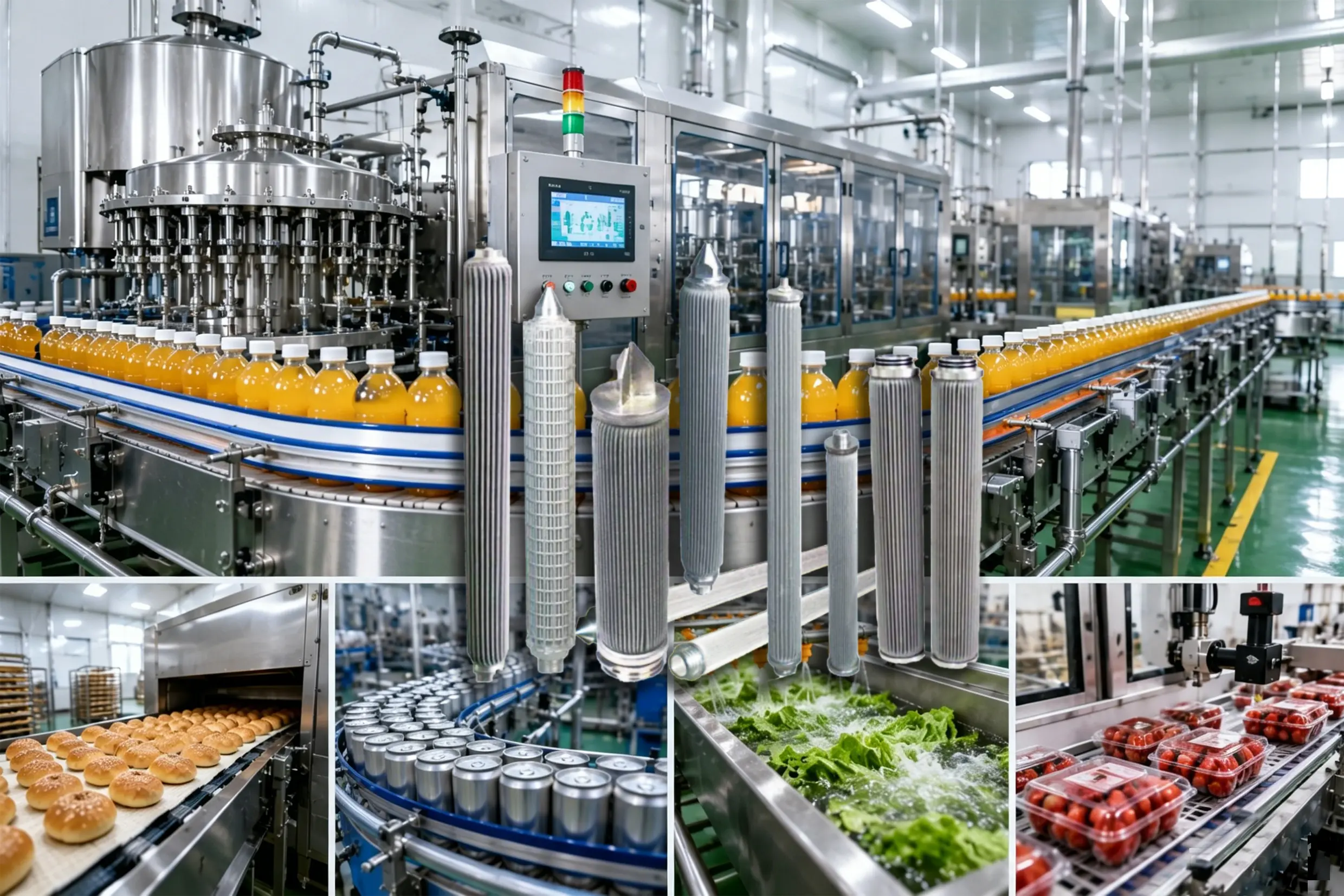
Sintered Fiber Felt for Food & Beverage Industry
The permanent replacement for diatomaceous earth (DE) in beer, wine and edible oil. Electropolished 316L sanitary depth-filtration elements for clarification, juice, dairy, syrup, soy sauce, vinegar, coffee and plant protein beverage.
Industry Characteristics
Why Food & Beverage Specifies Sintered Fiber Felt Depth Filtration
Food & beverage clarification combines high contaminant loads (yeast, pulp, bleaching earth, fermentation residue), sensitive product chemistry (no flavor loss, no extractables), and strict food-safety compliance (FDA, EC, 3-A). Sintered metal fiber felt's 3D random matrix captures these contaminants progressively through the depth — delivering 5–10× more dirt-holding than surface media, with electropolished surface that preserves product taste, color and shelf life.
DE Replacement
Eliminates silica waste, dust hazard and constant make-up dosing — 60–80% TCO reduction.
FDA / EC / 3-A Compliant
FDA 21 CFR food-contact, EC 1935/2004, 3-A Sanitary Standards, EHEDG hygienic design.
No Flavor Loss
Electropolished surface (Ra < 0.4 µm) — does not adsorb flavor compounds or release extractables.
CIP + SIP Cleanable
Withstands caustic / acid CIP cycles and 121–150 °C steam sterilization — 3–5+ reuse cycles.
Gradient Density
Coarse-to-fine gradient construction for edible oil bleaching-earth recovery.
High Dirt-Holding
5–10× the capacity of surface media — extends service life across high-fouling streams.
Application Coverage
12 Food & Beverage Applications — Equipment, Function & Recommended Rating
From beer, wine, juice and dairy clarification, to edible oil refining and syrup polishing, to soy sauce, vinegar, beverages, coffee extract and plant protein beverage.
← Scroll horizontally to view all columns →
| Production Line | Install Location | Function | Contaminants | Working Conditions | Customer Pain Point | Consequence Without Felt | Rating |
|---|---|---|---|---|---|---|---|
| Beer Production Line | Beer Trap Filter System | Improve clarity | Yeast particles | CIP service | Beer haze | Product downgrade | 1–5 µm |
| Wine Production Line | Wine Filter | Remove sediment | Tartrate crystals | Continuous filtration | Increased sediment | Customer complaints | 1–3 µm |
| Juice Production Line | Clarification Filter | Improve transparency | Pulp particles | High-sugar medium | Turbidity exceedance | Product returns | 3–10 µm |
| Dairy Production Line | Milk Filter | Remove curd particles | Milk protein aggregates | CIP / SIP | Pipeline plugging | Product contamination | 1–5 µm |
| Edible Oil Production | Oil Filter | Improve color | Activated carbon / clay | High-temp oil | Oil cloudiness | Quality drop | 3–10 µm |
| Syrup Production Line | Sugar Liquid Filter | Remove crystals | Sugar crystals | High viscosity | Filling plugging | Shutdown for cleaning | 5–20 µm |
| Starch Sugar Production | Process Filter | Product polishing | Colloidal particles | High-concentration sugar | Element blinding | Lower output | 5 µm |
| Soy Sauce Production | Fermentation Broth Filter | Improve clarity | Fermentation residue | High-salt environment | Increased sediment | Customer complaints | 5–10 µm |
| Vinegar Production | Final Filter | Remove suspended solids | Acetic-acid bacteria residue | Acidic medium | Product haze | Quality drop | 3 µm |
| Beverage Production Line | Ingredient Filter | Protect filling equipment | Particulate impurities | Continuous production | Nozzle plugging | Shutdown for maintenance | 5 µm |
| Plant Protein Beverage | Polishing Filter | Remove aggregates | Protein particles | High viscosity | Settling / separation | Customer complaints | 3–5 µm |
| Coffee Extract System | Extract Filter | Remove coffee fines | Fine particles | High-temp extraction | Sediment | Product downgrade | 5 µm |
Material Selection
Material Selection Guide — Service to Recommended Felt Construction
Construction is matched to product chemistry, viscosity and regulatory framework. Tailored per process & certification requirements.
| Service | Recommended Felt | Rationale |
|---|---|---|
| Beer filtration | Electropolished 316L Felt | Sanitary-grade hygiene + DE replacement. |
| Wine filtration | 316L Sintered Felt | High clarity without flavor loss. |
| Juice filtration | 316L Sintered Felt | High dirt-holding for pulp-bearing juice. |
| Dairy filtration | Electropolished 316L Felt | CIP / SIP cycle stability. |
| Edible oil refining | 316L Gradient Felt | Captures activated bleaching earth progressively. |
| Syrup filtration | Multi-Layer Sintered Felt | High-viscosity medium with low dP. |
| Soy sauce filtration | 316L Sintered Felt | Resistance to high-chloride salt corrosion. |
| Vinegar filtration | 316L Sintered Felt | Resistance to mild acetic-acid corrosion. |
| Coffee extraction | 316L Sintered Felt | High-temperature extraction stability. |
| Plant protein beverage | Multi-Layer Sintered Felt | High colloid-capture capability. |
Customer Concerns
Top 5 Questions from Food & Beverage Customers
1. Can SINFT sintered fiber felt replace diatomaceous earth (DE) in beer breweries?
add
Yes — this is the largest single migration in brewery filtration today. DE filtration generates hazardous silica waste, requires continuous make-up dosing, and the dust is a respiratory hazard. SINFT electropolished 316L sintered fiber felt depth-filtration elements deliver permanent micron rating at 1–5 µm, CIP/SIP cleanable, eliminate the DE waste stream, and reduce TCO 60–80% over a 5-year horizon. Multi-vessel duplex housings support uninterrupted brewery production.
2. Is SINFT sintered fiber felt FDA / EC food-grade compliant?
add
Yes. SINFT sanitary sintered fiber felt elements are designed for FDA 21 CFR food-contact compliance, EC 1935/2004 food contact materials, 3-A Sanitary Standards and EHEDG hygienic design. Material certificates, Ra < 0.4 µm electropolished surface documentation, passivation records and food-safety traceability available on request.
3. How does sintered fiber felt handle edible oil bleaching earth recovery?
add
Edible oil refining at 80–120 °C generates large quantities of spent bleaching earth (activated clay) that must be separated cleanly. SINFT 316L gradient-density sintered fiber felt construction — with coarser fibers on the upstream side transitioning to finer fibers downstream — captures bleaching earth progressively, delivering clear refined oil while preventing carryover. The 3–10 µm rating handles palm, soybean, rapeseed and olive oil refining.
4. Can SINFT sintered fiber felt clarify wine, beer and coffee without flavor loss?
add
Yes — diffusion-bonded all-metal construction with electropolished surface (Ra < 0.4 µm) does not adsorb flavor compounds or release extractables. SINFT sanitary sintered fiber felt is the field-proven choice for premium wine clarification (1–3 µm), beer trap filter (1–5 µm) and coffee extract polishing (5 µm). Preserves color, body, aroma and shelf life.
5. Which material for soy sauce, vinegar and other corrosive food media?
add
316L sintered fiber felt is the standard for soy sauce (high-chloride salt environment) and vinegar (mild acid). The chrome / nickel / molybdenum content resists chloride pitting and acetic acid corrosion at sustained service temperature. For severely corrosive specialty fermentation products, 904L or Hastelloy felt grades are available.
Related Products & Applications
Explore Related Solutions
Sintered Fiber Felt
Back to the full product overview, specs and downloads.
Fiber Felt · Pharmaceutical
API, biopharma, vaccine & cGMP service.
Sintered Mesh · Food & Pharma
3-A & cGMP sanitary surface filtration.
Sintered Mesh · Water Treatment
UPW / WFI permanent precision service.
Request a Quote — Food & Beverage Sintered Fiber Felt
Tell us your application (beer trap filter, wine clarification, edible oil bleaching earth, juice, dairy, soy sauce, vinegar, coffee, plant protein...), production scale, target micron rating and certification framework (FDA / EC / 3-A) — our engineering team replies with a tailored specification within 24 hours.