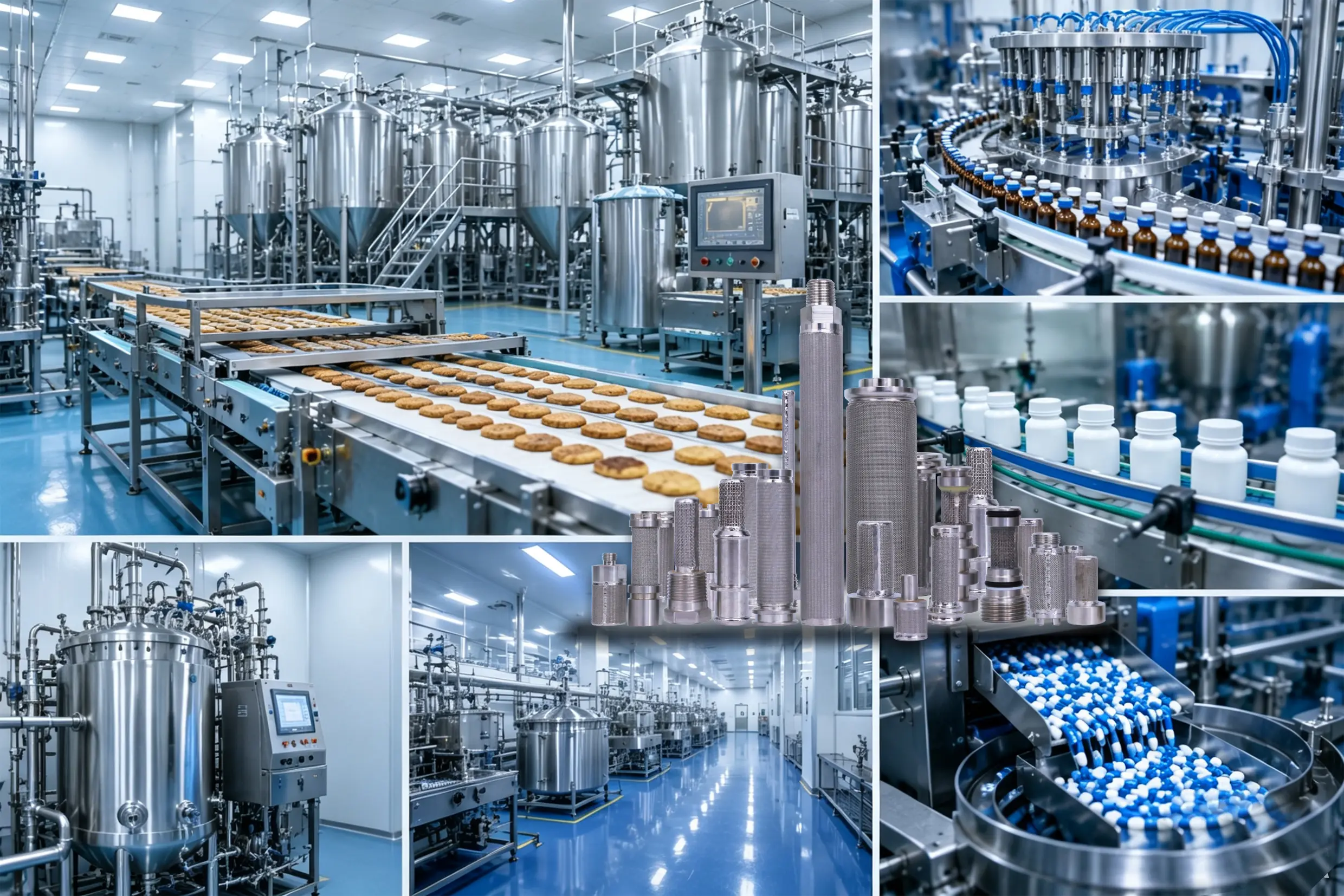
Sintered Mesh Filters for Food & Pharmaceutical Industry
Electropolished sanitary 316L sintered mesh — for beer polishing, wine, juice, dairy, edible oil, API crystallization, fermentation vent, WFI / PW final filter, pure steam and biopharma upstream / downstream service.
Industry Characteristics
Why Food & Pharma Demands Sanitary-Grade Sintered Mesh
Food and pharmaceutical service combines product-contact safety, regulatory compliance (cGMP, FDA, 3-A, EHEDG, USP) and aggressive CIP/SIP cleaning cycles. The filter is in direct contact with the product — beer, wine, dairy, API, WFI — and cannot shed fibers, leach contaminants or harbor bacteria. SINFT electropolished sintered mesh delivers all of this with a multi-year service life that replaces disposable cartridges and diatomaceous earth.
cGMP / FDA Compliance
Full traceability, material certificates, passivation records — ready for FDA / EMA / NMPA inspection.
3-A & EHEDG Hygienic Design
Smooth electropolished surface (Ra < 0.5 µm) eliminates harbor sites and biofilm.
Zero Media Migration
No fibers in beer, dairy, API or injectable drugs — diffusion-bonded permanent structure.
CIP & SIP Cleanable
Withstands repeated caustic, acid and 121–150 °C steam sterilization cycles.
DE / PP Replacement
Replaces diatomaceous earth in brewing and disposable PP in pharma. 60–80% TCO reduction.
USP <88> Class VI
Biocompatibility documentation for injectable, biopharma, vaccine and CGT service.
Application Coverage
15 Typical Food & Pharma Applications — Equipment, Conditions & Recommended Structure
From food & beverage (beer polishing, wine, juice, dairy, edible oil, syrup, condiments) to pharmaceutical & biopharma (PW / WFI, fermentation, API crystallization, biopharma upstream / downstream, drug formulation, compressed-air and pure-steam sterilization).
← Scroll horizontally to view all columns →
| Segment | Application Equipment | Install Location | Protected Equipment / Product | Working Conditions | Contaminants | Consequence Without Filter | Recommended Structure |
|---|---|---|---|---|---|---|---|
| Food | Beer Production | Beer Polishing System | Finished beer | CIP cleaning | Yeast particles | Beer haze / product scrap | Electropolished 316L |
| Food | Wine Production | Precision Filter | Wine | Continuous filtration | Tartrate crystals | Wine downgrade | 316L Sintered |
| Food | Juice Production | Clarification Filter | Juice product | High-sugar medium | Pulp particles | Turbidity exceedance | Food-Grade Sintered |
| Food | Dairy Production | Milk Filter | Pasteurization system | CIP / SIP service | Curd particles | Pipeline plugging | Electropolished Sintered |
| Food | Edible Oil Refining | Oil Filter | Refined oil | High-temp oil | Activated carbon dust | Oil cloudiness | 5-Layer Sintered |
| Food | Syrup Production | Syrup Filter | Filling system | High-viscosity medium | Crystal particles | Nozzle plugging | Sintered Mesh |
| Food | Condiments Production | Process Filter | Soy sauce, vinegar | Corrosive medium | Suspended particles | Product sedimentation | 316L Sintered |
| Pharma | Pharmaceutical PW System | Precision Filter | Purified water | cGMP service | Particulates | Water spec exceedance | Electropolished 316L |
| Pharma | WFI System | Final Filter | WFI system | High-temp circulation | Particle contamination | Injectable contamination / product recall | GMP-Grade Sintered |
| Pharma | Fermentation System | Fermentation Broth Filter | Fermenter | High-temperature sterilization | Cell debris | Fermentation failure | Electropolished Sintered |
| Pharma | API Production | Process Filter | API product | Solvent service | Crystal particles | Lower product purity / GMP risk | 316L / 904L Sintered |
| Pharma | Biopharmaceutical System | Pre-Filter | Downstream purification | Ultra-clean service | Protein aggregates | Product loss / batch scrap | High-Cleanliness Sintered |
| Pharma | Drug Formulation Line | Compounding Filter | Drug solution system | CIP / SIP | Particulates | Drug scrap | GMP Sintered |
| Pharma | Sterile Compressed Air | Pre-Filter for Sterile Air | Fermentation system | Sterile service | Rust, droplets | Microbial contamination / batch scrap | 316L Sintered |
| Pharma | Pure Steam System | Clean Steam Filter | SIP system | 121–150 °C steam | Rust, oxides | Sterilization failure / GMP non-compliance | Electropolished Sintered |
Material Selection
Material Selection Guide — Service to Recommended Construction
Construction is matched to product chemistry, hygienic level and regulatory framework. Use this as a starting reference; we tailor per analysis and validation requirement.
| Service Environment | Recommended Material | Rationale |
|---|---|---|
| General food & beverage | 316L Sintered | Food-grade compliance. |
| Beer polishing | Electropolished 316L | Easy CIP cleaning, no flavor migration. |
| Dairy filtration | Electropolished 316L | Sanitary-grade per 3-A. |
| Edible oil filtration | 316L Sintered | High-temp oil resistance. |
| PW purified water system | GMP-Grade 316L | Pharmaceutical standard. |
| WFI system | Low-Carbon 316L | Ultra-high cleanliness for injection-grade water. |
| Biopharmaceutical | Electropolished 316L | No dead corners, full drainability. |
| API production | 316L / 904L | Solvent corrosion resistance. |
| Strong acid pharma stream | Hastelloy C-276 | Maximum corrosion resistance. |
| CIP / SIP system | 5-Layer Sintered | Long-term sterilization stability. |
Operating Conditions
Why Sintered Mesh — Mapped to Food & Pharma Conditions
| Condition Type | Working Conditions | Why Stainless Steel Sintered Mesh |
|---|---|---|
| cGMP Pharmaceutical | Drug production environment | Meets regulatory traceability requirements. |
| FDA Food-Contact | Food-contact material | Safe, non-contaminating product contact. |
| CIP Cleaning | Caustic / acid cycles | Chemical-corrosion resistance. |
| SIP Sterilization | 121–150 °C steam sterilization | High-temperature steam tolerance. |
| Ultra-Clean Service | Ultra-low particle requirement | No media migration from diffusion-bonded structure. |
| High-Viscosity Media | Syrup, gels | High mechanical strength prevents deformation. |
| Corrosive Media | Acidic / alkaline liquids | 316L / 904L corrosion resistance. |
| Continuous Production | 24 h operation | Long-life regenerable construction. |
Customer Concerns
Top 5 Questions from Food & Pharma Customers
1. Is sintered mesh compliant with cGMP, 3-A and FDA standards?
add
Yes. SINFT electropolished 316L sintered mesh filters are designed for cGMP pharmaceutical service, 3-A Sanitary Standards, EHEDG hygienic design, USP <88> Class VI biocompatibility and FDA food-contact regulations. Material certificates, surface finish documentation (Ra < 0.5 µm), passivation records and product traceability available on request. Drawing-to-order with full validation package for regulated industries.
2. Can SINFT sintered mesh replace diatomaceous earth (DE) in beer polishing?
add
Yes — and this is one of the fastest-growing migrations in brewery filtration. DE filtration generates hazardous waste, requires constant make-up dosing, and the silica dust is a respiratory hazard. SINFT electropolished 316L sintered mesh delivers permanent micron rating, is CIP/SIP cleanable, eliminates the DE waste stream, and reduces total cost of ownership 60–80% over a 5-year horizon. Multi-vessel duplex configurations support uninterrupted brewery production.
3. How does SINFT support CIP and SIP cycles?
add
All SINFT sanitary sintered mesh elements are designed for CIP (Clean-in-Place) with caustic and acid cycles and SIP (Steam-in-Place) at 121–150 °C. Diffusion-bonded multi-layer construction has no fasteners, gaskets or polymer parts that fail under steam sterilization. Electropolished surface (Ra < 0.5 µm) minimizes harbor sites and biofilm formation.
4. What's the right material for API and biopharma applications?
add
Electropolished 316L sintered mesh is the standard for API process filtration, biopharma upstream / downstream and final fill-finish. For solvent-bearing API service: 316L. For strongly acidic API streams: 904L. For severely corrosive specialty pharma chemistry: Hastelloy C-276. Material is matched per process chemistry and regulatory framework (USFDA, EMA, NMPA).
5. How long do sintered mesh filters last in food & pharma service?
add
With proper CIP/SIP regeneration, SINFT sintered mesh elements run 5–10 years in food and pharma service, replacing 10–20 cycles of disposable cartridges. The diffusion-bonded structure does not drift in micron rating across the campaign. Validation cycles, integrity test results and lifecycle documentation available for regulated production.
Related Products & Applications
Explore Related Solutions
Request a Quote — Food & Pharma Sintered Mesh
Tell us your application (beer polishing, wine, dairy, edible oil, API crystallization, WFI / PW, fermentation vent, pure steam...), product, target micron rating and regulatory framework (cGMP / 3-A / FDA / USP) — our engineering team replies with a tailored specification within 24 hours.