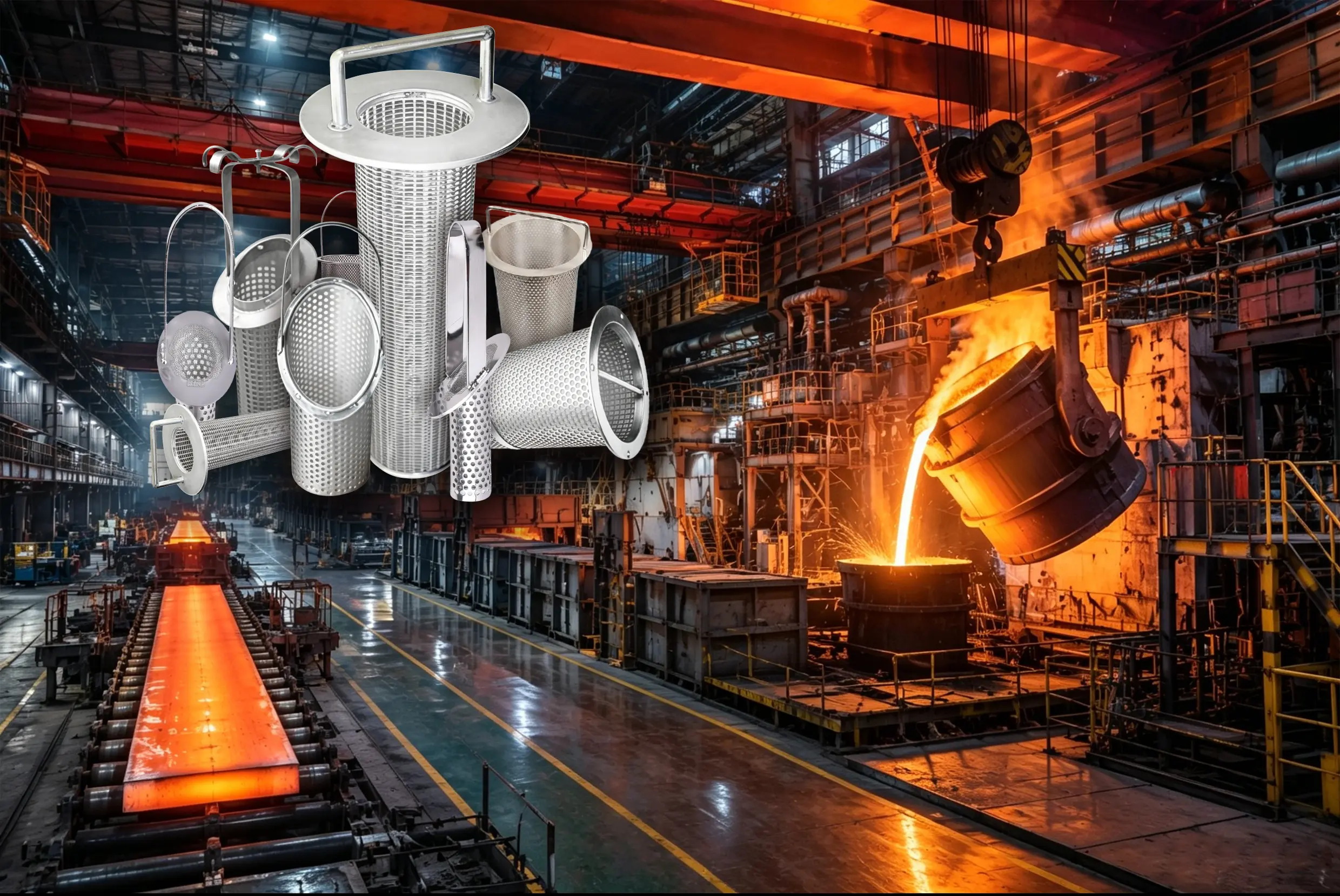
Stainless Steel Basket & Tube Filters for Steel & Metallurgy Industry
Blast furnace cooling, sinter plant, BOF oxygen lance, continuous casting secondary and mold cooling, hot-rolling descaling, cold-rolling emulsion, pickling, galvanizing, BF gas, coke tar and aluminum slurry — engineered in 304 / 316L / 904L / Hastelloy C-276.
Industry Characteristics
Why Steel & Metallurgy Demands Heavy-Duty Basket & Tube Pre-Filtration
Steel mills run the largest, most contaminated cooling-water and process-fluid loops in heavy industry. Mill scale, iron oxide, ore fines, coke fines and slag are unavoidable. Baskets and tube filters intercept this bulk debris upstream of cooling-water pumps, descaling nozzles, mold cooling, emulsion sprays and acid recirculation — keeping mills running and protecting hundred-million-dollar caster and rolling-mill assets.
Mill Scale Interception
Iron oxide flakes attack pumps and spray nozzles — coarse baskets intercept at source.
Mega-Flow Cooling
Blast furnace and CC cooling loops run continuously at very high flow — DN500–DN1200 baskets required.
High-Pressure Descaling
100–400 bar descaling nozzles demand wedge-wire anti-blinding protection.
Pickling Acid Corrosion
HCl and H₂SO₄ recirculation lines require 904L for service life.
Abrasive Slurry Service
Aluminum bauxite and coke tar slurries demand wedge-wire wear resistance.
Costly Downtime
A hot-mill stoppage costs USD $100K–$500K+ per hour — filter reliability is loss-prevention.
Application Coverage
16 Typical Steel & Metallurgy Applications — Equipment, Conditions, Filtration Rating & Material
Covering iron-making (blast furnace, sinter plant), steel-making (BOF), continuous casting, hot & cold rolling, surface treatment (pickling, galvanizing), coke and gas systems, and non-ferrous metallurgy (electrolyte, aluminum slurry).
← Scroll horizontally to view all columns →
| Application System | Equipment | Install Location | Service Medium | Working Conditions | Contaminants | Customer Pain Point | Consequence Without Filter | Rating | Type |
|---|---|---|---|---|---|---|---|---|---|
| Blast Furnace Cooling Water | BF Cooling Pump | Pump inlet | Recirculating cooling water | High-flow continuous | Mill scale, silt, scale | Impeller wear | Cooling system failure | 500–3000 µm | Basket |
| BF Top Cooling | Top Cooling Equipment | Cooling water inlet | Cooling water | High-temperature zone | Rust, scale | Nozzle plugging | Cooling failure | 500–1000 µm | Basket |
| Sinter Plant | Main Circulation Pump | Pump inlet | Industrial water | High-dust environment | Sinter ore dust | Pump wear | Equipment shutdown | 300–1000 µm | Basket |
| BOF Oxygen Lance Cooling | Oxygen Lance Cooling | Cooling water inlet | Cooling water | High-temp impact | Mill scale | Uneven cooling | Oxygen lance damage | 300–1000 µm | Basket |
| CC Secondary Cooling | Secondary Spray System | Upstream of spray nozzle | Recirculating water | 24×7 | Mill scale, SS | Nozzle plugging | Slab quality defects | 100–300 µm | Tube |
| CC Mold Cooling | Mold Cooling Water System | Heat exchanger inlet | Softened water | High-precision cooling | Scale particles | Mold over-temperature | Breakout incident | 100–200 µm | Tube |
| Hot Rolling Descaling | HP Descaling System | Upstream of spray nozzle | High-pressure water | 100–400 bar | Mill scale | Descaling nozzle wear / plugging | Poor descaling result | 100–300 µm | Tube |
| Hot Rolling Lubrication | Lubrication Station | Oil pump inlet | Lube oil | Heavy load | Metal particles | Bearing wear | Mill shutdown | 50–150 µm | Tube |
| Cold Rolling Emulsion | Emulsion System | Circulation pump inlet | Rolling emulsion | High-flow circulation | Metal fines | Plate surface defects | Product quality drop | 50–200 µm | Tube |
| Pickling Line | Acid Recirculation | Acid pump inlet | HCl / H₂SO₄ | Severely corrosive | Mill scale | Acid pump corrosion | Production interruption | 100–300 µm | Tube |
| Galvanizing Line | Flux Solution System | Circulation | Flux solution | Corrosive environment | Oxide particles | Spray nozzle defects | Plating defects | 50–100 µm | Tube |
| Mill Hydraulic System | Hydraulic Station | Tank outlet suction | Hydraulic oil | High pressure | Metal wear particles | Valve seizure | Hydraulic fault | 50–100 µm | Tube |
| Coking Plant Tar Transfer | Tar Transfer System | Transfer pump inlet | Coal tar | High viscosity | Coke particles | Pipe plugging | Transfer interruption | 500–2000 µm | Basket |
| Blast Furnace Gas | Gas Compressor Inlet | Gas pipeline | BF gas | High-dust gas | Iron dust, coke fines | Compressor wear | System shutdown | 50–200 µm | Tube |
| Non-Ferrous Electrolyte | Electrolyte Circulation | Circulation pump inlet | Electrolyte | Corrosive service | Anode slime particles | Pump wear | Lower electrolysis efficiency | 50–200 µm | Tube |
| Aluminum Refinery Slurry | Slurry Transfer | Slurry pump inlet | Bauxite slurry | Highly abrasive | Ore slurry | Pump impeller wear | Frequent overhaul | 500–3000 µm | Basket |
Material Selection
Material Selection Guide — Service to Recommended Alloy & Structure
Material and mesh structure are matched to corrosion chemistry, contaminant size and operating pressure. Use this as a starting reference; we tailor to your fluid analysis.
| Service Environment | Recommended Material | Rationale |
|---|---|---|
| General recirculating water | SS 304 | Cost-effective default with adequate service life. |
| Cooling water systems | SS 316L | Higher Mo content for better corrosion resistance. |
| HP descaling system | 316L Wedge Wire | Anti-blinding profile resists erosion under high pressure. |
| Lube oil system | 316L Woven Mesh | Easy cleaning, long service life. |
| Hydraulic oil system | 316L Woven Mesh | High mechanical strength for HP service. |
| Pickling acid system | SS 904L | High Cr / Ni / Mo content resists HCl, H₂SO₄ pitting. |
| Electrolyte system | SS 904L | Corrosion-resistant in non-ferrous electrolyte chemistry. |
| Coke tar system | 316L Wedge Wire | Anti-blinding profile prevents coke particle plugging. |
| Blast furnace gas | 316L Sintered Mesh | Temperature and pressure resistant for BF gas service. |
| Extreme corrosion service | Hastelloy C-276 | Maximum chemical corrosion resistance. |
Technical Specifications
SINFT Steel Mill Basket & Tube Filter — Key Parameters
Engineering targets we hit on every steel-mill project.
Diameter Range
DN500–DN1200
For BF and CC cooling water loops.
Open Area
40–75%
Maximum flow at minimum dP.
HP Descaling
100–400 bar
Wedge wire tube filter rated for hot strip mill.
Mill Scale Capture
100–3000 µm
Full range from CC mold to cooling-water bulk.
Wear Resistance
Wedge Wire
For coke tar, bauxite slurry and descaling.
Acid Resistance
904L
HCl & H₂SO₄ pickling line service.
Construction
Fully Welded
Vibration-proof for mill-stand service.
Cleanability
Backwash + CIP
Online switchover via duplex housing.
Customer Concerns
Top 5 Questions from Steel & Metallurgy Customers
1. Why is mill scale interception so important in steel mill cooling water?
add
Mill scale (iron oxide flakes) is unavoidable in hot rolling, continuous casting and descaling. Once it enters the cooling water loop it abrades pump impellers, plugs spray nozzles, fouls heat exchangers and degrades slab surface quality. SINFT basket and tube filters at 100–3000 µm intercept mill scale at pump inlets and upstream of spray nozzles — protecting pumps, nozzles and end-product quality.
2. How big are basket filters typically needed for blast furnace and CC cooling?
add
Very big. Blast furnace and CC closed cooling-water loops run continuously at high flow. SINFT delivers DN500–DN1200 multi-basket parallel arrays with 40–75% open area, sized to deliver pump-rated flow at clean differential pressure. For continuous casting mold cooling, 100–200 µm tube filters protect against mold thermal stress and breakout incidents.
3. What’s special about high-pressure descaling filter design?
add
Hot-rolling descaling runs at 100–400 bar and the spray nozzles have very small orifices. Mill scale particles cause rapid erosion and plugging. SINFT 316L wedge wire tube filters at 100–300 µm provide anti-blinding protection upstream of descaling nozzles, dramatically extending nozzle life and improving scale removal quality.
4. Which material should I select for pickling and galvanizing service?
add
316L resists most general steel mill service. For pickling lines (HCl, H₂SO₄), 904L is the standard — its high Cr / Ni / Mo content resists acid pitting and stress corrosion. For galvanizing flux solutions and non-ferrous electrolytes, 904L is also recommended. For extreme corrosion environments, Hastelloy C-276 provides maximum resistance.
5. Can SINFT basket filters be cleaned and reused?
add
Yes — all SINFT basket and tube filters are fully-welded all-metal construction. They can be regenerated by backwash, ultrasonic, chemical or steam cleaning. Duplex housing configurations support online switchover — one basket in service, one cleaned and standby — eliminating shutdown for cleaning. This is the standard practice in continuous-production steel mills.
Related Products & Applications
Explore Related Solutions
Basket Filters & Strainers
Back to the full product overview, specs and downloads.
Pleated · Steel & Metallurgy
Fine-polish hydraulic, lube and EH oil filtration.
Basket & Tube · Power Generation
CCW, boiler feed, FGD, EH oil and nuclear service.
Basket & Tube · Petrochemical
FCC, hydrocracking, ethylene and refinery service.
Request a Quote — Steel & Metallurgy Basket / Tube Filters
Tell us your unit (BF, sinter, BOF, CC, hot/cold rolling, pickling…), system (cooling water, descaling, emulsion, acid…), flow rate and contaminant — our engineering team replies with a tailored specification within 24 hours.