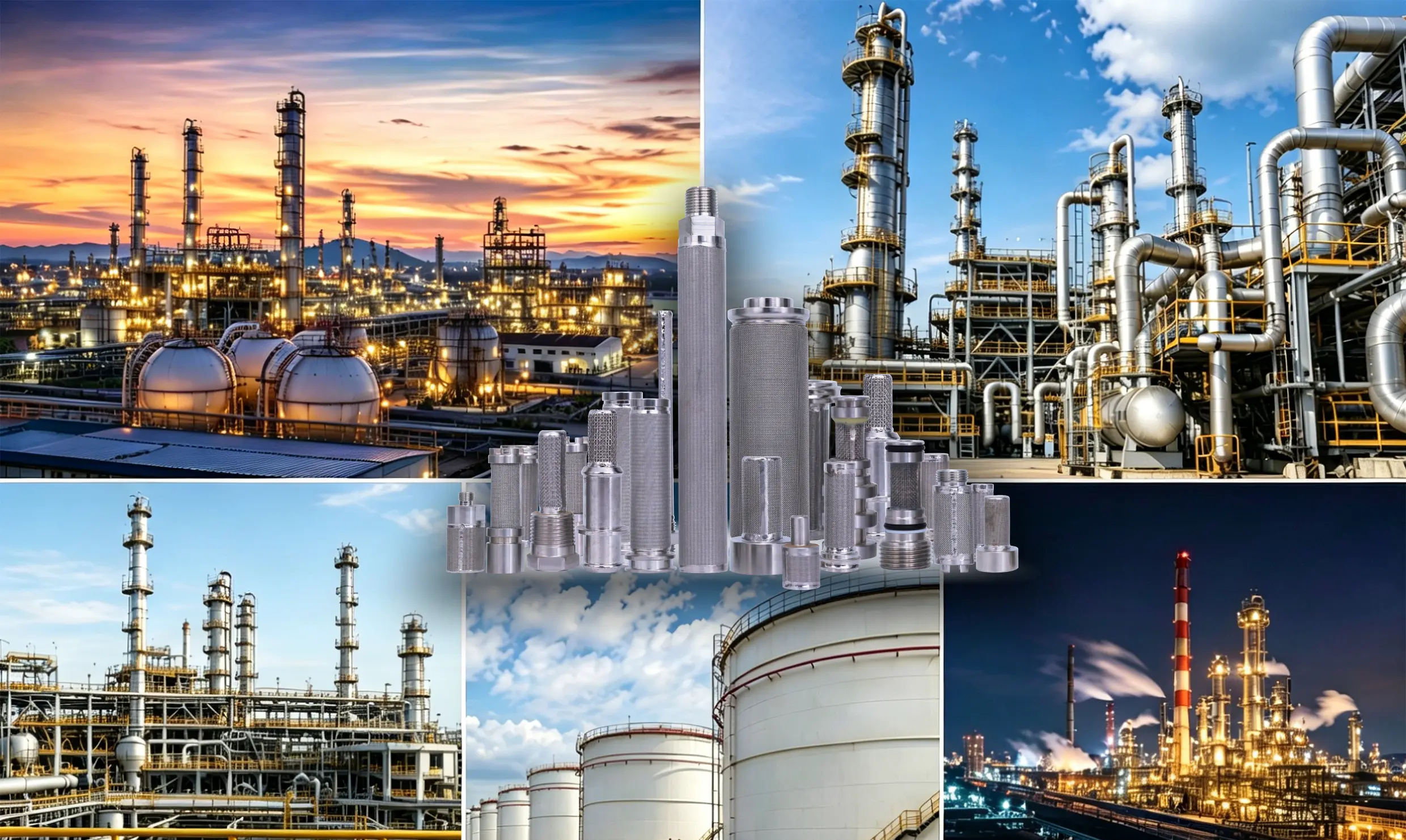
5-Layer Sintered Mesh Filters for Petrochemical Industry
Diffusion-bonded multi-layer sintered wire mesh elements engineered for FCC, hydrocracking, HDS catalyst protection, PTA & PX aromatics, polymer melt (PP / PE), amine sweetening, flare gas recovery and cracked gas compression — permanent micron rating, multi-year backwash reuse.
Industry Characteristics
Why Petrochemical Demands Diffusion-Bonded Sintered Mesh
Petrochemical filtration is defined by three conditions no other product can survive at once: sustained 200–600 °C, 50–300 bar, and the requirement to protect multi-million-dollar catalyst beds with permanent, drift-free micron rating across years of cyclic backwash. Sintered wire mesh is the only media that delivers all three.
Extreme Temperature
200–600 °C across FCC, hydrocracking, ethylene cracking — only metal media survives.
Extreme Pressure
50–300 bar in hydrocracking, polyolefin melt and gas compression — 5-layer construction won’t collapse.
High-Value Catalyst Protection
HDS, hydrocracking and polyolefin catalysts cost millions — sintered mesh delivers permanent micron rating.
Cyclic Backwash Reuse
Diffusion-bonded structure tolerates years of pulse/backwash without precision drift.
Polymer Melt Service
PP / PE / PET melt at 220–310 °C, 50–300 bar — sintered mesh is the only viable media.
Aggressive Chemistry
Amine, acidic, FeS-bearing service — 316L, 904L and 310S material options.
Application Coverage
12 Typical Petrochemical Applications — Equipment, Conditions & Recommended Structure
FCC, hydrocracking, HDS, PTA, PX aromatics, polyolefin melt, amine sweetening, catalyst recovery, flare gas, cracked gas compression and solvent recovery — each combination of temperature, pressure and contaminant maps to a specific sintered mesh construction.
← Scroll horizontally to view all columns →
| Application Unit | Equipment | Install Location | Working Conditions | Contaminants | Customer Pain Point | Consequence Without Filter | Recommended Structure |
|---|---|---|---|---|---|---|---|
| FCC Catalytic Cracking | Catalyst Recirculation Filter | Recirculation pump & nozzle | 250–550 °C | Catalyst fines, coke | Catalyst-induced equipment wear | Pump wear, valve seizure | 5-Layer 316L Sintered |
| Hydrocracking Unit | Recycle Oil Filter | Catalyst bed | 200–450 °C; 50–200 bar | Iron sulfide particles | Catalyst bed plugging | Rising dP | 5-Layer 316L Sintered |
| HDS (Hydrodesulfurization) | Feed Filter | Reactor catalyst | High-temp / high-pressure | Rust, scale | Catalyst poisoning | Reduced reaction efficiency | 5-Layer 316L Sintered |
| PTA Plant | Slurry Filter | Spinneret & heat exchanger | 150–320 °C | Crystal particles | Nozzle plugging | Lower product quality | Multi-Layer Sintered |
| PX Aromatics | Feed Filter | Transfer pump | High-temp organic medium | Rust, polymer particles | Product purity drop | Equipment wear | Sintered Mesh |
| Amine Sweetening | Amine Filter | Amine pump | Corrosive medium | Iron sulfide particles | Amine foaming | Lower system efficiency | 316L / 904L Sintered |
| Catalyst Recovery | Catalyst Recovery Filter | Recovery unit | High-temperature service | Catalyst powder | Catalyst loss | Higher operating cost | Sintered Mesh |
| Polypropylene (PP) Plant | Melt Filter | Melt pump & die head | 220–300 °C | Gels, carbonized particles | Black-spec defects | Product downgrade | Multi-Layer Sintered |
| Polyethylene (PE) Plant | Melt Filter | Die head system | High-pressure melt | Unmelted particles | Product defects | Higher reject rate | Sintered Mesh |
| Flare Gas Recovery | Gas Filter | Compressor | High-flow gas | Dust, droplets | Compressor wear | Unplanned shutdown | Sintered Mesh |
| Cracked Gas Compression | Process Gas Filter | Compressor impeller | 100–450 °C | Coke fines, iron-oxide | Impeller wear | Compressor faults | High-Temp Sintered |
| Solvent Recovery | Solvent Filter | Evaporator | Corrosive medium | Resin particles | Heat exchanger plugging | Lower efficiency | 316L Sintered |
Operating Conditions
Why Sintered Mesh — Mapped to Petrochemical Conditions
| Condition Type | Working Conditions | Why Stainless Steel Sintered Mesh |
|---|---|---|
| High Temperature | 200–600 °C | Sintered mesh retains structural integrity at sustained high temperature. |
| High Pressure | 50–300 bar | Multi-layer diffusion-bonded mesh offers extreme collapse resistance. |
| Backwash / Pulse Service | Automatic backwash filter | Sintered mesh supports indefinite backwash without precision drift. |
| Catalyst Protection | High-value catalyst inventory | Stable micron rating prevents fines from reaching the catalyst bed. |
| Corrosive Service | Amine, acidic media | 316L / 904L resist pitting and stress corrosion. |
| High Flow | Hundreds of tons / hour | Stable dP across very-high-flow streams. |
| Continuous Production | 24 h × 365 d | Multi-year service life between change-outs. |
| Polymer Melt | High-viscosity melt | Strong differential-pressure resistance under high-viscosity loading. |
Customer Concerns
Top 5 Questions from Petrochemical Customers
1. Why does sintered mesh outperform other filter media in catalyst-bed protection?
add
In hydrocracking, HDS and polyolefin reactors, catalyst replacement costs millions of dollars and unplanned regeneration is a major production loss. Sintered mesh delivers a permanent, diffusion-bonded pore structure that does not drift with loading, backwash cycles or temperature. It removes iron sulfide, scale and catalyst fines reliably for years — directly extending catalyst run-length and reactor MTBF.
2. Our previous filter elements kept collapsing under pressure. How does SINFT solve this?
add
SINFT 5-layer diffusion-bonded sintered mesh is one of the strongest filter media in industry. The protection mesh and reinforcement layers carry the load while the precision layer holds the micron rating. Tested up to 300 bar with no permanent deformation — suitable for hydrocracking, polyolefin melt and high-pressure gas service where pleated or single-layer mesh fails.
3. Does backwash degrade filtration precision over time?
add
No. The pore structure is diffusion-bonded — wires are metallurgically fused at every contact point. Backwash, ultrasonic cleaning, chemical regeneration and steam regeneration do not move the precision wires. SINFT customers routinely achieve 3–5+ years of cyclic backwash service without any precision drift.
4. What’s the maximum operating temperature?
add
All-metal construction. 316L is rated for continuous service up to ~600 °C. For higher temperature (ethylene cracking outlet, FCC regenerator) we offer 310S and Hastelloy. For amine sweetening with H₂S we recommend 904L. Material is selected per fluid analysis.
5. Pleated cartridge has higher area. Why pay more for sintered mesh?
add
Pleated cartridges deliver high area at lower cost but require periodic replacement (typically 6–12 months). Sintered mesh elements run for 3–5+ years with periodic cleaning. The total cost of ownership flips — in high-value protection service (catalyst beds, polymer melt, high-pressure gas) sintered mesh is the lowest TCO solution. We typically deploy basket pre-filter → pleated bulk filter → sintered mesh final protection.
Related Products & Applications
Explore Related Solutions
Sintered Mesh Filter
Back to the full product overview, specs and downloads.
Pleated · Petrochemical
High-area mid-stage precision filtration.
Basket & Tube · Petrochemical
First-stage large-flow coarse filtration.
Petrochemical Overview
Full petrochemical application portfolio.
Request a Quote — Petrochemical Sintered Mesh Filters
Tell us your process unit (FCC, hydrocracking, HDS, PP/PE, PTA, amine…), fluid analysis, temperature, pressure and target micron rating — our engineering team replies with a tailored specification within 24 hours.