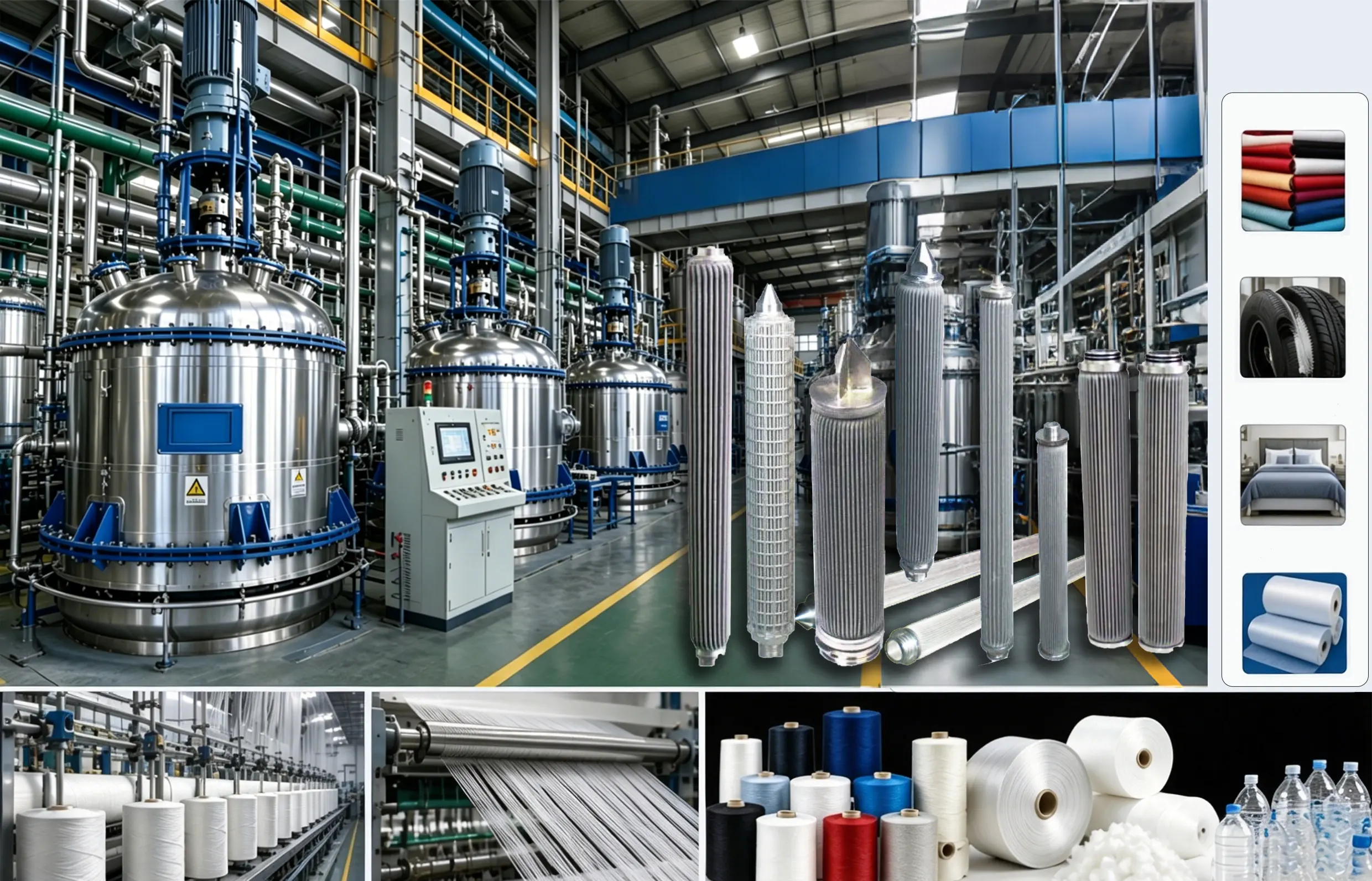
Sintered Fiber Felt for Polymer Melt Filtration
The flagship application for sintered metal fiber felt — engineered as the core media for high-end polymer melt filters and screen changers across PET, POY/FDY spinning, BOPET/BOPP film, PP/PE/PA/ABS/PBT/PPS, masterbatch and hot-melt adhesive.
Industry Characteristics
Why Polymer Melt Is the Flagship Application of Sintered Fiber Felt
Polymer melt filtration is the most technically demanding service in industry — and the application where sintered metal fiber felt is the unrivaled industry standard. Every major polymer melt filter OEM specifies sintered fiber felt as the core media inside their flagship screen-changer platforms.
| Service Characteristic | Element Requirement |
|---|---|
| High Temperature (200–400 °C) | All-metal construction with sustained high-temp stability. |
| High Pressure (50–500 bar) | Multi-layer reinforced construction with high collapse strength. |
| High Viscosity | High porosity for low baseline differential pressure. |
| Continuous Production | Long service life with periodic regeneration. |
| High-Quality Product | Single-digit micron rating with stable Beta ratio. |
| High Throughput | High flux per area at acceptable differential pressure. |
Application Coverage
14 Polymer Melt Applications — Equipment, Function & Recommended Rating
From PET polyester and POY / FDY spinning, to BOPET / BOPP / CPP film, PP / PE polyolefin, ABS resin, PA nylon, PBT, PPS engineering plastic, masterbatch and hot-melt adhesive — each combination of polymer chemistry, operating temperature and quality grade maps to a specific micron rating.
← Scroll horizontally to view all columns →
| Production Line | Install Location | Function | Contaminants | Working Conditions | Customer Pain Point | Consequence Without Felt | Rating |
|---|---|---|---|---|---|---|---|
| PET Polyester Line | Melt Filter | Improve polyester purity | Black specs, gels | 280–320 °C | Filament breakage | Product downgrade | 5 µm |
| POY Spinning Line | Upstream of spin pack | Spinneret protection | Gel particles | High-temp continuous | Spinneret hole plugging | Filament break, shutdown | 5 µm |
| FDY Spinning Line | Melt Filter | Improve fiber quality | Carbonized particles | ~ 290 °C | Higher fuzz rate | Lower Grade-A yield | 3 µm |
| BOPET Film Line | Upstream of extruder | Improve transparency | Gels | High-pressure melt | Fish-eye defects | Film scrap | 5 µm |
| BOPP Film Line | Melt Filter | Optical performance | Black specs | 250–300 °C | Customer complaints | Product returns | 10 µm |
| CPP Film Line | Melt Filter | Film uniformity | Unmelted particles | Continuous production | Film pinholes | Higher reject rate | 10 µm |
| Polypropylene (PP) Plant | Polymer Filter | Resin quality polishing | Gels | High-temp high-pressure | Black-spec exceedance | Product downgrade | 5 µm |
| Polyethylene (PE) Plant | Melt Filter | Product polishing | Carbonized particles | Melt state | Film fish-eyes | Quality drop | 10 µm |
| ABS Resin Line | Polymer Filter | Surface finish quality | Gel agglomerates | High-viscosity service | Injection-molding defects | Customer complaints | 5 µm |
| PA Nylon Line | Melt Filter | Improve fiber grade | Oxidation particles | > 280 °C | Filament breakage | Product scrap | 3 µm |
| PBT Production Line | Melt Filter | Remove degradation | Carbonized particles | High-temp polymerization | Black specs | Lower product grade | 5 µm |
| PPS Engineering Plastic | Melt Filter | Precision filtration | HT carbonized particles | > 300 °C | Product defects | High-value loss | 3 µm |
| Masterbatch Line | Extruder Filter | Improve dispersion | Agglomerates | High viscosity | Color specks | Color-variation issue | 10 µm |
| Hot-Melt Adhesive Line | Melt Filter | Spray-gun quality | Carbonized particles | HT melt | Nozzle plugging | Shutdown for maintenance | 5 µm |
Operating Conditions
Operating Conditions Analysis — Polymer Type to Element Requirement
| Service Type | Operating Condition | Element Requirement |
|---|---|---|
| PET Melt | 280–320 °C | High dirt-holding capacity. |
| Polyester Spinning | Continuous service | Long service life. |
| BOPET Film | High transparency requirement | Ultra-precision micron rating. |
| PP Polymerization | High-pressure melt | Collapse resistance. |
| ABS Resin | High viscosity | Low differential pressure. |
| Engineering Plastic | High-temp degradation risk | High-temperature stability. |
| Masterbatch | High loading | Ultra-high dirt-holding capacity. |
| Hot-Melt Adhesive | Carbonization prone | Depth filtration. |
Material Selection
Material Selection Guide — Polymer to Recommended Felt Construction
Filter material is matched to polymer chemistry, melt temperature, melt-pump pressure and OEM platform requirement.
| Service Polymer | Recommended Felt | Rationale |
|---|---|---|
| PET Polyester | 316L Sintered Felt | Industry-standard configuration. |
| PP Polypropylene | 316L Sintered Felt | High dirt-holding capacity. |
| PE Polyethylene | 316L Sintered Felt | Low differential pressure. |
| PA Nylon | 316L Sintered Felt | High-temperature service. |
| ABS Resin | 316L Sintered Felt | High-precision filtration. |
| PBT Polyester | 316L Sintered Felt | Long service life. |
| PPS Engineering Plastic | Inconel Sintered Felt | Ultra-high temperature service above 300 °C. |
| Masterbatch | Multi-Layer Sintered Felt | Ultra-high dirt-holding capacity. |
| Hot-Melt Adhesive | 316L Sintered Felt | Resists carbonization plugging. |
| HP Polymer Service | Multi-Layer Composite Felt | Maximum collapse resistance. |
Customer Concerns
Top 5 Questions from Polymer Melt Customers
1. Why is sintered fiber felt the dominant media for polymer melt filtration?
add
Polymer melt at 280–400 °C, 50–500 bar with sustained high viscosity is the most demanding filtration service in industry. Surface mesh blinds rapidly with gels and carbonized particles; pleated cartridges fail under sustained melt-pump pressure. Sintered metal fiber felt’s 3D random matrix captures gels, carbon and unmelted resin progressively through the depth, delivering 5–10× more dirt-holding capacity at single-digit micron rating. Beta ratios above 5000 (β > 5000). This is why every major melt-filter OEM specifies sintered fiber felt as the core media.
2. Does SINFT supply retrofit fiber felt elements for major screen-changer OEMs?
add
Yes — SINFT custom-manufactures retrofit sintered fiber felt elements for all major polymer melt filter platforms: Maag EAK / CSC, Gneuss RSFgenius / RSFsmart, Kreyenborg K-SWE / V-Type, BKG HiCon / NCSC, Coperion ZS-EG, Nordson BKG, Erema SW RTF and many others. Drawing-to-order with material certificates, integrity test and dimensional inspection. Typical cost savings vs OEM original part: 30–60%.
3. What micron rating for optical film and lithium battery separator?
add
BOPET / BOPP optical-grade film and lithium battery separator demand the highest melt purity. SINFT 3–5 µm electropolished 316L sintered fiber felt is the standard, with 7-layer composite construction for high-pressure cycling. For PPS engineering plastic at 300 °C+, Inconel fiber felt is recommended. Sub-3 µm available on request for ultra-precision optical applications.
4. How does SINFT handle continuous back-flush screen changer service?
add
For continuous back-flush screen changers (Gneuss RSFgenius, BKG NCSC, Kreyenborg K-SWE), the element undergoes thousands of reverse-flow cycles per campaign. SINFT multi-layer composite construction with reinforced 5–7 layer sintered fiber felt + sintered mesh support layers survives sustained pressure-reversal without precision drift. This is the field-proven standard for rPET, BOPP and BOPET continuous film lines.
5. How long do sintered fiber felt elements last in polymer melt service?
add
Service life depends on contaminant loading and operating cycle. In standard polymer melt service with periodic chemical / pyrolytic regeneration, SINFT sintered fiber felt elements achieve 3–5+ reuse cycles, dramatically reducing total cost of ownership vs single-use polymer cartridges. For continuous back-flush service, element life of multiple years is common. Validation cycles and lifecycle documentation available for OEM qualification.
Related Products & Applications
Explore Related Solutions
Sintered Fiber Felt
Back to the full product overview, specs and downloads.
Fiber Felt · Petrochemical
FCC catalyst recovery, PTA, ethylene quench oil.
Sintered Mesh · Polymer & Fiber
Spin-pack & high-pressure melt service.
Pleated · Polymer & Fiber
Bulk pleated pre-spinneret polishing.
Request a Quote — Polymer Melt Sintered Fiber Felt
Tell us your polymer (PET, PP, PE, PA, ABS, PBT, PPS, masterbatch, BOPET, BOPP…), throughput, melt temperature, melt-pump pressure differential and OEM screen-changer brand & model (Maag, Gneuss, Kreyenborg, BKG, Coperion, Erema…) — our engineering team replies with a tailored specification within 24 hours.