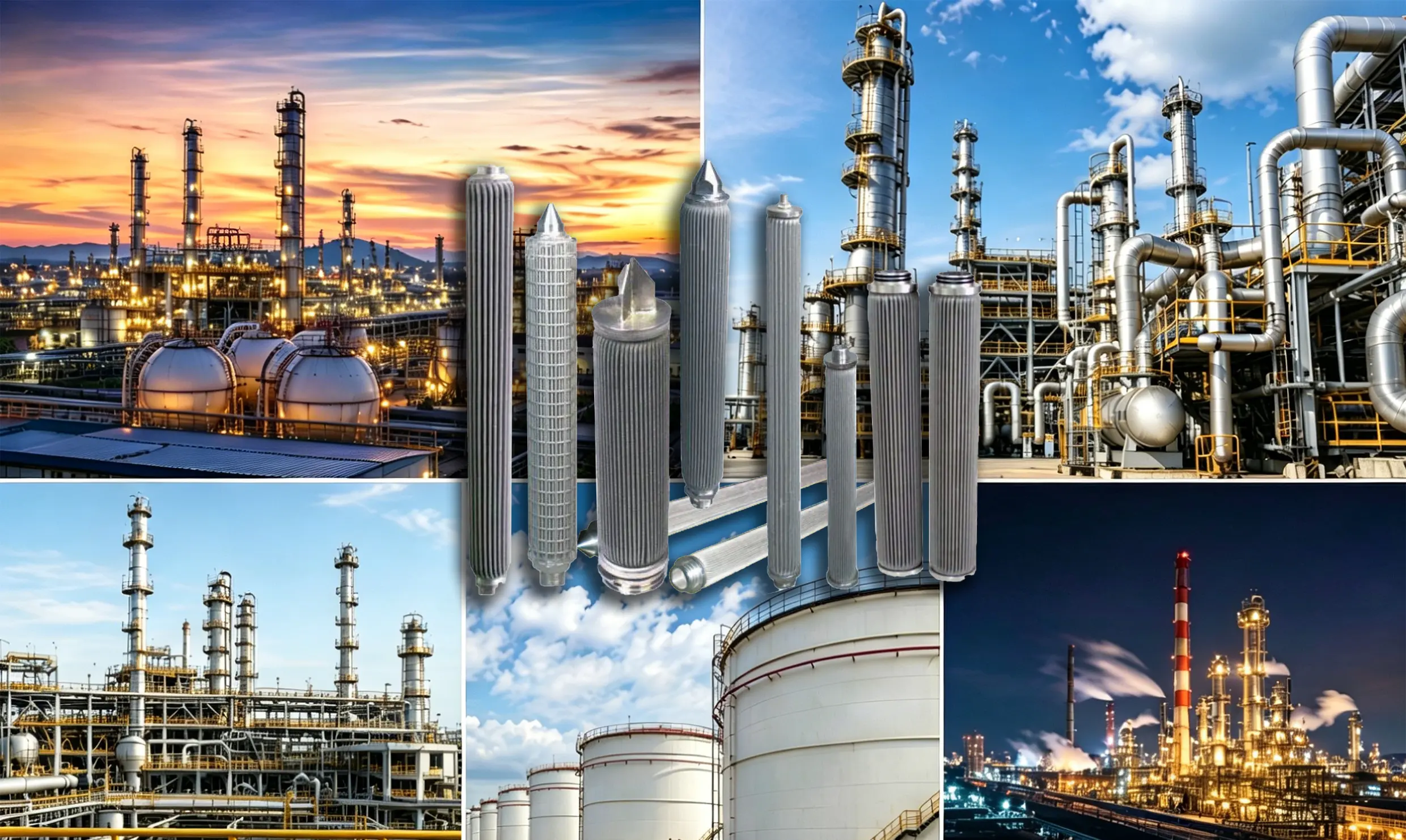
Sintered Fiber Felt Filters for Petrochemical Industry
3D depth-filtration metal fiber felt for the most demanding petrochemical service — FCC catalyst recovery, PTA slurry, polymer melt (PP/PE/ABS), ethylene quench oil, synthetic rubber & fiber, fine chemicals and high-purity lubrication.
Industry Characteristics
Why Petrochemical Specifies Sintered Fiber Felt
When the service combines high temperature, high viscosity, polymer melt, catalyst recovery or fine chemical purity, sintered metal fiber felt is the only depth-filtration media that survives. Its 3D random fiber matrix captures particles throughout the depth of the element — delivering 5–10× the dirt-holding capacity of surface mesh at the same micron rating, plus Beta ratios above 5000 (β>5000).
High Temperature
280–550 °C across PP / PE melt, PTA, ethylene quench oil and FCC catalyst recovery service.
High-Viscosity Media
Polymer melt at 100–400 bar — 3D fiber matrix holds without compaction.
Catalyst Recovery
FCC and HDS catalyst recovery — Inconel sintered fiber felt above 600 °C.
Polymer Melt Black-Spec
3D depth structure traps gels and carbonized particles before the die head.
Fine Chemical Purity
1–5 µm precision for catalyst production, fine chemicals and pharma-grade chemistry.
Ultra-High Dirt-Holding
5–10× the capacity of sintered mesh — essential for high-fouling FCC slurry and rPET.
Application Coverage
12 Typical Petrochemical Applications — Equipment, Conditions & Recommended Rating
From FCC catalyst recovery, PTA / PX aromatics, ethylene cracking quench oil, polymer melt (PP/PE/ABS), synthetic rubber and fiber, to fine catalyst production, lubrication and solvent recovery — each combination of temperature, viscosity and contaminant maps to a specific sintered fiber felt construction.
← Scroll horizontally to view all columns →
| Application Unit | Install Location | Function | Contaminants | Working Conditions | Customer Pain Point | Consequence Without Felt | Rating |
|---|---|---|---|---|---|---|---|
| FCC Catalytic Cracking | Catalyst Recovery Filter | Catalyst recovery | FCC catalyst fines | 350–550 °C | High catalyst loss | Catalyst run-off | 3–10 µm |
| PTA Plant | Slurry Filter | Impurity removal | Crystal particles | High-temp slurry | Black specs in product | Product downgrade | 5–20 µm |
| PX Aromatics | Process Filter | Equipment protection | Metal particles | Continuous production | Equipment wear | Shutdown for repair | 5 µm |
| Ethylene Cracking | Quench Oil Filter | Oil purification | Coke fines | > 250 °C | Coke deposition | Heat exchanger plugging | 10 µm |
| Polypropylene (PP) Plant | Melt Filter | Resin quality polishing | Gels | 280–320 °C | Black specs | Off-spec product | 5–25 µm |
| Polyethylene (PE) Plant | Melt Filter | Precision filtration | Unmelted particles | High-temp / high-pressure | Film pinholes | Customer complaints | 10 µm |
| ABS Resin Plant | Polymer Filter | Product polishing | Gels | Continuous production | Surface defects | Product scrap | 5 µm |
| Synthetic Rubber Plant | Process Liquid Filter | Spinneret protection | Gel agglomerates | High-viscosity medium | Spinneret hole plugging | Shutdown for cleaning | 10 µm |
| Synthetic Fiber Plant | Melt Filter | Spin-pack protection | Gels | ~ 280 °C | Filament breakage | Product downgrade | 5 µm |
| Catalyst Production | Catalyst Filter | Product separation | Fine powder | High-temp slurry | Lower yield | Feedstock waste | 1–5 µm |
| Lube Oil Production | Polishing Filter | Oil polishing | Fine particles | High cleanliness | Oil grade drop | Customer returns | 3 µm |
| Solvent Recovery | Process Filter | Solvent recovery | Metal particles | Corrosive environment | Solvent contamination | Off-spec product | 5 µm |
Element Construction
Multi-Layer Composite Construction — Engineered for Petrochemical Severity
Every SINFT sintered fiber felt element is built as a multi-layer composite — protection mesh, filtration felt, support mesh, perforated skeleton, machined end caps and fully-welded construction. Each layer engineered for the specific function it performs.
| Component | Recommended Material | Rationale |
|---|---|---|
| Filtration Layer | 316L Sintered Fiber Felt | High porosity, ultra-high dirt-holding 3D structure. |
| High-Temp Filtration Layer | Inconel Sintered Fiber Felt | Service above 600 °C without structure relaxation. |
| Support Layer | 316L Sintered Mesh | Increases mechanical strength under high dP. |
| Inner Skeleton | 316L Perforated Plate | Maximum collapse resistance. |
| Outer Protection | 304 / 316L Woven Mesh | Prevents mechanical damage during handling. |
| End Caps | 316L Machined Solid | Single-piece corrosion-resistant construction. |
| Gaskets / Seals | Graphite / PTFE / Viton | Selected per service chemistry. |
| Welding | TIG / Laser | Fully-welded construction — no adhesives or fasteners. |
Material Selection
Material Selection Guide — Service to Recommended Felt
Filter material is matched to service temperature, viscosity, corrosion and precision requirement.
| Service Environment | Recommended Felt | Rationale |
|---|---|---|
| Polymer melt | 316L Sintered Felt | Industry-standard 3D depth structure for gels and black specs. |
| PTA slurry | 316L Sintered Felt | High-temperature corrosion resistance. |
| FCC catalyst recovery | Inconel Sintered Felt | Service stability above 600 °C. |
| High-temp cracked gas | 310S Sintered Felt | High-temperature stability with cost advantage vs Inconel. |
| Strongly acidic medium | Hastelloy C-276 Felt | Maximum chemical corrosion resistance. |
| Chloride-bearing medium | 904L Sintered Felt | Chloride pitting resistance. |
| HP polymer service | Multi-Layer Composite Felt | Multi-layer composite for sustained HP cycling. |
| Fine chemical product | Pharma-Grade 316L Felt | Electropolished surface for sub-micron purity. |
Customer Concerns
Top 5 Questions from Petrochemical Customers
1. What makes sintered fiber felt different from sintered mesh in petrochemical service?
add
Sintered mesh provides surface filtration — particles are captured on the wire mesh surface. Sintered fiber felt provides depth filtration — particles are captured throughout a 3D random matrix of metal fibers. This gives sintered fiber felt 5–10× more dirt-holding capacity than sintered mesh for the same micron rating, plus higher Beta ratio (β > 5000) and natural tolerance for viscous, gel-bearing or coke-laden polymer melts and FCC slurry oil.
2. Why is sintered fiber felt the industry standard for polymer melt filtration?
add
Polymer melt (PP, PE, ABS, synthetic rubber, synthetic fiber) at 280–320 °C carries gels, carbonized particles and unmelted resin that aggressively block surface filters. Sintered fiber felt’s 3D depth structure captures these contaminants progressively through the matrix, dramatically extending service life between change-outs while eliminating black-spec defects at the die head.
3. Can sintered fiber felt handle FCC slurry oil and ethylene quench oil?
add
Yes — these are the highest dirt-holding services in industry, and sintered fiber felt is the field-proven media. For FCC catalyst recovery at 350–550 °C, we recommend Inconel sintered fiber felt that withstands sustained high temperature without sintered structure relaxation. For ethylene quench oil with coke fines at 250 °C+, 316L sintered fiber felt is the standard.
4. What’s the multi-layer structure of SINFT sintered fiber felt elements?
add
SINFT sintered fiber felt elements feature a 5-layer engineered composite: outer protection mesh (304/316L woven), filtration layer (316L sintered fiber felt), support layer (316L sintered mesh), inner skeleton (316L perforated plate), with end caps machined from solid 316L and TIG/laser fully-welded construction. Gasket selection (graphite, PTFE, Viton) per service. The result: depth filtration plus mechanical strength for high-dP service.
5. Which material grade for severe petrochemical service?
add
316L sintered fiber felt for general polymer melt and PTA slurry. Inconel for FCC catalyst recovery (> 600 °C). 310S for high-temp ethylene cracking gas. 904L for chloride-bearing service. Hastelloy C-276 for strongly acidic streams. Multi-layer composite construction for severe HP polymer service. Pharma-grade electropolished 316L for fine chemical and precision filtration.
Related Products & Applications
Explore Related Solutions
Sintered Fiber Felt
Back to the full product overview, specs and downloads.
Sintered Mesh · Petrochemical
Permanent rating for catalyst protection & HP gas.
Pleated · Petrochemical
Bulk pleated polishing service.
Basket & Tube · Petrochemical
Pump & valve coarse pre-filtration.
Request a Quote — Petrochemical Sintered Fiber Felt
Tell us your process unit (FCC, PTA, PP/PE, ethylene cracking, ABS, synthetic rubber/fiber…), fluid analysis, target micron rating, operating envelope and OEM melt-filter brand — our engineering team replies with a tailored specification within 24 hours.