If a basket strainer plugs too often, passes damaging particles, or cannot be cleaned without deforming the screen, the mesh size may not be the only problem. The opening, open area, support plate, rim fit, debris load, and cleaning access all work together. Basket strainer mesh size is really a custom element specification.
Direct Answer: Basket Strainer Mesh Size
Basket strainer mesh size should be selected from the particle that must be stopped, the allowable pressure drop, the debris load, and the basket construction, not from a generic mesh chart alone. In industrial service, the same nominal mesh count can perform differently when it is used as woven wire cloth, a perforated plate, a woven liner inside a support basket, or a sintered mesh insert.
For most engineering and purchasing decisions, the practical question is: what is the largest particle that can safely pass downstream, and how much open area can the strainer keep after dirt loading? A finer screen may protect pumps, nozzles, valves, meters, or downstream filter cartridges better, but it can also raise pressure drop, blind faster, and require more cleaning. A coarser perforated basket may be more robust for coarse debris, but it may not protect fine clearances.
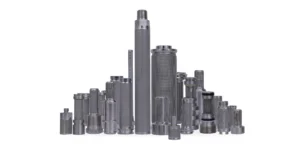
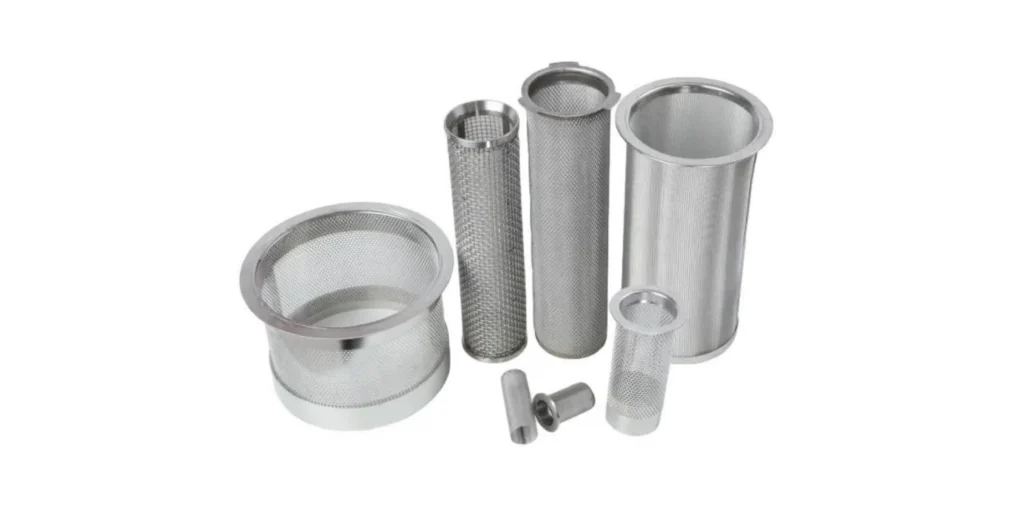
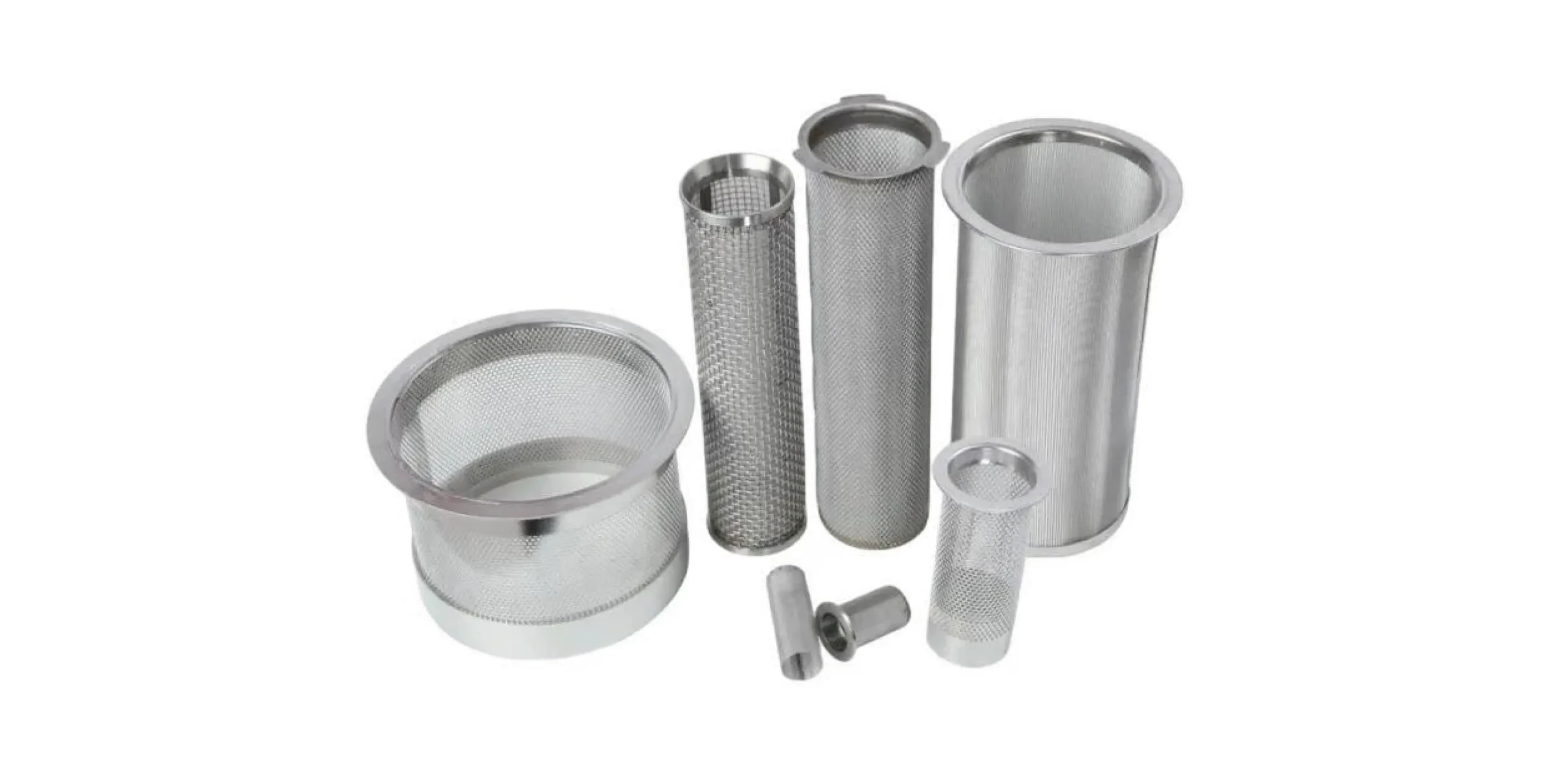
SINFT basket filters and strainers can be made from perforated plate, woven mesh, or sintered mesh, with common mesh options from 20 to 200 mesh and custom round, square, slotted, or punched openings. The final mesh size must still be confirmed against the actual fluid, contaminant, flow, pressure-drop budget, cleaning cycle, and existing housing dimensions.
Basket Strainer Mesh Size at a Glance
Choose the coarsest basket strainer mesh size that protects the downstream equipment and still keeps the element cleanable within the planned service interval. Fine mesh is useful only when the basket area, support, and cleaning method can handle the added resistance and retained solids.
| Selection question | What it controls | Engineering note |
|---|---|---|
| What particle must be stopped? | Opening size or micron target | Use the critical downstream clearance or product-quality limit, not only visible dirt size |
| Is the basket a primary filter or prefilter? | Coarse perforation, mesh liner, or finer insert | Basket strainers often protect equipment before finer filtration |
| How much debris is expected? | Basket volume, open area, cleaning interval | High debris load needs more area and easy removal, not just smaller openings |
| What pressure drop is allowed? | Open area, basket length, media type, support | Compare clean and dirty conditions, not only clean basket data |
| Can the screen be cleaned? | Woven mesh, perforated plate, sintered mesh, liner design | Sticky, fibrous, or deformable particles may blind fine mesh quickly |
| Does it fit the housing? | OD, length, rim, handle, flange, seal, insertion depth | Mesh choice fails if the basket does not seal or seat correctly |
This makes basket strainer mesh size a system decision. A 40 mesh liner in one basket and a 40 mesh liner in another basket may not give the same pressure drop, dirt capacity, or cleaning life if the open area, liner support, flow direction, and housing geometry are different.
Mesh Count, Opening Size, and Micron Rating Are Not the Same
Mesh count tells you how many openings or wires occur per linear inch, while opening size tells you the approximate space a particle can pass through. Micron rating is a filtration performance term and should be tied to a defined medium, test method, and efficiency expectation.
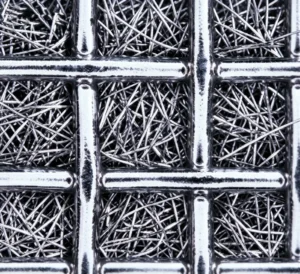
For woven wire cloth, two screens with the same mesh count can have different opening sizes if the wire diameter changes. Thicker wires reduce the aperture and open area. Thinner wires increase open area but may reduce mechanical strength or abrasion resistance. That is why a purchasing note such as “100 mesh stainless steel” is incomplete unless it also specifies the wire diameter, weave type, material, and whether the value is a nominal screen description or a tested retention requirement.
For perforated plate, the specification is usually given by hole diameter or slot width, hole pattern, pitch, plate thickness, and open area. For sintered mesh, the controlling layer, support layers, and tested rating matter. If the basket uses a woven mesh liner inside a perforated support, both layers must be specified because the support affects strength and open area while the liner controls particle retention.
External standards help define terms, but they do not replace application testing. ASTM E11 covers woven wire test sieve cloth and test sieves, while ISO 9044 covers industrial woven wire cloth technical requirements. These references are useful for terminology and specification discipline; the actual strainer still needs application-specific validation.
Common Basket Strainer Mesh Size Ranges
Industrial basket strainers commonly use coarse perforated openings for equipment protection and finer woven mesh liners when smaller particles must be retained. SINFT’s confirmed basket product information lists 20, 30, 40, 60, 80, 100, 150, and 200 mesh as common mesh options, plus round, square, slotted, and custom punching.
Use the following table as a selection framework, not a universal conversion chart.
| Typical basket media choice | Better starting point when | Main risk to check |
|---|---|---|
| Perforated plate basket | Large chips, weld slag, scale, gasket fragments, or coarse debris must be stopped | Hole size may be too coarse for fine downstream clearances |
| Perforated basket with woven mesh liner | The housing needs rigid support and the retention target is finer than the perforation | Liner collapse, tearing, bypass, or difficult cleaning if support is poor |
| Woven mesh basket | Moderate particle retention with visual inspection and removable cleaning | Wire diameter and open area may vary at the same mesh count |
| Sintered mesh basket or insert | Stable pore structure, repeated cleaning, or higher mechanical rigidity is needed | More expensive and still must be matched to pressure drop and contaminant release |
| Slotted or custom-punched basket | Long fibers, flakes, or a directional debris shape dominates | Slot orientation and bridge formation must be reviewed |
When the retained solids are large and irregular, start with a robust perforated basket and check whether downstream equipment needs a finer liner. When the process needs finer retention, start with the target particle size and then increase basket area, support, and cleaning access to control pressure drop.
Open Area Matters as Much as Mesh Size
Open area is the percentage of the basket surface that is available for flow before dirt loading. A smaller opening can protect better, but if it sharply reduces open area, the basket may load too quickly or create excessive pressure drop.
Open area depends on:
- mesh count and wire diameter for woven wire cloth;
- hole diameter, pitch, and pattern for perforated plate;
- slot width, slot length, and pitch for slotted baskets;
- support perforation behind a mesh liner;
- basket diameter, length, bottom style, and blocked area near the rim;
- the usable flow path inside the housing.
Do not compare only “60 mesh versus 100 mesh.” Compare the usable open area of the complete element and the cleaning interval at the expected solids load. In a retrofit, the existing housing may limit basket diameter or length, so a finer screen may require a pleated liner, longer basket, different support, or a staged filtration approach rather than a simple mesh substitution.
How Mesh Size Affects Pressure Drop
Basket strainer pressure drop increases when openings become smaller, when open area decreases, when fluid viscosity rises, or when dirt covers the available area. The clean pressure drop is only the starting condition; the operating pressure drop depends on loading.
General piping design still controls the system around the strainer. ASME B31.3 Process Piping is a common reference for process piping design responsibilities, while the strainer manufacturer or system engineer must evaluate the actual component pressure drop and mechanical limits. A basket element should not be treated as an isolated screen if the housing, nozzle orientation, bypass risk, and maintenance procedure control the real installation.
When reviewing pressure drop, separate four values:
- Clean basket pressure drop: measured or estimated at specified flow, temperature, viscosity, and fluid.
- Normal operating pressure drop: expected after some contaminant has accumulated.
- Cleaning trigger pressure drop: the differential pressure at which operators clean or change the basket.
- Maximum allowable differential pressure: the limit for the basket, liner, welds, support, seal, and housing.
SINFT also publishes a separate filter pressure drop vs flow rate guide for broader pressure-drop selection. For a basket strainer, use that concept with the actual basket geometry, support structure, contaminant loading, and cleaning interval.
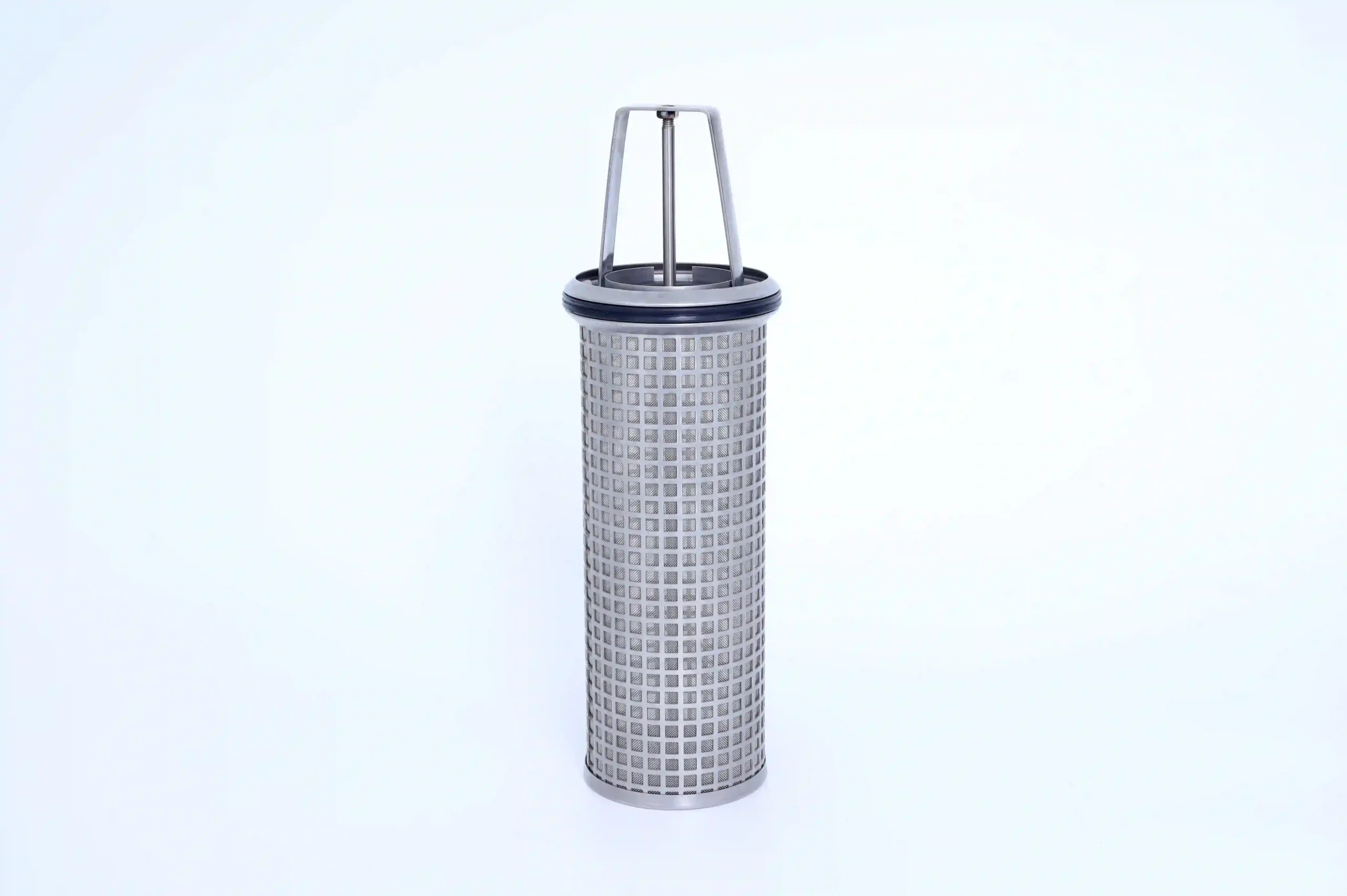
Perforated Basket or Woven Mesh Liner?
Use a perforated basket when robustness and coarse debris removal are the priority; add or select woven mesh when the downstream protection target is finer than the perforation. Many industrial baskets combine both.
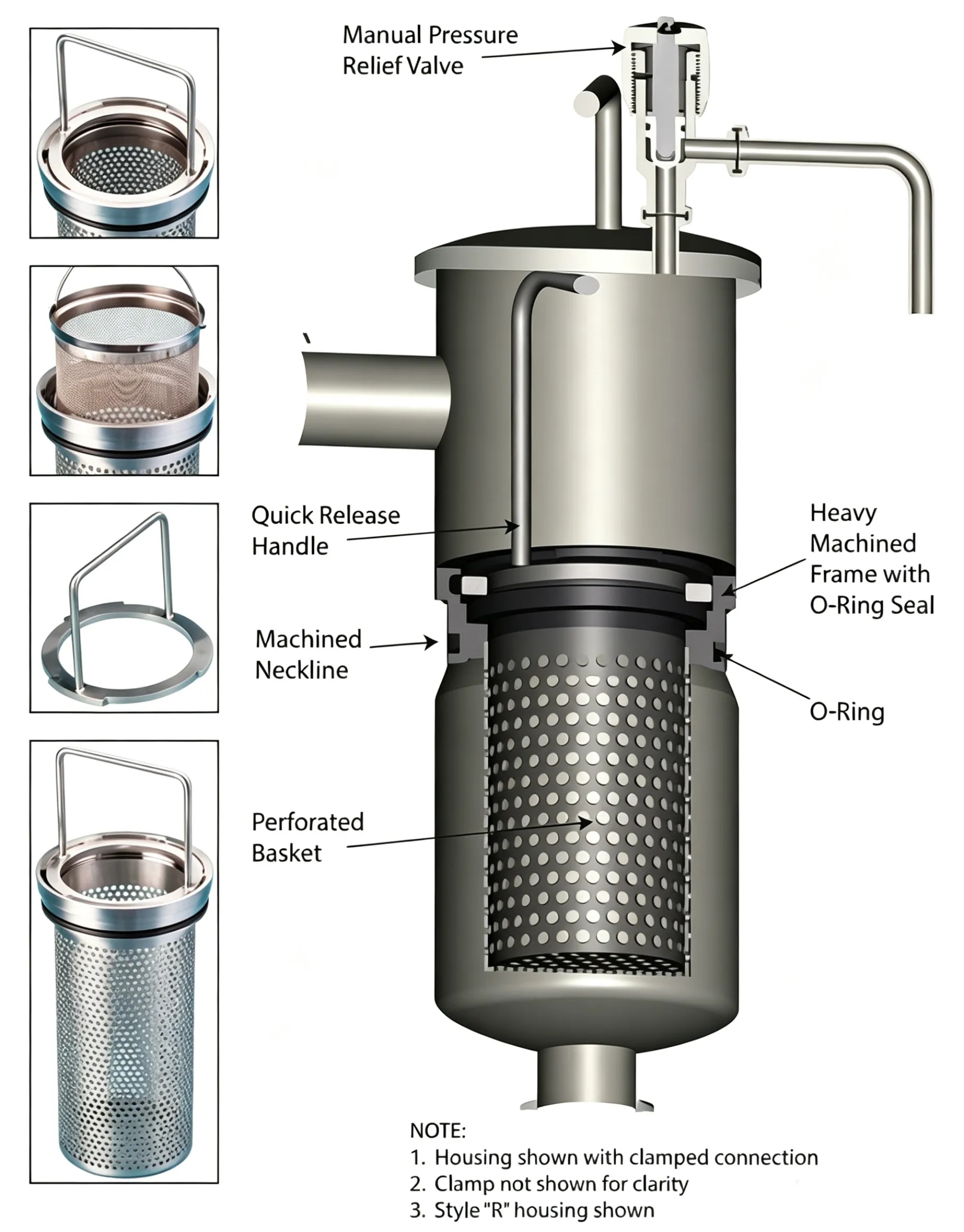
A perforated basket is easier to inspect, robust against larger particles, and suitable for many pump-protection or pipeline-protection duties. It can be made with round, square, slotted, or custom punched holes. However, coarse perforation alone may allow smaller particles to pass.
A woven mesh liner improves particle retention, but it needs support. If a fine mesh liner is unsupported, it can deform, tear, or separate from the rim under differential pressure and cleaning. If the support perforation blocks too much area behind the liner, pressure drop may rise even if the mesh itself looks adequate.
A practical specification should state:
- basket body material, such as SS304, SS316, SS316L, carbon steel, copper, or alloy;
- perforated plate hole size, pattern, and thickness if used;
- woven mesh count, wire diameter, weave type, and material if used;
- whether the mesh is inside, outside, welded, wrapped, clamped, or removable;
- rim, ring, flange, thread, handle, bottom style, and seal details;
- deburring, cleaning, and passivation requirements if needed.
SINFT’s custom filter manufacturer service can build baskets from drawings, old samples, housing dimensions, or photos. That is especially useful when the buyer has an existing basket that fails by tearing, bypass, high pressure drop, or poor fit.
How to Size a Basket Strainer for an Existing Housing
For a replacement basket, dimensional fit is as important as mesh size because bypass at the rim can defeat even a correctly selected screen. A fine mesh basket that does not seat correctly is worse than a coarser basket that seals reliably.
Measure or confirm:
- Basket outside diameter and inside diameter where relevant
- Overall length and effective screened length
- Rim diameter, rim thickness, step, groove, or flange geometry
- Bottom style: flat, domed, cone, reinforced, or open
- Handle shape, lifting clearance, and cover interference
- Seal position and whether the housing relies on metal contact, gasket, or O-ring
- Flow direction and dirty-side location
- Existing mesh count, perforation size, support plate, and liner layout
- Visible deformation, plugged areas, cracked welds, or bypass marks on the old basket
If the old basket is unavailable, provide the housing drawing, housing photos, cover-to-seat depth, inlet and outlet orientation, and the target contaminant. For a custom replacement, SINFT can review OD, ID, length, flange, end ring, handle, and support details before manufacturing.
Application-Based Starting Points
The right basket strainer screen size changes by application because the protected equipment and debris type change. A basket used before a pump in water treatment is not necessarily specified the same way as a basket used in petrochemical transfer or power-plant auxiliary systems.
| Application | Common protection goal | Mesh-size decision note |
|---|---|---|
| Water treatment | Protect pumps, valves, spray nozzles, or downstream filters from sand, scale, and pipe debris | Balance fine retention against frequent cleaning; see SINFT water treatment filters |
| Petrochemical and oil service | Remove coarse process debris before sensitive equipment or finer elements | Confirm chemical compatibility, viscosity, cleaning safety, and bypass control; see petrochemical filtration |
| Power generation | Protect condensate, cooling, fuel, or auxiliary equipment from scale and debris | Maintenance access and pressure-drop alarms can matter as much as opening size; see power plant filtration |
| Self-cleaning or backwash systems | Hold debris on a cleanable surface until reverse flow or manual cleaning | Choose openings that retain the target solids but release during cleaning; see basket and tube filters for self-cleaning systems |
If fine polishing is required after the basket, a downstream cartridge or sintered element may be more appropriate. The basket should remove the debris it is designed for without stealing the pressure-drop budget needed by the final filter.
Common Specification Mistakes
Most basket strainer mesh problems come from incomplete specifications, not from mesh count alone. The following mistakes often cause repeat failures:
- Ordering only by mesh count. “80 mesh” does not define wire diameter, open area, weave, support, material, or performance.
- Assuming smaller is always safer. Finer screens can blind quickly, raise pressure drop, collapse liners, or shorten cleaning intervals.
- Ignoring open area after support. A strong perforated support can also block flow if the pattern is not matched to the liner.
- Copying a mesh from another fluid. Viscosity, particle shape, stickiness, and temperature can change loading behavior.
- Missing bypass paths. Poor rim fit, damaged seals, or wrong insertion depth allows solids to bypass the basket.
- Treating a basket as a final filter. Basket strainers are often prefilters; fine product-quality filtration may need a cartridge, sintered mesh, or fiber felt stage.
- Not defining the cleaning endpoint. Buyers should know the pressure-drop trigger, cleaning method, and inspection criteria before approving a new mesh.
For broader particle-rating language, the filter micron rating chart explains why mesh size, micron rating, nominal rating, and absolute rating should not be mixed without test context. For system comparison, the basket filter vs cartridge filter guide explains when a basket should remain a prefilter and when a cartridge element is the better final stage.
What Buyers Should Confirm Before RFQ
A useful RFQ for basket strainer mesh size should describe the process, the contaminant, the retained particle target, and the housing fit. That allows the manufacturer to propose the mesh and support rather than guessing from a keyword.
Send the following information:
- working fluid or gas;
- contaminant type, particle size range, hardness, shape, and load;
- target particle size or equipment clearance to protect;
- flow rate and operating temperature;
- operating pressure and allowable differential pressure;
- viscosity and whether it changes at startup or shutdown;
- material requirement such as SS304, SS316, SS316L, carbon steel, copper, or alloy;
- corrosion risk and cleaning chemical compatibility;
- existing basket OD, ID, length, rim, handle, seal, and bottom style;
- current mesh count, perforation size, or photos of the old element;
- housing drawing, old sample, or part number if available;
- cleaning method and desired cleaning interval;
- quantity, inspection reports, certificates, and packaging requirements.
SINFT can review basket, slanted basket, tube, flanged tube, and removable liner designs. For a custom replacement or new basket design, contact SINFT Filter with the housing dimensions, process conditions, photos, and target particle size.
How SINFT Can Help With Basket Strainer Mesh Selection
SINFT can help when mesh size has to become a manufacturable basket, not just a number on a purchase request. SINFT basket filters and strainers can be made as baskets, slanted baskets, tubes, flanged tubes, and removable liners using perforated plate, woven mesh, sintered mesh, or combined support structures.
If you are replacing an existing basket, send the old sample, housing drawing, OD, length, rim, handle, bottom style, seal position, mesh or perforation, and photos of plugging or damage. If you are specifying a new element, send the particle target, debris load, flow rate, pressure-drop budget, material, cleaning method, and application conditions. SINFT can then review whether a different opening, larger open area, stronger support, or custom basket geometry is needed.
Frequently Asked Questions
What mesh size is best for a basket strainer?
There is no universal best mesh size for a basket strainer. Select the coarsest opening that protects the downstream equipment, then confirm pressure drop, open area, debris load, support strength, cleaning method, and housing fit. If the basket is a replacement, the old rim and seal fit can be just as important as the mesh count.
Is mesh size the same as micron rating?
No. Mesh size describes a screen geometry, usually openings or wires per inch. Micron rating describes particle retention and should be tied to a defined medium, test method, and efficiency expectation. Two screens with the same mesh count can have different opening size and open area if the wire diameter, weave, or construction is different.
Should a basket strainer use perforated plate or woven mesh?
Use perforated plate for robust coarse-debris protection. Use woven mesh or a mesh liner when finer particles must be retained. Many industrial baskets combine perforated support with a woven mesh liner. When you choose that combined structure, confirm that the support plate does not block too much flow or leave the mesh unsupported.
Does finer mesh always improve filtration?
Finer mesh can retain smaller particles, but it may also increase pressure drop, blind faster, reduce cleaning life, or require stronger support. It is not always the better industrial choice. If your downstream equipment can tolerate a larger particle, a coarser and more cleanable basket may reduce maintenance cost without sacrificing protection.
How do I reduce basket strainer pressure drop?
Increase usable open area, use a larger or longer basket if the housing allows it, avoid unnecessarily fine mesh, control debris loading, clean at a defined differential pressure, and confirm that the support structure does not block too much flow. If the housing cannot accept more area, consider staged filtration or a different basket construction.
What information is needed to copy an existing strainer basket?
Provide the old basket or accurate measurements of OD, ID, length, rim, handle, bottom style, seal position, mesh or perforation, material, flow direction, and photos of wear, plugging, or deformation. Also send the working fluid, debris type, flow, pressure-drop limit, and cleaning method so the replacement is not only dimensionally correct but also suitable for service.
Final Thoughts
Basket strainer mesh size is correct only when it protects the downstream equipment, keeps pressure drop within the system budget, remains mechanically supported, can be cleaned at the expected debris load, and fits the housing without bypass. Start with the protected clearance or particle target, then send SINFT the complete basket data: material, opening, open area, support, rim, handle, seal, dimensions, cleaning method, and acceptance checks.