If your drawing only says “sintered mesh” or “Dutch weave,” the supplier still cannot know the real filtration target. Square weave and Dutch weave can both become excellent control layers, but they solve different problems. The right choice depends on whether your process needs a visible aperture, finer pore path, lower clean resistance, easier release, or a tested retention result.
Direct Answer: Square Weave vs Dutch Weave Sintered Mesh
In a square weave vs Dutch weave sintered mesh comparison, choose square weave when a visible, geometrically defined aperture and relatively open flow path are the priorities; choose a Dutch weave when the filtration task requires a denser woven control layer with an indirect pore path. That is a starting rule, not a universal performance ranking. The actual result depends on the exact weave, wire diameters, layer stack, rating method, fluid, contaminant, element area, support and fabrication.
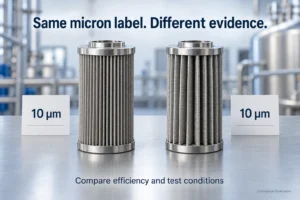
The important purchasing distinction is that “square weave” and “Dutch weave” describe families of woven structures, not complete filter specifications. Sintering bonds wire contacts and stabilizes a multilayer laminate, but it does not make every construction with the same nominal micron label hydraulically or mechanically equivalent. You still need the weave subtype, wire data, rating method, flow direction, laminate stack, and finished-element geometry.
Square Weave vs Dutch Weave Sintered Mesh at a Glance
| Selection factor | Square weave sintered mesh | Dutch weave sintered mesh |
|---|---|---|
| Basic geometry | Warp and weft wires form visible square openings | Warp and weft systems differ in count, diameter or packing; the pore path is not a simple square opening |
| How to describe the control layer | Mesh count, wire diameter and calculated/measured aperture are useful starting data | Plain Dutch, twilled Dutch, reverse Dutch or another defined construction plus wire data and a validated rating method |
| Flow path | Relatively direct through the open squares | More indirect through small passages between closely packed wires |
| Hydraulic expectation | Often selected for high open area and low clean resistance at a suitable aperture | Depends strongly on the Dutch subtype; do not assume one pressure-drop value from the word “Dutch” |
| Particle retention | Closely related to the defined aperture when the screen acts as a surface-retention layer | Must be tied to a test-based retention or pore-size definition rather than mesh count alone |
| Deposit release | Open surface geometry may make deposits easier to observe and release | Fine, tortuous passages may retain certain deposits more tenaciously; actual cleanability is contaminant-dependent |
| Typical reason to specify | Screening, classification, protection or cleanable surface filtration | Finer control-layer duty, polymer processing or another service needing a dense woven pore structure |
| Main RFQ risk | Treating mesh count as a complete rating without wire diameter | Writing only “Dutch weave” without subtype, rating method, permeability or flow-direction requirements |
This table compares control-layer behavior. The finished sintered element may add protective, drainage, distribution, reinforcing or perforated-support layers that change pressure drop, strength and cleaning behavior.
What Is Square Weave Sintered Mesh?
Square weave sintered mesh uses a woven control layer with regularly spaced warp and weft wires that create visible square apertures, then diffusion-bonds that layer to one or more supporting meshes.
In a plain square weave, each wire alternates over and under the crossing wires. Other square-mesh patterns can exist, but the defining feature is an opening that can be described geometrically. Mesh count alone is insufficient because two meshes with the same count can use different wire diameters and therefore have different clear openings and open areas.
Manufacturer guidance from Haver & Boecker distinguishes square mesh from filter cloth and treats aperture, wire diameter and mesh geometry as essential selection data. The terminology and dimensional checks for industrial woven wire cloth are covered by ISO 9044:2016, while ASTM E2016-22 provides a specification framework for industrial woven wire cloth.
Square control layers are attractive when engineers need:
- an understandable relationship between the physical aperture and the screening duty;
- a relatively open passage for a specified retention requirement;
- a surface that supports cake formation and mechanical or hydraulic cleaning;
- repeatable classification of larger particles;
- a laminate whose structural layers can be selected separately from its control opening.
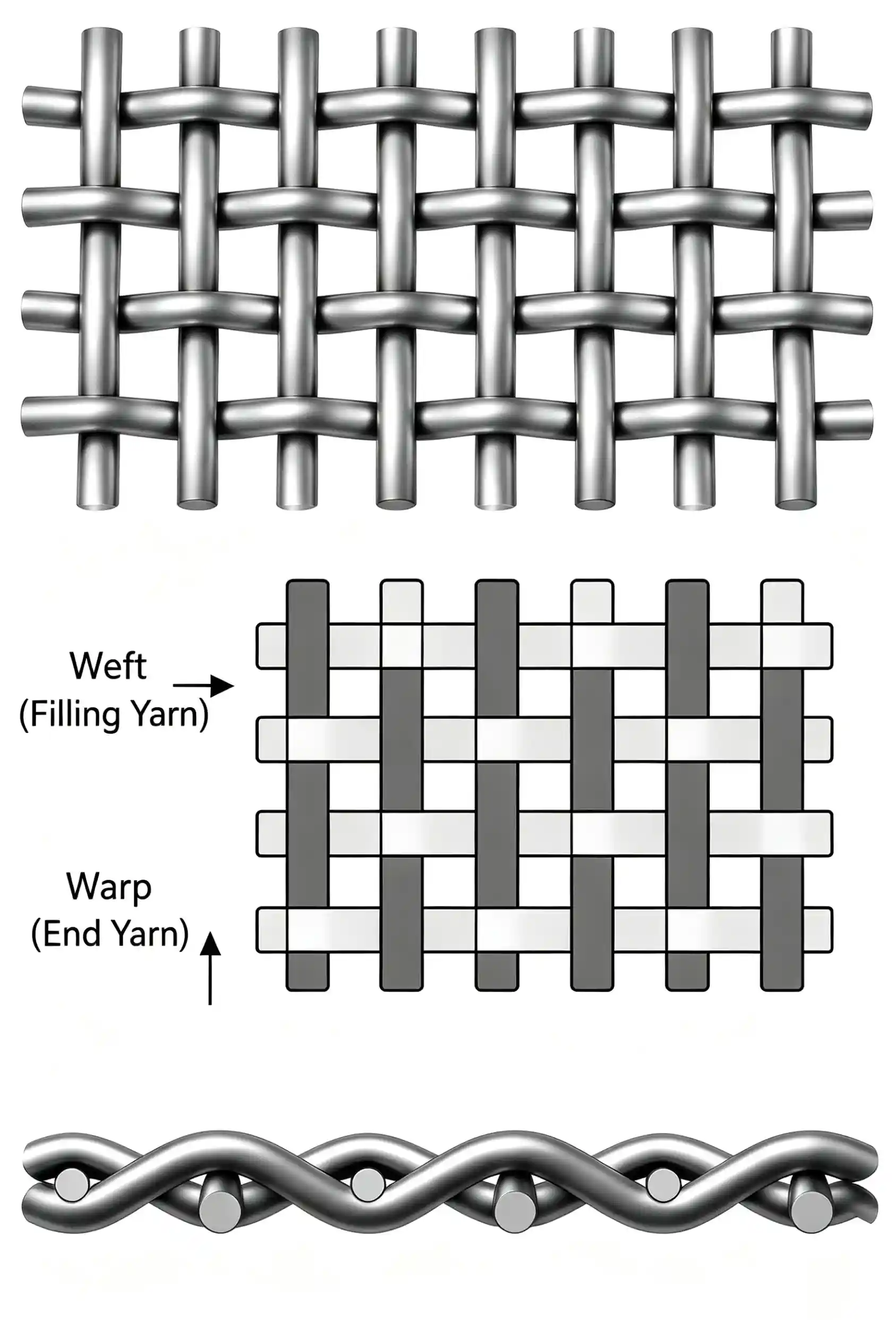
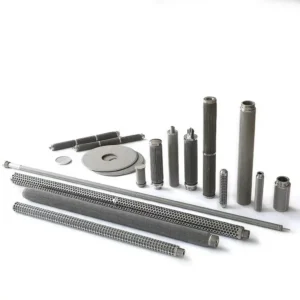
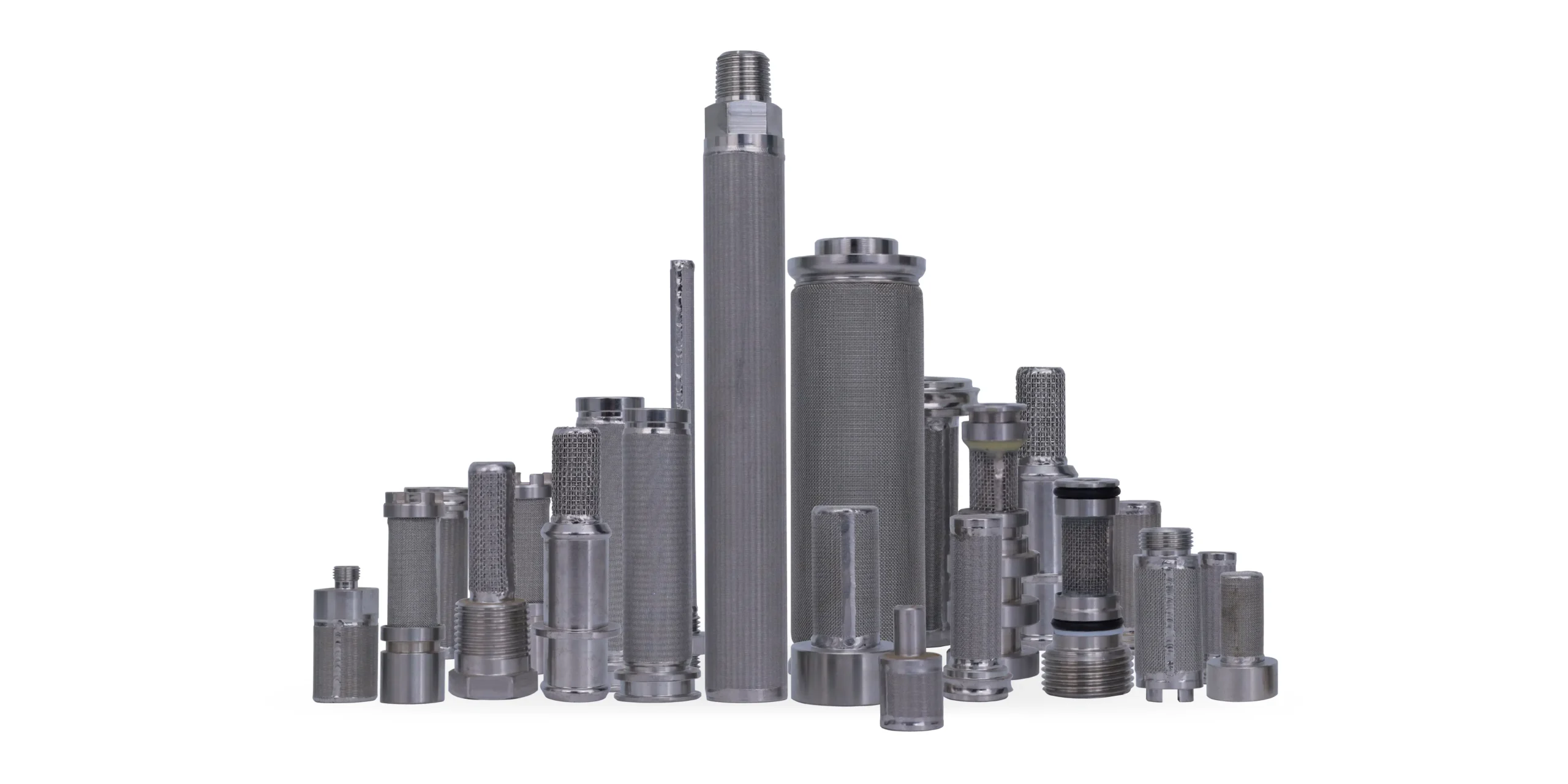
SINFT sintered mesh filter elements can use square, twill, Dutch or perforated-supported structures. The confirmed product-family references include 2–7 layers, with a standard five-layer laminate being common, and filtration ratings from 1–200 µm depending on the chosen construction. Those family ranges should not be applied to every weave, thickness, alloy or finished element without engineering confirmation.
What Is Dutch Weave Sintered Mesh?
Dutch weave sintered mesh uses a densely woven control layer in which the warp and weft systems are not arranged as equal, open square apertures. Fine wires are packed closely around larger supporting wires, creating small, indirect flow passages.
“Dutch weave” is not one geometry. The family includes plain Dutch, twilled Dutch and reverse Dutch constructions, among other manufacturer-specific variants. The Haver & Boecker weave overview separates square meshes and filter cloths and lists different properties for different weave types. Its POROSTAR Dutch weave description also illustrates why a named Dutch construction must be evaluated on its own permeability and pore characteristics rather than treated as representative of the whole family.
Dutch weave is considered when the design needs:
- a finer woven control structure than an open square aperture can conveniently provide;
- stable surface filtration within a bonded multilayer laminate;
- a defined bubble-point, pore-size or retention performance linked to a qualified test;
- a weave designed around a particular combination of throughput, fine retention and mechanical support;
- a control layer for polymer melt, chemical, hydraulic or other demanding process filtration.
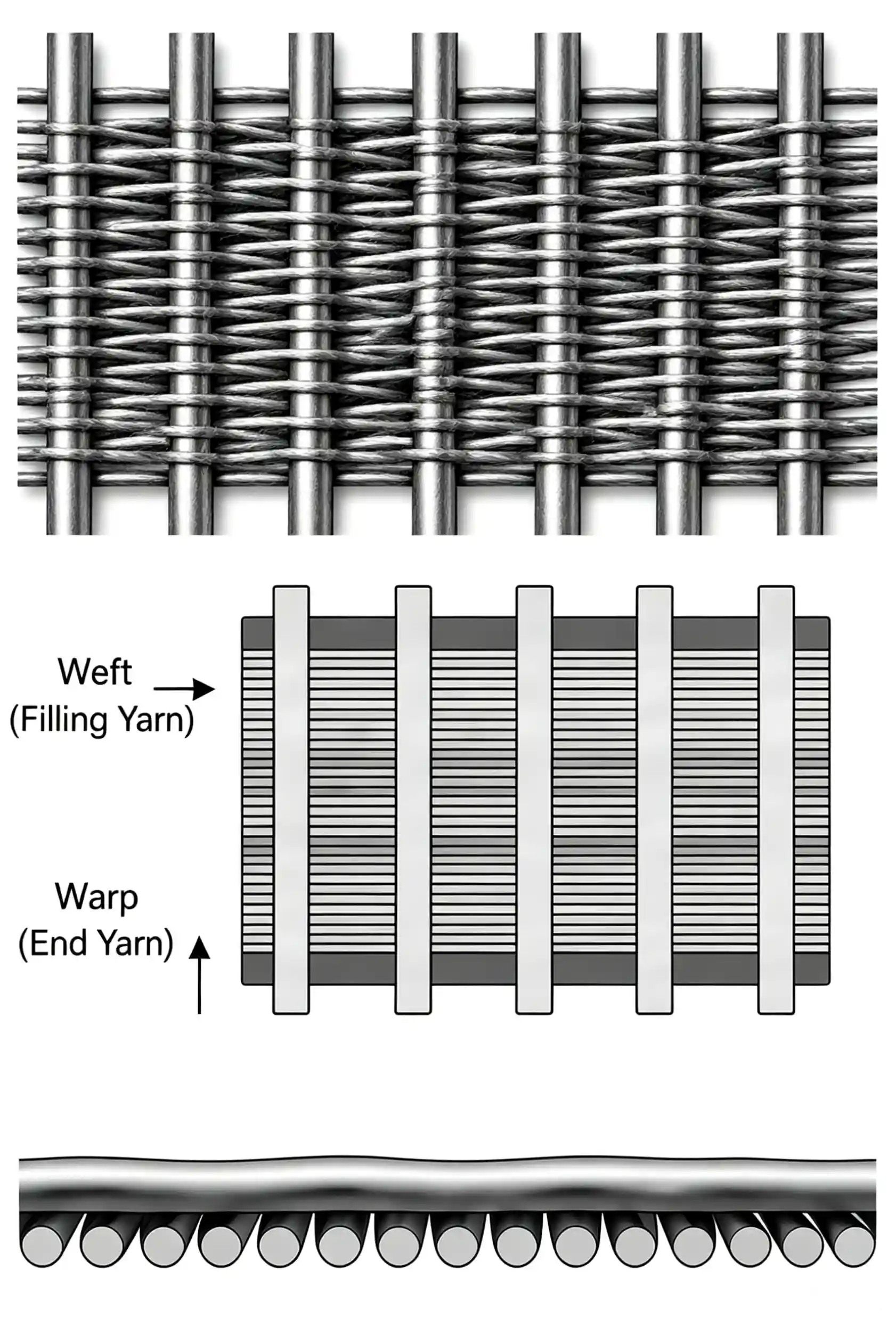
Do not convert a Dutch-weave mesh count directly into a micron rating using a generic mesh chart. Ask what the stated rating represents and how it was measured.
Aperture and Micron Rating: Why the Numbers Are Not Interchangeable
A square mesh can be described by a clear aperture, but a Dutch weave usually needs a pore-size or retention test that reflects its three-dimensional passages.
For square weave, engineers can begin with mesh count and wire diameter, calculate the nominal opening, and confirm it by the agreed inspection method. That is useful for screening, but the opening dimension is still not automatically an “absolute” particle rating. Particle shape, orientation, deformability, agglomeration and operating conditions affect passage.
For Dutch weave, there is no single square hole to measure. Useful supplier data may include:
- geometric pore size based on the weave model;
- bubble-point or maximum-pore test results;
- calibrated particle-retention or separation data;
- nominal or absolute rating with a stated efficiency and test protocol;
- quality-control limits for the specified production lot.
The filter micron rating chart and definition guide explains why nominal, absolute, aperture and efficiency-based ratings cannot be substituted without a common definition. For procurement, write both the required filtration outcome and the verification method into the drawing or purchase specification.
Permeability and Pressure Drop: Compare Curves, Not Weave Names
Square weave generally offers a more direct flow path, but neither weave family has one universal permeability or pressure-drop value.
At clean conditions, pressure drop is affected by pore geometry, open area, media thickness, number of layers, active area, viscosity, density, temperature and flow regime. After operation begins, deposited solids can dominate the result. A Dutch construction designed for high throughput may outperform a different Dutch construction, while an inadequately sized square mesh element can still create unacceptable differential pressure.
Therefore, compare candidate laminates using:
- the same fluid or a justified test fluid;
- the same temperature and viscosity basis;
- superficial velocity or flow per unit active area;
- clean and loaded conditions;
- the complete laminate—not an isolated control layer;
- the finished element, including supports, seams and inactive end zones.
ISO 3968:2017 describes a method for evaluating pressure drop versus flow characteristics of hydraulic filters. Even when a project uses another standard, the principle remains valuable: document the test fluid and conditions instead of comparing isolated catalog numbers. The SINFT guide to filter pressure drop versus flow rate shows how area, viscosity, loading and system hardware change the curve.
Does Sintering Make the Two Weaves Equally Strong?
No. Sintering stabilizes wire intersections, but finished strength depends on the entire laminate and element geometry.
Diffusion bonding reduces wire movement and allows several meshes to behave as an integrated porous sheet. Supporting layers can protect a fine control weave, distribute load and provide drainage. Yet strength is still affected by:
- layer count, sequence and orientation;
- wire diameter and weave geometry;
- laminate thickness and porosity;
- cylinder diameter, unsupported span and pleat geometry;
- perforated cores, outer guards and end hardware;
- longitudinal seams, end welds and forming quality;
- forward and reverse differential pressure;
- cyclic loading, temperature and corrosion allowance.
The 5-layer sintered wire mesh guide explains the protective, control, dispersion and reinforcing functions in a common laminate. It also shows why the control weave cannot be selected independently from support and flow direction.
SINFT’s confirmed sintered-mesh family includes stainless steel 304, 316 and 316L as well as Hastelloy, Monel and Inconel options; DOE, 222, 226, threaded, flanged and custom connections are available. Alloy and connection availability do not prove suitability for a particular chemical or load case. Confirm compatibility, joint design and allowable differential pressure for the exact construction.
Which Weave Is Easier to Clean or Backwash?
Square weave often presents a more open surface and a shorter release path, but cleanability is governed as much by the contaminant as by the weave.
Dry, rigid particles that form a permeable surface cake may release readily. Sticky polymer, soft organic matter, scale, oxide, fibers or particles lodged inside constricted passages may require a different cleaning method. A Dutch control layer can provide fine filtration, but its indirect passages may make embedded material harder to remove. Conversely, a poorly supported square layer may deform during an aggressive reverse-pressure event.
Before approving either weave for reuse, define:
- deposit chemistry, size distribution and adhesion;
- filtration direction and the side where the cake forms;
- backwash fluid, pressure, duration and discharge route;
- compatibility with ultrasonic or chemical cleaning;
- maximum forward and reverse differential pressure;
- inspection and acceptance criteria after cleaning.
The stainless steel filter cartridge cleaning guide separates backwash, ultrasonic and compatible chemical methods. For a system-level decision, the backwash filter vs cartridge filter guide compares automatic in-place cleaning with planned cartridge removal. A weave that can be cleaned in a laboratory is not automatically suitable for an automatic backwash system.
How Layer Architecture Changes the Weave Decision
The control layer determines the primary pore geometry, while adjacent layers make that geometry usable in a finished filter.
A sintered laminate may use square meshes throughout, Dutch meshes throughout, or a hybrid stack. It may also place a fine control layer between protective and drainage meshes, or bond woven mesh to a perforated plate for additional support. SINFT’s confirmed construction range is 2–7 layers, but the right stack is determined by the duty—not by maximizing layer count.
Common architecture choices include:
- all-square laminate: open, understandable passages with multiple square meshes providing filtration, drainage and reinforcement;
- Dutch control layer with support meshes: dense filtration layer protected and reinforced by coarser woven layers;
- multiple Dutch layers: used when the specified pore structure or mechanical arrangement requires it;
- perforated-supported laminate: adds a rigid backing where element geometry or differential load calls for it;
- pleated sintered laminate: adds active area but introduces forming, pleat-spacing and support considerations.
For hydraulic and lubrication circuits, stable rating, clean pressure drop, collapse resistance and contamination control must be reviewed together; see the hydraulic and lubrication filtration application. In polymer processing, viscosity, gel behavior, thermal exposure, cleaning and residence time may dominate; see polymer melt filtration.
Selection Matrix for Engineers and Buyers
| Requirement | Better starting candidate | What must still be verified |
|---|---|---|
| Visible, specified screening aperture | Square weave | Wire diameter, aperture tolerance, particle shape and support |
| High clean permeability at a moderate retention level | Square weave | Actual laminate curve at operating viscosity and temperature |
| Fine woven surface-filtration control | Dutch weave | Exact subtype, test-based rating, permeability and cleanability |
| Particle classification by geometric opening | Square weave | Measurement method and allowable aperture variation |
| High-viscosity polymer duty | Dutch or purpose-designed hybrid | Rheology, temperature, residence time, gel load and screen-change method |
| Automatic backwash | Often square or a qualified cleanable weave | Cake release, reverse differential pressure, support and valve sequence |
| High structural load | Either, with engineered supports | Complete element collapse/burst qualification and weld design |
| Existing housing replacement | Match the validated original before optimizing | OD, ID, length, seal, end connection, flow direction and clearances |
Treat this as a shortlisting tool. A final choice should be based on samples, drawings and comparable test data.
Common Specification Mistakes
1. Specifying only mesh count
Mesh count does not define square aperture without wire diameter, and it is especially inadequate for Dutch weave.
2. Treating “Dutch weave” as one product
Plain, twilled and reverse Dutch structures have different pore paths and hydraulic characteristics. State the exact construction or required performance.
3. Comparing micron labels from different test methods
A geometric aperture, bubble point, nominal retention and absolute efficiency rating answer different questions.
4. Ignoring the complete laminate
The control mesh may be only one layer. Protection, drainage, reinforcement and perforated support change thickness, flow and strength.
5. Assuming finer always means better
An unnecessarily restrictive weave raises clean pressure drop and can shorten the loading interval without improving the process outcome.
6. Approving the media but not the element
Seams, end welds, seals, connections, inactive area and housing fit can control real-world performance.
What to Include in an RFQ
A useful sintered mesh RFQ connects the required filtration outcome to a defined weave, laminate, element and test plan.
Provide:
- Fluid or gas composition, viscosity and operating temperature
- Contaminant type, size distribution, concentration and cake behavior
- Required retention outcome and its aperture, nominal, absolute, efficiency or pore-test definition
- Minimum, normal and maximum flow
- System pressure and allowable clean, terminal, forward and reverse differential pressure
- Preferred square or Dutch weave and the reason for that preference
- Wire specification, layer count, layer sequence, alloy and thickness if already controlled
- Filtration direction, dirty side, clean side and backwash direction
- Element OD, ID, length, shape, active area and support arrangement
- DOE, 222, 226, threaded, flanged or custom connection plus seal details
- Cleaning method, cycle frequency and post-cleaning acceptance criteria
- Inspection method, certificates, traceability, drawing, sample and quantity
SINFT’s custom filter manufacturing service can review the weave, laminate, formed geometry, supports, welds and connection as one design. For a feasibility review, send the application data, drawing and required test method.
How SINFT Can Help With Sintered Mesh Weave Selection
SINFT can manufacture sintered mesh filter elements using square weave, twill weave, Dutch weave, and perforated-supported structures when the application requirements are clear. The confirmed sintered mesh product family includes 2-7 layer constructions, 1-200 µm ratings depending on structure, and forms such as cartridges, tubes, discs, cones, panels, baskets, and custom welded assemblies.
If you are not sure whether square weave, Dutch weave, or a hybrid laminate fits your process, SINFT can review the fluid, contaminant, rating definition, flow, viscosity, temperature, pressure-drop limit, cleaning method, housing dimensions, and required inspection method. This is often more useful than choosing a weave name first and trying to force the element design around it.
Frequently Asked Questions
What is the main difference between square weave and Dutch weave sintered mesh?
Square weave has visible square apertures formed by regularly spaced warp and weft wires. Dutch weave uses dissimilar, closely packed wire systems that create smaller, indirect pore passages rather than simple square openings. For purchasing, this means square weave can often be specified with aperture and wire data, while Dutch weave usually needs a construction-specific rating or pore test.
Is Dutch weave always finer than square weave?
Not as a universal rule. Dutch weaves are commonly selected for fine filtration, but both terms cover many constructions. A fine square weave, a plain Dutch weave, a twilled Dutch weave, and a reverse Dutch weave can all behave differently. Compare the specified rating, test method, permeability, layer support, and finished-element design rather than judging only by the weave family.
Does Dutch weave always have a higher pressure drop?
No. Its denser pore path can increase resistance, but pressure drop depends on the exact weave, layer stack, thickness, area, fluid properties and flow. A purpose-designed Dutch laminate may perform differently from a different Dutch construction. Compare pressure-drop curves at the same test fluid, temperature, viscosity, active area, flow rate, and finished-element boundary.
Can mesh count be converted directly to microns for Dutch weave?
No reliable universal conversion exists because Dutch weave does not have a single square opening. Mesh count may describe wire arrangement, but it does not directly define the smallest passage or retention efficiency. Use a construction-specific geometric pore value, bubble-point result, or particle-retention test with a stated method, and keep that definition in the purchase specification.
Which weave is better for backwashing?
Square weave is often a useful starting point because of its open surface geometry, but contaminant release, support, reverse differential pressure and the complete system determine suitability. Dutch weave may be harder to clean if particles embed in indirect passages. Qualify the chosen element under the intended cleaning cycle, including backwash direction, pressure, duration, and post-cleaning acceptance criteria.
Can square and Dutch weave be combined in one sintered laminate?
Yes. A Dutch control layer may be bonded to square protective, drainage or reinforcing layers. Square and Dutch layers can also be combined with perforated support when the element needs extra rigidity. The approved drawing should define every layer, its orientation, flow direction, thickness, alloy, support structure, and inspection requirement before production.
What should I send for a custom sintered mesh weave recommendation?
Send the fluid or gas, contaminant type, required rating definition, flow, viscosity, temperature, pressure-drop limit, forward and reverse differential pressure, cleaning method, element dimensions, end connection, seal requirement, housing drawing, and quantity. If you have a failed or worn element, photos or an old sample can help the supplier identify whether weave choice, support, welding, or cleaning behavior caused the problem.
Final Thoughts
The correct square weave vs Dutch weave sintered mesh decision comes from matching pore geometry to the filtration mechanism, then validating flow, loading, cleaning and strength in the complete element. Do not purchase either option from weave name or micron label alone. Define the rating method, permeability basis, layer architecture, flow direction, differential pressure, cleaning duty and finished dimensions before asking SINFT to review the element design.