A filter reaches its alarm point while production is still running. Should the element be cleaned, replaced or checked for a change in operating conditions? The answer is not the largest pressure number on its datasheet. A filter differential pressure replacement limit is a maintenance criterion for a defined assembly and duty. Confusing it with a bypass setting or strength rating can leave downstream flow or filtration inadequately protected.
Direct Answer: What Is the Filter Differential Pressure Replacement Limit?
Use the equipment manufacturer's approved changeout or cleaning criterion for the installed filter and its specified operating conditions. There is no single differential-pressure value that applies to every industrial metal element. The criterion must be consistent with required flow, fluid properties, element construction, assembly limits and the approved alarm response.
For a cleanable metal element, reaching a service trigger can mean removal for approved cleaning—not automatic permanent disposal. Return it to service only after the required acceptance checks. Replace or quarantine an element that is damaged, cannot meet those checks or has an unresolved specification. A low pressure reading alone does not prove filtration integrity.
1. Separate the Pressure Numbers Before Making a Decision
A service trigger, bypass setting and structural rating describe different functions. Record each one against its source rather than treating the terms as interchangeable.
| Term | What it describes | What it does not establish |
|---|---|---|
| Clean differential pressure | Baseline loss at stated flow and fluid conditions | A universal replacement point |
| Cleaning or changeout criterion | Documented maintenance action point | Permission to continue until a strength rating |
| Indicator or alarm setting | Signal used by the approved service procedure | Proof of the element's physical condition |
| Bypass cracking pressure | Start of bypass opening, if fitted | Fully open flow capacity or a routine operating target |
| Allowable operating differential | Limit confirmed for the offered assembly and duty | A disposable or reusable life allowance |
| Collapse/burst test rating | Structural verification under stated test conditions | A plant maintenance threshold |
Differential pressure is the difference between relevant upstream and downstream pressures during flow. It is not the same as line pressure or the housing's pressure rating. An element can experience significant differential pressure inside a housing whose line pressure is otherwise within specification.
ISO 2941:2009 describes verification of hydraulic filter element collapse/burst pressure rating in the intended flow direction. That scope is not a universal changeout rule, a reverse-flow approval or evidence that every SINFT construction has been tested to that standard.
Confirm flow direction, temperature and whether a quoted limit applies to the medium, complete cartridge or entire assembly. Do not copy a maximum differential value from one metal product family to another. For the basic operating relationship, see the filter pressure-drop and flow-rate guide.
2. Validate the Reading Without Delaying Required Action
Follow the approved alarm response first; diagnostic checks must not become permission to exceed a documented limit. When the procedure permits evaluation, collect enough information to interpret the reading.
Confirm instrument identity, calibration and pressure-tap locations. Determine whether it measures the element, complete housing or additional downstream equipment. A single upstream pressure gauge cannot generally establish filter differential pressure when downstream pressure varies.
Record actual flow, fluid temperature and fluid identity with the pressure readings. Compare with a verified clean baseline at matched conditions. An elevated startup reading may reflect viscosity, while a higher reading over repeated runs at comparable conditions may indicate added resistance. Neither observation alone proves whether the medium is intact.
HYDAC's indicator documentation distinguishes differential measurement from static-pressure indication and discusses cold-start behavior. It also shows why alarm arrangements are product-specific. Do not transfer its example settings to another assembly.
For the fluid-property checks, use the viscosity and filter pressure-drop guide. Also establish whether an indicator automatically resets or retains a previous trip. A retained signal and a current measured differential are different records; handle both according to the equipment procedure.
3. Establish a Documented Criterion, Not an Arbitrary Number
The responsible equipment or process team should approve the service criterion using the exact assembly's data. If the threshold is missing, request it instead of deriving one from a catalogue maximum.
Start with the equipment manual, filter specification, indicator details and the duty for which the installation was approved. Resolve conflicts between nameplate, drawing and supplier documentation. A replacement that physically fits may still have different retention, flow resistance, support or bypass-related features.
The review should identify:
- Required downstream flow, pressure and cleanliness or product-quality target.
- Clean assembly loss at normal and relevant startup conditions.
- Confirmed element and housing limits at actual temperature and flow direction.
- Bypass configuration, if present, including its specified operating characteristics.
- Indicator accuracy, switching behavior and any approved startup logic.
- Maintenance response: immediate action, controlled changeover or another documented procedure.
- Evidence needed before a cleaned element can be released for reuse.
These inputs are not combined by simply subtracting a fixed percentage from the collapse rating. A strong element can still leave inadequate downstream flow or lose filtration through bypass. Likewise, a low pressure budget can require service well before a structural limit becomes relevant.
HYDAC's bypass FAQ explains that changes can involve assembly-specific parts and identification. The practical implication is to seek the appropriate manufacturer's approval, not adjust a bypass or raise an alarm to extend a run.
For non-bypass assemblies, the absence of bypass does not make continued operation acceptable until collapse. Review the equipment's flow requirement and approved limits. For automated backwash systems, a cleaning trigger, cleaning sequence and an escalation condition after unsuccessful cleaning are also separate decisions.
4. Decide Whether to Clean, Replace or Investigate
Clean only a construction approved for cleaning; replace or quarantine an element whose condition cannot be accepted. The following table organizes the maintenance review without supplying a substitute pressure setting.
| Condition | Appropriate review path | Evidence required |
|---|---|---|
| Service trigger reached; cleanable element; no known damage | Approved removal and cleaning | Cleaning procedure and release criteria |
| Disposable or non-cleanable construction | Replacement under the service procedure | Correct replacement specification |
| Cleaned element still shows excessive matched-condition loss | Review cleaning effectiveness and construction | Valid baseline, flow data and inspection |
| Deformation, corrosion, damaged connection or failed integrity check | Quarantine; replacement or supplier-approved disposition | Inspection findings and traceable specification |
| Alarm with changed flow, temperature or fluid | Follow alarm procedure and investigate conditions | Paired operating data and instrument checks |
| Unexpected pressure decrease after a high reading | Investigate before assuming recovery | Flow, bypass/sealing condition and integrity evidence |
Do not repeatedly clean an element just because it is metal. The contaminant, medium, bonds, welds, supporting parts and seals must tolerate the selected method. Surface appearance does not show whether all internal deposits have been removed or whether the retention structure has been damaged.
Use pleated metal cartridges and sintered mesh filter elements as construction-specific options, not as a guarantee that every part can withstand every cleaning cycle. For systems designed around reverse-flow cleaning, review the exact backwash filter cartridge and its permitted cleaning duty.
Before opening a housing, follow the site's isolation, depressurization, cooling, draining and hazardous-fluid procedures. This article is a selection and maintenance-planning guide, not a vessel-opening or cleaning instruction.
5. Check a Cleaned Element Before Returning It to Service
Successful cleaning requires evidence of acceptable flow behavior and continued fitness for filtration—not merely a shiny surface. Agree on acceptance criteria before the first cleaning cycle.
Review at least the following, as applicable to the construction and duty:
- Identity and history: confirm part, medium, grade, flow direction and previous cleaning/service events.
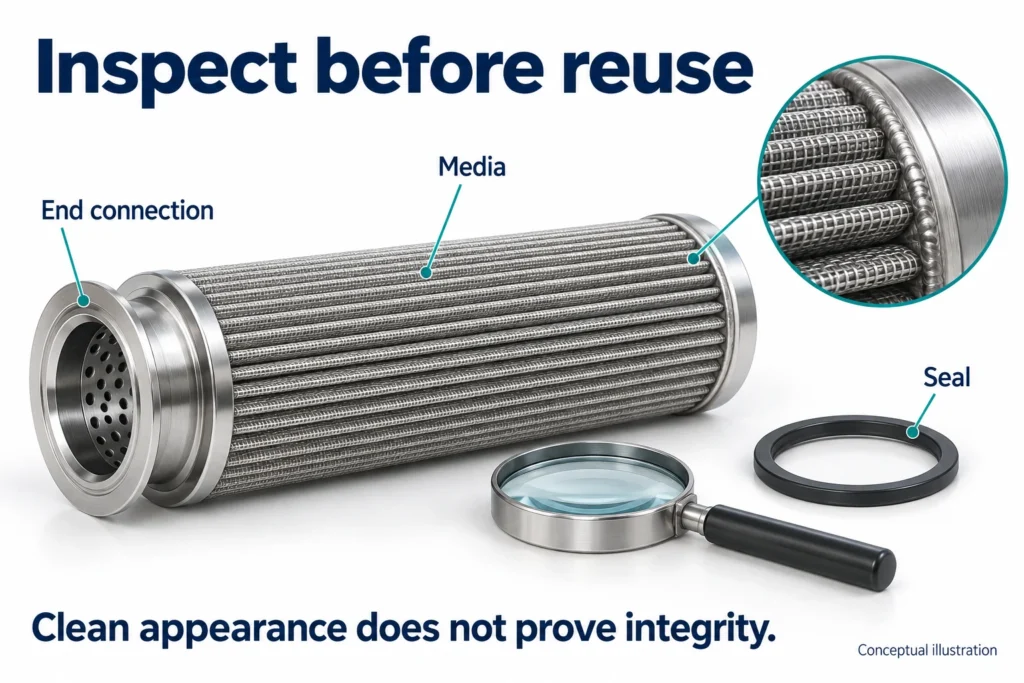
- Media and supports: look for deformation, damaged pleats, corrosion, loose components and other unacceptable changes.
- Connections and seating: inspect end fittings, welds, seating surfaces and dimensional fit.
- Seal condition: confirm the specified seal and replacement requirements; do not assume a cleaned seal is reusable.
- Residual contamination: check against the required cleanliness and chemical-residue criteria.
- Flow or permeability: compare using the approved test method and reference conditions.
- Integrity or retention: perform the applicable verification agreed for that medium and service.
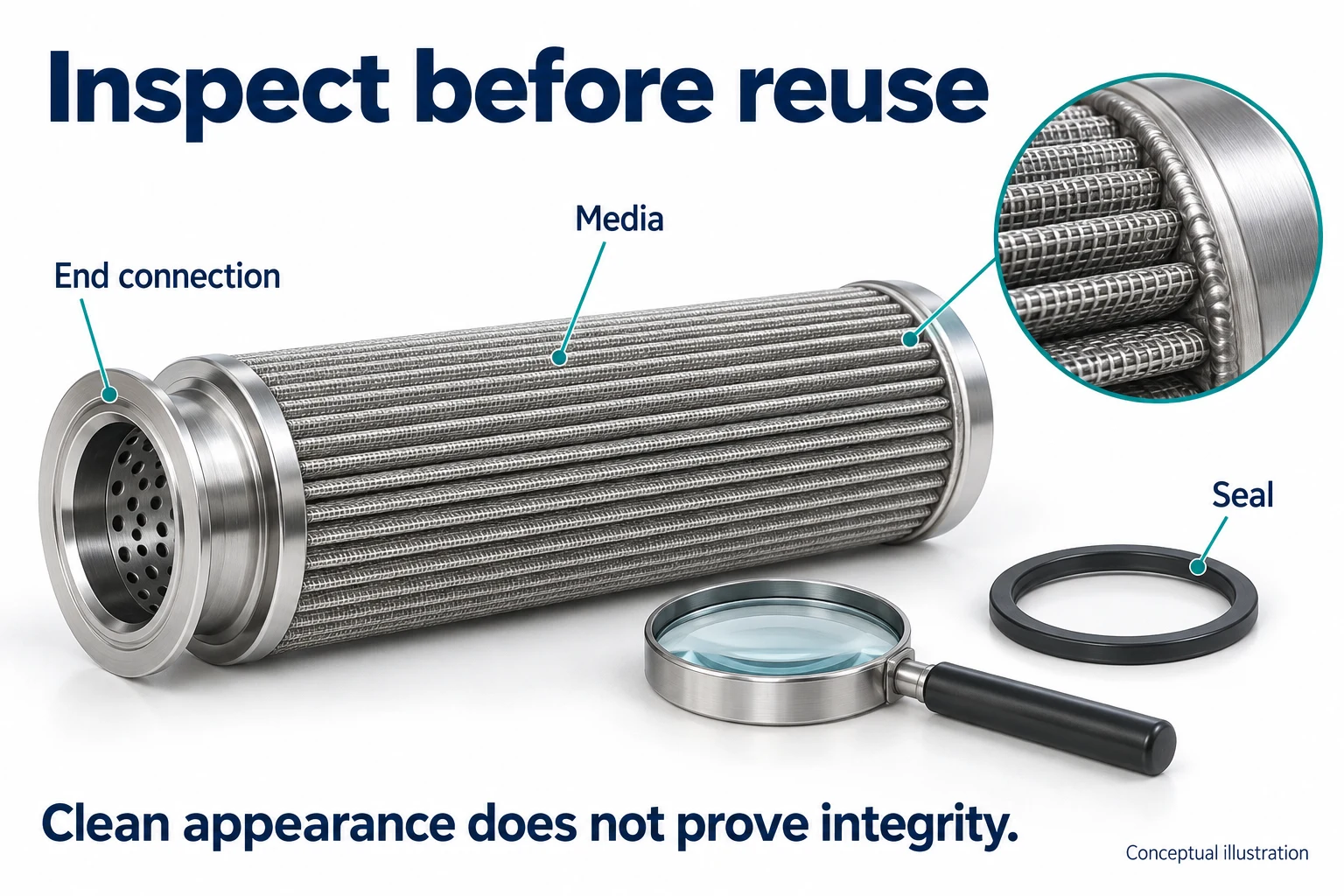
A restored clean pressure drop is encouraging but cannot rule out a leak path or damaged medium. Conversely, residual resistance needs investigation even if the element looks clean. Record the method, conditions, result and release decision so the next maintenance cycle has a valid comparison.
Pall's polymer element overview describes metal constructions intended for repeated cleaning. It supports treating cleanability as a construction-specific capability; it does not provide a lifetime or acceptance criterion for a SINFT element.
If the required verification is unavailable, do not invent a pass percentage or certify reuse by appearance. Ask the responsible supplier/equipment team for a disposition or use an approved replacement.
6. Apply the Criterion to the Actual Industrial Duty
Hydraulic oil, polymer melt and backwash service should not share an assumed maintenance limit. The consequence of pressure loss and the acceptance evidence differ by application.
In hydraulic and lubrication systems, coordinate filter service with the specified protection and operating requirements. Include cold starts in the assessment, but do not use a viscosity explanation to override an alarm. Record downstream operating conditions where they affect the equipment's required service response.
For polymer melt filtration, include polymer grade, temperature, throughput and product-quality requirements. The supported structure, contaminants and approved changeover procedure matter alongside differential pressure. A lower reading does not establish acceptable gel removal or product quality.
In backwash service, evaluate whether the approved cleaning cycle restores the expected behavior at comparable conditions. A recurring trigger can reflect an unresolved duty or cleaning problem. Increasing cleaning pressure, extending the cycle indefinitely or raising the trigger requires an approved review; it is not a default remedy.
What to Confirm Before RFQ
A replacement enquiry should state the operating duty and service criteria, not only the measured pressure. Send:
- Existing element and housing identification, drawings, sample or photographs.
- Medium, material, retention/rating basis and contaminant characteristics.
- Flow, temperature, viscosity and fluid composition at the relevant operating points.
- Clean and current differential readings, measurement locations and instrument details.
- Documented maintenance criterion, alarm response and applicable assembly limits.
- Bypass configuration, if any; do not assume it is built into every cartridge.
- Forward/reverse flow, cleaning method, cycle history and reuse acceptance results.
- Overall/active dimensions, OD/ID, end connection, seating datum and seal specification.
- Required quantity, traceability, inspection records and replacement urgency.
Identify missing or conflicting limits explicitly. Do not ask a replacement manufacturer to certify an unknown old element from nominal dimensions alone. Request confirmation of which ratings and tests apply to the offered construction and which decisions remain with the equipment owner.
How SINFT Can Help
SINFT can review drawings, samples, housing dimensions and service conditions for custom metal elements and replacement matching. Relevant constructions include pleated metal cartridges, sintered mesh and duty-specific backwash elements.
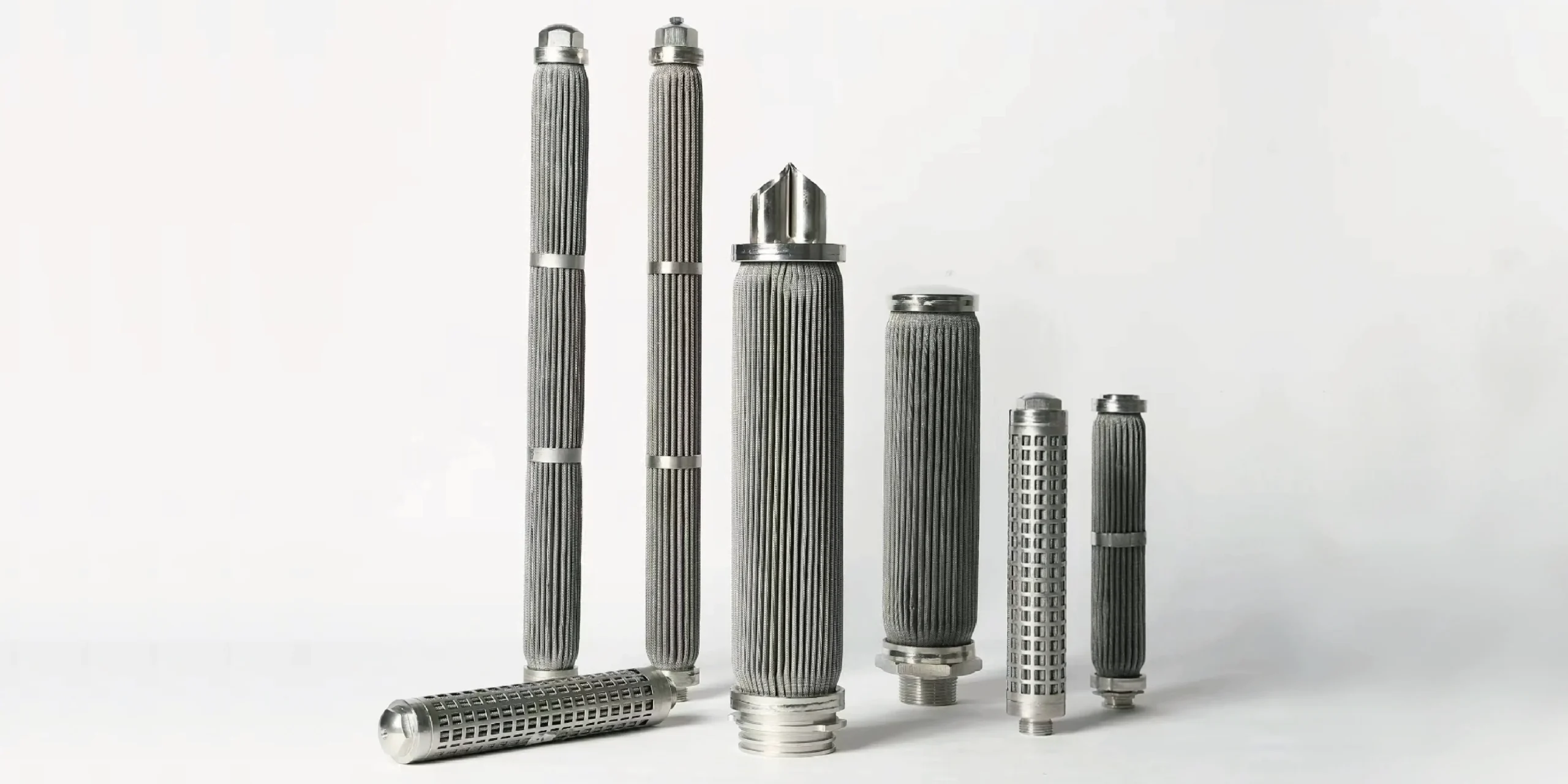
The review can address medium, materials, supporting structure, end fittings and relevant inspection/documentation requirements. Final service limits and cleaning suitability require confirmation for the offered assembly; the product family's maximum reference value is not a universal changeout setting.
Use the custom filter manufacturing service for drawing-based or old-sample replacements. Send the housing drawing and operating record, including the approved service criterion and cleaning history. Control settings, vessel approval and the plant's release-to-service decision remain with the responsible equipment/process team.
Frequently Asked Questions
Is there a standard replacement pressure for every filter element?
No universal value applies to every industrial element. Use the approved criterion for the exact filter assembly and duty, with its stated measurement conditions. Required flow, fluid properties, filtration target, bypass configuration and confirmed operating limits all matter. If the criterion is missing, obtain it from the responsible equipment or filter supplier rather than converting a catalogue maximum into a maintenance setting.
Is bypass pressure the same as replacement pressure?
No. Bypass cracking pressure describes when the specified valve begins opening, where one is fitted. A maintenance criterion defines the required service action and must be coordinated with that assembly's protection strategy. Do not wait for bypass as a routine replacement signal or assume cracking means full bypass capacity. Follow the documented alarm response and do not change valve settings without approval.
Can I keep running until the collapse rating is reached?
No. A collapse or burst rating is structural verification under stated conditions, not permission for routine operation at that pressure difference. Required downstream flow, filtration performance or another assembly limit may become unacceptable earlier. Use the approved maintenance and operating criteria. Also confirm temperature, flow direction and the exact tested construction rather than transferring one rating to another element or cleaning duty.
Should a metal element be cleaned or replaced at the service trigger?
That depends on whether the particular construction and contamination are approved for cleaning. A reusable element may be removed for an established cleaning process, followed by the required acceptance checks. A disposable element, damaged assembly or element that fails those checks needs replacement or an approved disposition. Being made of stainless steel does not by itself establish cleanability or indefinite reuse.
Does normal pressure drop after cleaning prove the element is good?
No. Restored pressure drop indicates acceptable resistance only under the measured conditions. It does not rule out damaged media, leakage, incorrect seating or residual contamination. Use the agreed flow, integrity, dimensional and cleanliness checks for that construction. If the required evidence is missing, obtain a supplier or equipment-team disposition rather than treating a low reading or clean appearance as a complete acceptance test.
What if the alarm appears only during cold startup?
Cold fluid viscosity can contribute to a high differential reading, but that explanation does not override the equipment's protection procedure. Record actual flow, temperature and pressure, then compare against valid clean reference data when the procedure permits. Check instrument behavior and approved startup logic. Do not disable an alarm, raise a threshold or force full flow solely to remove the indication.
Final Thoughts
A useful replacement limit connects a defined filter assembly with a required maintenance action. Keep it separate from bypass behavior and structural test ratings, interpret readings at the stated conditions and verify a cleaned element before reuse. For replacement planning, submit the operating record, approved criteria and installation drawing together. That gives the supplier a clear duty to review while keeping equipment protection and release decisions properly defined.