If you are choosing a sintered mesh filter element, the phrase “5 layer” is useful but not enough for purchasing. The same layer count can behave differently when the weave, flow direction, alloy, thickness, support tube, weld design, and cleaning method change. The safer question is what each layer must do in your actual filter assembly.
Direct Answer: What Is 5 Layer Sintered Wire Mesh?
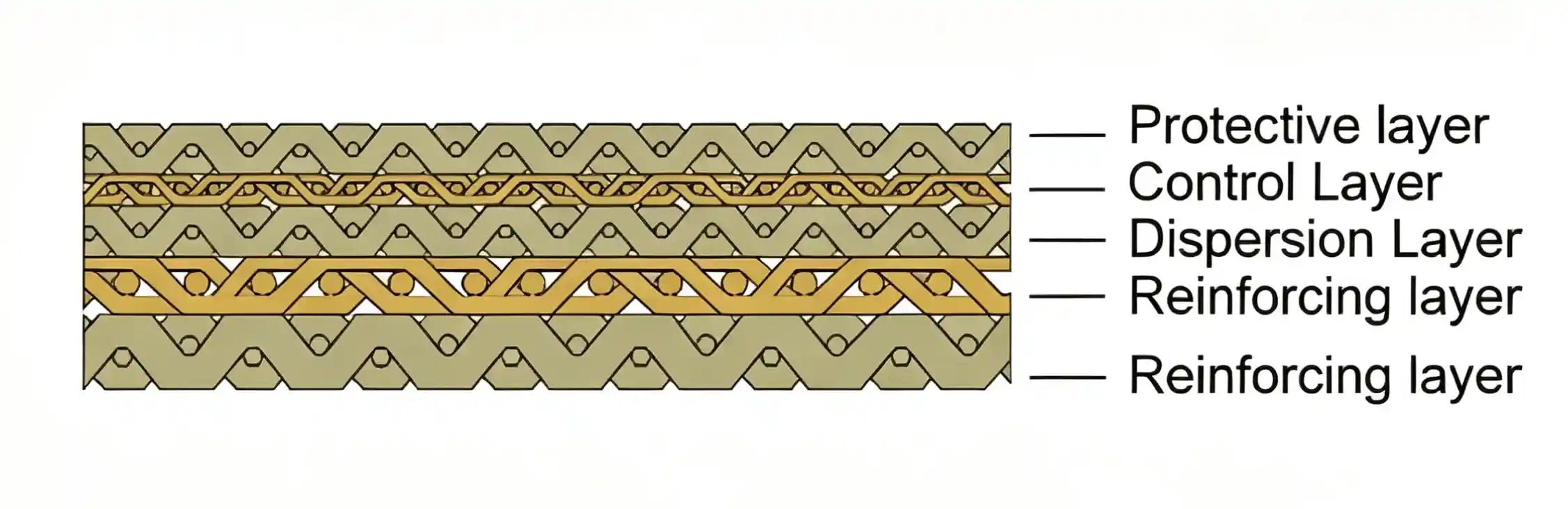
A standard 5 layer sintered wire mesh combines a fine control layer with protective, dispersion, and reinforcing meshes that are diffusion-bonded into one porous metal laminate. The control layer establishes the filtration opening; the adjacent meshes protect it, distribute load and flow, and give the laminate enough stability for forming, welding, cleaning, and use in a finished filter element.
Five layers do not automatically make a filter more accurate, lower in pressure drop, or suitable for every pressure and backwash condition. Performance depends on the weave and wire specification of each layer, layer order, alloy, thickness, flow direction, finished-element geometry, supports, joints, and test method. You should specify the required result rather than ordering “standard five-layer mesh” without a construction drawing.
5 Layer Sintered Wire Mesh at a Glance
The five layers divide filtration and structural duties instead of asking one fine mesh to perform every function.
| Typical layer function | Main duty | What the buyer should confirm |
|---|---|---|
| Protective layer | Shields the fine control mesh from handling, abrasion, and direct particle impact | Raw or clean side, weave, wire diameter, and compatibility with cleaning |
| Control or filter layer | Defines the separation opening and primary retention behavior | Rating definition, weave, aperture or pore characterization, and integrity test |
| Dispersion or separation layer | Separates fine and coarse meshes and spreads flow or load | Open area, permeability, and effect on pore support |
| Reinforcing layer | Carries differential-pressure and fabrication loads | Mesh orientation, wire size, formed diameter, and weld design |
| Second reinforcing/support layer | Adds stability and supports drainage or welding | Orientation relative to the first support layer and required reverse-load behavior |
Layer names are not fully standardized across suppliers. One manufacturer may call the third layer a protection layer; another may call it separation, dispersion, or drainage. The drawing, mesh specifications, and stated flow direction are more reliable than the label alone.
What Is 5 Layer Sintered Wire Mesh?
Five-layer sintered wire mesh is a laminate of five woven metal meshes permanently bonded at their contact points by a controlled diffusion process.
Sintering does not turn the assembly into a solid sheet. The connected pore network remains open, while the bonded wire contacts reduce relative layer movement and help preserve the intended geometry under fabrication and service loads.
Haver & Boecker’s POROSTAR wire mesh laminates provide a manufacturer example of configurable multilayer constructions. Its standard laminate can use five or six layers, while lighter, high-flow, or perforated-metal-supported versions use different structures for different mechanical and hydraulic needs.
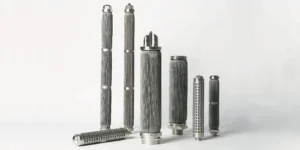
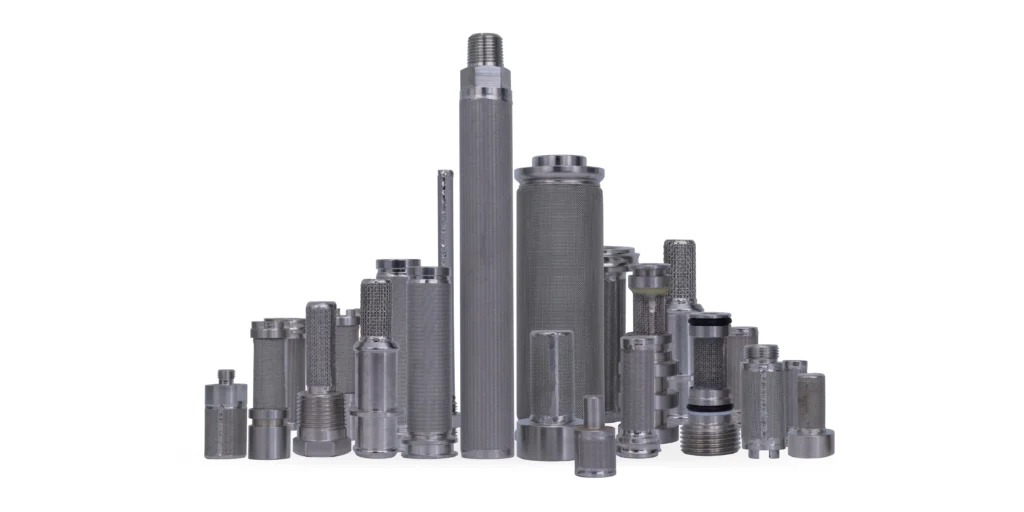
SINFT sintered mesh filter elements can use 2–7 layers, with a five-layer structure being a common option. The confirmed product family covers 1–200 µm ratings and 0.5–5.3 mm common thicknesses, but those ranges describe the family—not every five-layer combination.
What Does Each Sintered Mesh Layer Do?
The control layer performs the separation, while the other layers keep that fine mesh usable as an industrial filter medium.
1. Protective layer
The protective mesh is commonly placed on the side exposed to incoming contaminant. It reduces direct mechanical damage to the fine filter layer during handling, forming, installation, and service. Its openings must be coarse enough not to become the unintended controlling restriction.
Protection is application-specific. Abrasive solids, scraping during cake discharge, aggressive backwash, or frequent manual handling may require a different protective arrangement from clean-gas or low-solids liquid service.
2. Control or filter layer
The control layer contains the weave selected to establish the primary retention behavior. Depending on the design, it may be a square weave, Dutch weave, or another precisely specified woven cloth.
Do not infer finished-element efficiency from mesh count alone. Request the aperture, nominal or absolute rating definition, efficiency or beta ratio where relevant, and the test performed on the media or finished element. The filter micron rating chart explains why mesh opening, nominal rating, absolute rating, efficiency, and beta ratio are not interchangeable terms.
3. Dispersion or separation layer
This intermediate mesh prevents the fine control layer from sitting directly against a much coarser support. It can distribute load, maintain drainage space, and reduce local deformation at the contact pattern. Its influence on flow resistance and support must be evaluated as part of the laminate rather than treated as an inactive spacer.
4 and 5. Reinforcing layers
The coarser reinforcing meshes provide bending stiffness, dimensional stability, and a structure that can be cut, rolled, welded, or formed into a component. Their mesh directions may be arranged differently to balance the laminate and improve support.
Haver & Boecker’s POROSTAR brochure illustrates one five-layer sequence as protection, filter, protection, support, and a second support layer oriented at 90 degrees. SINFT’s diagram uses protective, control, dispersion, and two reinforcing layers. Both show the same engineering principle: filtration and mechanical duties are distributed across different meshes.
Which Side Faces the Incoming Fluid?
The approved flow direction should be shown on the laminate or finished-element drawing; it should not be guessed from surface appearance.
In a common surface-filtration arrangement, contaminated fluid reaches the protective side first, particles are retained at or near the control layer, and filtrate exits through the coarser support structure. That orientation gives the fine layer upstream protection while the reinforcing layers carry the downstream load.
However, the required orientation can change with:
- Inside-out versus outside-in cartridge flow
- Normal filtration versus reverse backwash
- Location of a perforated support tube or plate
- Which side must release the filter cake
- Differential-pressure direction
- Whether the laminate is symmetrical
- Weld and end-hardware design
Mark the normal flow arrow, backwash direction, and dirty/clean sides on the drawing. If the process can reverse unintentionally, specify the maximum reverse differential pressure and validate the finished element for that load.
Why Sinter Five Layers Instead of Using One Mesh?
A multilayer laminate lets a fine filter cloth retain its filtration function while coarser meshes supply protection and strength.
Compared with a loose or unsupported fine woven screen, an appropriate sintered laminate can provide:
- Reduced movement between wires and layers
- More stable pore geometry under mechanical load
- Improved handling during cutting, rolling, and welding
- A self-supporting or more easily supported element structure
- A defined drainage path behind the control layer
- Better suitability for controlled backflushing and repeated cleaning
- Greater resistance to fraying at fabricated edges
Pall describes Rigimesh sintered woven wire mesh as wire mesh bonded at its contact points so the wires do not shift under stress. Pall also states that multilayer composites can be configured for application-specific flow, pressure drop, thickness, or strength.
These advantages are conditional. A poorly selected laminate can still have excessive pressure drop, trap sticky solids, crack at a weld, deform under reverse load, or be difficult to clean. The complete element—not the raw sheet alone—must be qualified.
Is Five-Layer Mesh Always the Best Sintered Structure?
No. Five-layer mesh is a versatile baseline, but lighter, higher-flow, finer Dutch-weave, or perforated-supported structures may better fit a specific duty.
If your process needs a rigid, cleanable metallic surface with balanced support, a five-layer laminate is often a practical starting point. If your main problem is very low pressure drop, extremely fine retention, high reverse differential pressure, or sticky contaminant release, the layer count should be compared with other laminate structures before the element is approved.
| Construction | Evaluate it when | Main trade-off to confirm |
|---|---|---|
| Standard five-layer laminate | Balanced filtration, protection, formability, and structural support are required | Pressure drop and formed-part strength for the actual layer set |
| Three-layer or light laminate | Small formed diameter, pleating, or lower sheet thickness is important | Reduced structural reserve compared with a heavier laminate |
| All-square-weave laminate | High permeability and open flow paths are priorities | Whether the required fine retention can be achieved |
| All-Dutch-weave laminate | Fine woven control and stable pore structure are required | Higher resistance and cleaning behavior |
| Perforated-metal-supported laminate | High differential or reverse-direction support is required | Added thickness, weight, blocked area, and forming limits |
| Six- or seven-layer laminate | Additional drainage, protection, or strength is needed | Higher resistance, stiffness, cost, and weldability |
Mott’s SM Series sintered wire mesh cartridges are a manufacturer example of self-supporting five-layer elements. Haver & Boecker separately describes light, high-flow, standard, and perforated-supported POROSTAR variants, demonstrating that layer count is only one design variable.
How Does Layer Design Affect Pressure Drop?
Pressure drop is determined by the resistance of the entire pore path, not simply by the number of layers.
Important variables include:
- Control-layer weave and opening
- Wire diameter and open area of every layer
- Laminate thickness and compression
- Layer alignment and contact pattern
- Fluid viscosity, density, and temperature
- Gas compressibility where applicable
- Flow per unit active area
- Support tube, perforated plate, housing, and valve restrictions
- Clean versus contaminated condition
A five-layer laminate with an open control weave can be more permeable than a thinner but tightly woven Dutch-weave structure. Conversely, adding coarse support layers still adds resistance and may block part of the open area at contact points.
ISO 3968:2017 provides a hydraulic-filter method for evaluating differential pressure versus flow at different flow rates and viscosities. For other fluids, use the same discipline: compare curves only when fluid condition, temperature, element area, housing, and measurement boundaries are defined. The published filter pressure drop vs flow rate guide provides the full sizing framework.
How Should Filtration Integrity Be Verified?
Verify both the porous medium and the fabricated joints because a precise control layer cannot prevent bypass through a defective seam or end connection.
Depending on the application and purchase specification, validation may include:
- Dimensional inspection and layer-orientation confirmation
- Material certificate or alloy verification
- Visual and weld inspection
- Bubble-point or fabrication-integrity testing
- Air-permeability or clean pressure-drop testing
- Particle-removal efficiency testing under an agreed method
- Forward and reverse differential-pressure qualification
- Post-cleaning comparison with the new-element baseline
ISO 2942:2018 covers fabrication integrity and first-bubble-point determination for hydraulic filter elements. Bubble point can support integrity checking and largest-pore characterization under the stated method; it is not automatically a functional filtration-efficiency or dirt-capacity rating.
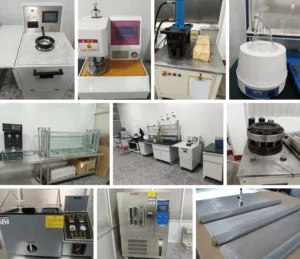
SINFT lists bubble-point, burst-pressure, air-permeability, dimensional, material, metallographic, and pore-integrity checks among its available quality-control capabilities. The required inspection and acceptance criteria should be stated in the order.
Where Is Five-Layer Sintered Mesh Used?
Use five-layer sintered mesh where stable metallic surface filtration, fabrication strength, and cleanability matter more than maximum depth-loading capacity.
Possible finished forms include:
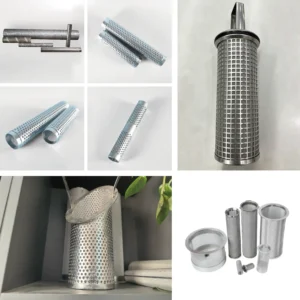
- Smooth cylindrical cartridges
- Filter candles and tubes
- Discs and flat panels
- Cones and baskets
- Pleated sintered-mesh cartridges
- Welded custom assemblies
For hydraulic and lubrication duty, review the sintered mesh hydraulic application page together with the required cleanliness, flow, viscosity, pulsation, and differential pressure. For automated cleaning, the self-cleaning and backwash application page should be evaluated with the reverse-flow load and cake-release behavior.
If the actual decision is between a rigid sintered laminate and a high-area pleated cartridge, use the published sintered mesh vs pleated filter guide. If the contaminant may benefit from depth capture rather than surface cake formation, review surface filtration vs depth filtration.
Common Specification Mistakes
Most errors come from ordering a layer count without defining what each layer must achieve.
Avoid:
- Treating every five-layer laminate as the same construction
- Assuming the top layer in a diagram is always the process inlet side
- Specifying mesh count without wire diameter, weave, or rating definition
- Applying raw-media strength to a welded finished cartridge
- Ignoring reverse-flow and backwash differential pressure
- Comparing pressure-drop data at different viscosities or areas
- Selecting alloy while ignoring weld filler, end hardware, and seals
- Assuming more layers always mean better filtration
- Using bubble point as the only proof of filtration efficiency
- Omitting flatness, thickness, forming radius, or weld requirements
The stainless steel filter cleaning guide explains how to define cleaning conditions and post-cleaning acceptance without assuming unlimited reuse.
RFQ Checklist for Engineers and Buyers
A useful five-layer sintered mesh RFQ defines media performance, laminate construction, finished geometry, and process conditions together.
If you want the supplier to recommend a usable finished element rather than only quote sheet material, provide:
- Fluid or gas composition, viscosity, and operating temperature
- Contaminant type, particle distribution, concentration, and cake behavior
- Required rating and its nominal, absolute, efficiency, aperture, or test definition
- Minimum, normal, and maximum flow
- System pressure and allowable forward and reverse differential pressure
- Normal flow direction, dirty side, clean side, and backwash direction
- Required layer sequence, weave, wire specification, alloy, and thickness if already defined
- Element OD, ID, length, shape, active area, and support arrangement
- DOE, 222, 226, threaded, flanged, or custom end connection and seal details
- Welding, forming, surface finish, cleaning, and passivation requirements
- Inspection method, acceptance criteria, certificates, and traceability
- Drawing, old sample, housing dimensions, quantity, and operating history
The published 222 vs 226 filter cartridge guide explains why the outlet adapter, O-ring size, locking features, closed end, and insertion depth must be specified separately.
SINFT’s custom filter manufacturing service can review the laminate, formed geometry, support, welds, end connection, and inspection plan. To request a feasibility review, send the process data and drawings.
How SINFT Can Help With Five-Layer Sintered Mesh Elements
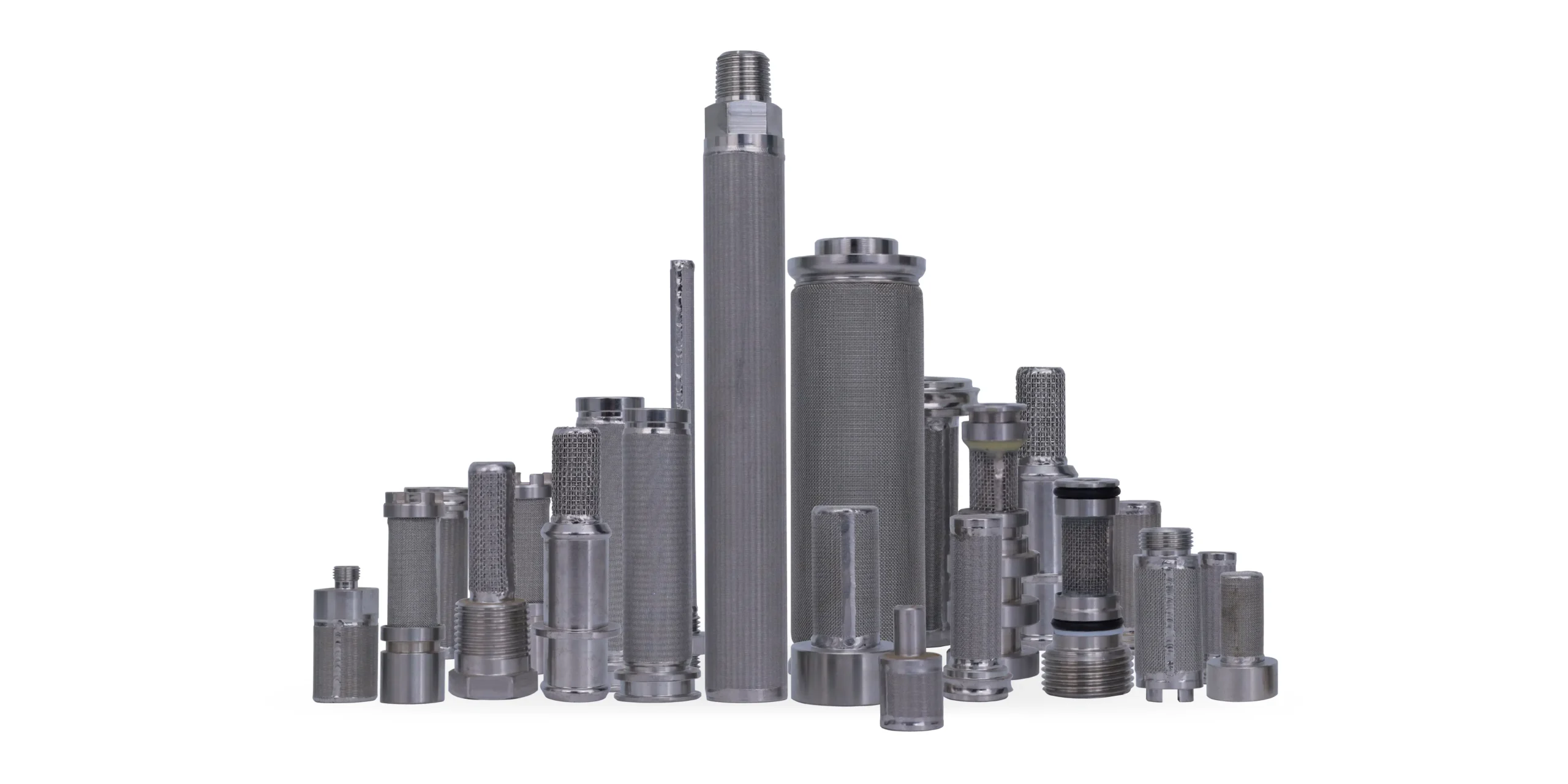
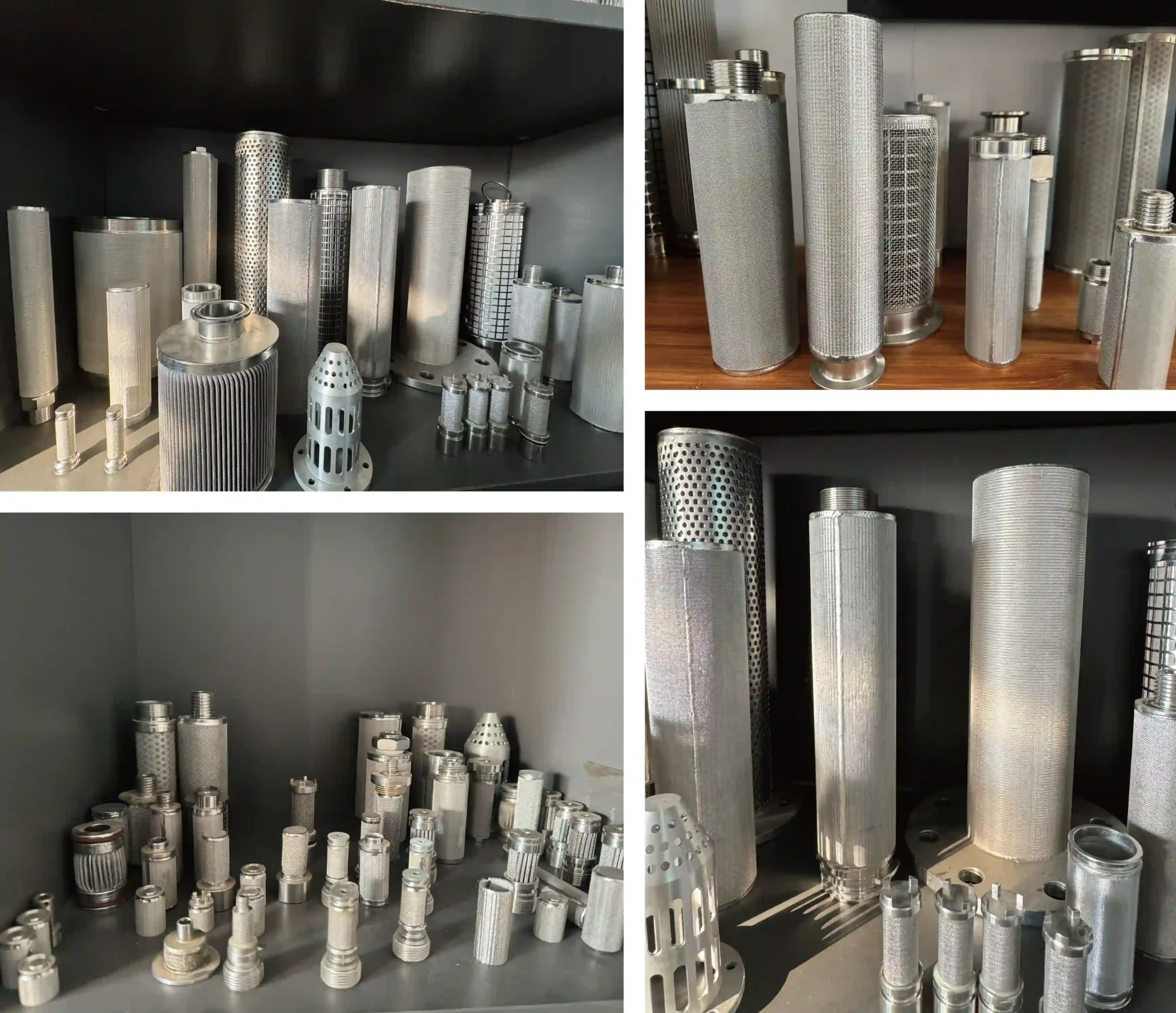
SINFT can manufacture sintered mesh filter elements using 2-7 layer structures, including standard five-layer laminates, when the media, geometry, flow direction, connection, and inspection requirements are defined. The confirmed product family includes cylindrical cartridges, filter tubes, discs, cones, panels, baskets, pleated elements, and custom welded assemblies.
For a new design or replacement, SINFT can review your drawing, old sample, housing dimensions, fluid, contaminant, required rating, flow, temperature, differential pressure, cleaning method, and documentation needs. This helps decide whether a five-layer laminate is enough, whether a perforated support is needed, or whether another sintered mesh structure fits the duty better.
Frequently Asked Questions
What are the five layers in sintered wire mesh?
A common arrangement uses one protective layer, one control or filter layer, one dispersion or separation layer, and two reinforcing layers. Names and order vary by manufacturer, so the approved drawing should define each mesh, weave, wire specification, thickness, and flow direction. Do not assume that two “five-layer” laminates are equivalent unless the actual layer specifications match.
Which layer determines the micron rating?
The control or filter layer normally establishes the primary retention opening. Finished performance still depends on the rating definition, layer support, fabrication integrity, seals, and test method. When you request a quotation, clarify whether the rating means aperture, nominal rating, absolute rating, efficiency, beta ratio, or another agreed test result.
Is five-layer sintered mesh a depth filter?
Standard five-layer woven-mesh laminates are commonly used for surface filtration because a defined control layer retains particles at or near its surface. It should not be treated as equivalent to a random-fiber depth medium. If your contaminant should load through a porous matrix rather than form a removable surface cake, compare sintered mesh with sintered fiber felt or another depth media.
Can five-layer sintered mesh be backwashed?
It can be suitable for backwashing when the layer orientation, support, welds, end hardware, and finished element are qualified for the specified reverse flow and differential pressure. Backwash capability is not guaranteed by layer count alone. You should define normal flow, backwash direction, contaminant release behavior, maximum reverse differential pressure, and post-cleaning acceptance criteria.
Does adding more layers improve filtration accuracy?
Not automatically. The control-layer weave and the agreed rating method determine retention. Additional layers usually provide protection, support, drainage, or strength, and may also increase pressure drop. A six- or seven-layer structure may be useful for added support, but it should be selected for a specific mechanical or hydraulic reason, not because more layers sound more precise.
What information is needed to manufacture a five-layer filter element?
Provide the fluid, contaminant, rating definition, flow, viscosity, temperature, forward and reverse differential pressure, layer specification, alloy, thickness, dimensions, flow direction, connection, seal, cleaning method, drawing, and inspection requirements. For custom elements, include housing dimensions or an old sample so the supplier can evaluate fit, weld design, active area, support, and inspection requirements together.
When should I choose a custom sintered mesh filter element?
Choose a custom element when catalog dimensions, end connections, support structures, alloy options, or inspection requirements do not match your housing or process. Custom work is also useful when you need to copy an old element, change from disposable media to reusable metal media, add a special flange or thread, or validate the element for cleaning, reverse flow, or non-standard geometry.
Final Thoughts
A 5 layer sintered wire mesh works best when each layer has a defined job and the finished element is specified around the real process. Use the standard structure as a starting architecture, not a complete purchase specification. If your project depends on rating definition, flow direction, cleaning, reverse load, alloy, or custom geometry, SINFT can review the application before recommending a sintered mesh element.