If two filter elements have the same micron rating, one may still flow more easily than the other. The difference often sits in the media structure: pore path, porosity, thickness, pleating, support layers and contamination loading. A filter element air permeability test helps compare that flow resistance, but only when the test condition is clear enough to mean something in real purchasing.
Direct Answer: What Does a Filter Element Air Permeability Test Tell You?
A filter element air permeability test measures how readily air passes through filter media or a filter element under defined conditions. It helps compare clean media resistance, batch consistency, clogging tendency and cleaning recovery. It does not directly prove particle retention, micron rating, liquid pressure drop, burst strength, chemical compatibility or service life.
For custom stainless steel filter elements, air permeability should be read together with filtration rating, media type, active area, flow direction, fluid viscosity, temperature, pressure drop, support design and the finished element geometry.
Air Permeability vs Filtration Rating
Air permeability is a flow measurement. Filtration rating is a retention measurement. They are related, but they are not interchangeable.
| Question | Air permeability answers | It does not answer alone |
|---|---|---|
| How easily does air pass through the clean media? | Yes, under stated test conditions | Real liquid flow at process viscosity |
| Is one media grade more restrictive than another? | Often, if tested the same way | Which one removes the target contaminant better |
| Did cleaning restore part of the open pore structure? | It can help compare before/after condition | Whether all embedded particles or chemical residues are removed |
| Is a filter element strong enough for pressure load? | No | Collapse or burst pressure rating |
| Is the largest pore within an agreed limit? | No | Bubble point or other pore-size/integrity data |
This is the buying trap: a more permeable element may have lower resistance, but it may also have larger or more open flow paths. A less permeable element may provide finer retention, but it may load faster or create higher pressure drop. The correct decision is not “higher permeability is better.” It is whether the permeability, retention and dirt-loading behavior fit the process.
What Is Measured in an Air Permeability Test?
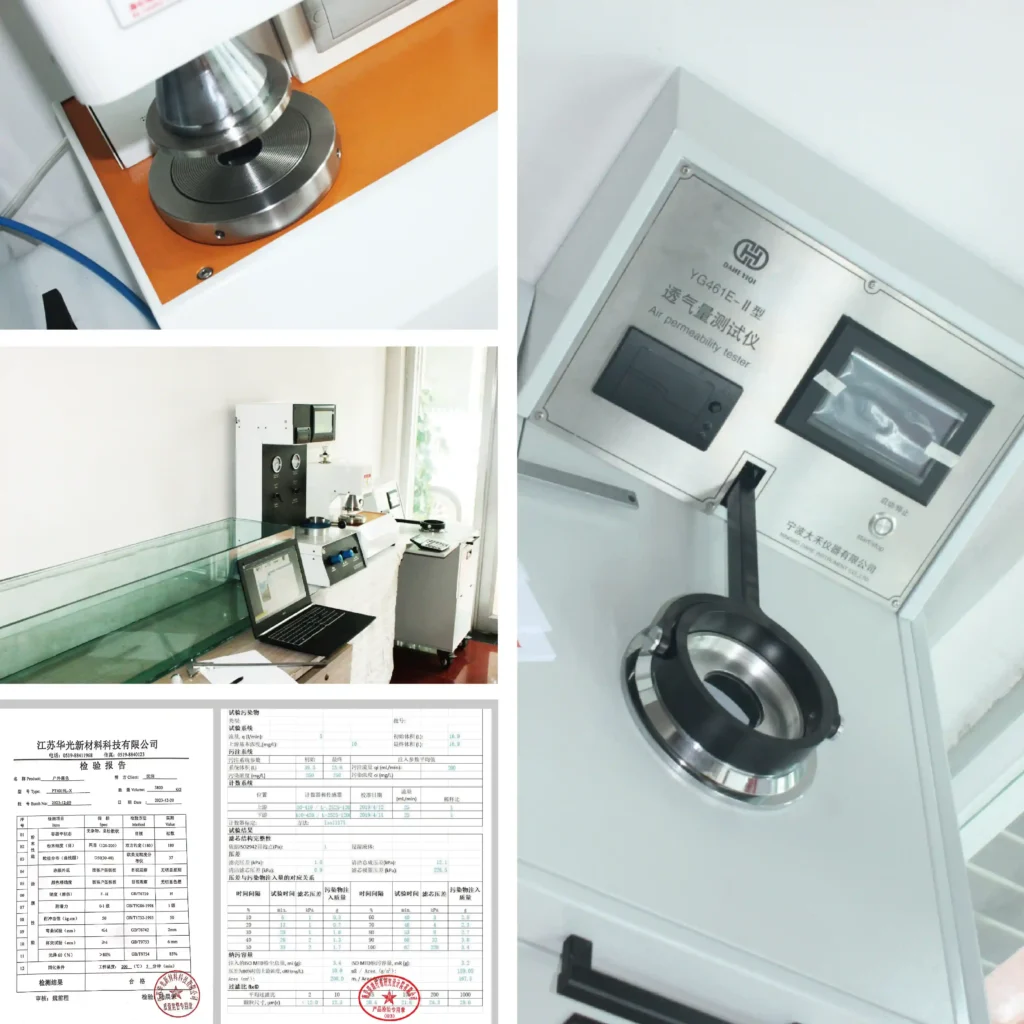
An air permeability test normally measures airflow through a known area of media or element at a specified pressure difference. The result is meaningful only when the report states how the test was done.
Important test conditions include:
- sample or finished element identification;
- test area or element geometry;
- air pressure or differential pressure;
- flow unit and reporting basis;
- temperature and condition of the sample;
- dry, cleaned, contaminated or as-manufactured state;
- flow direction, if the media is directional;
- test standard or internal method;
- acceptance limit or comparison sample.
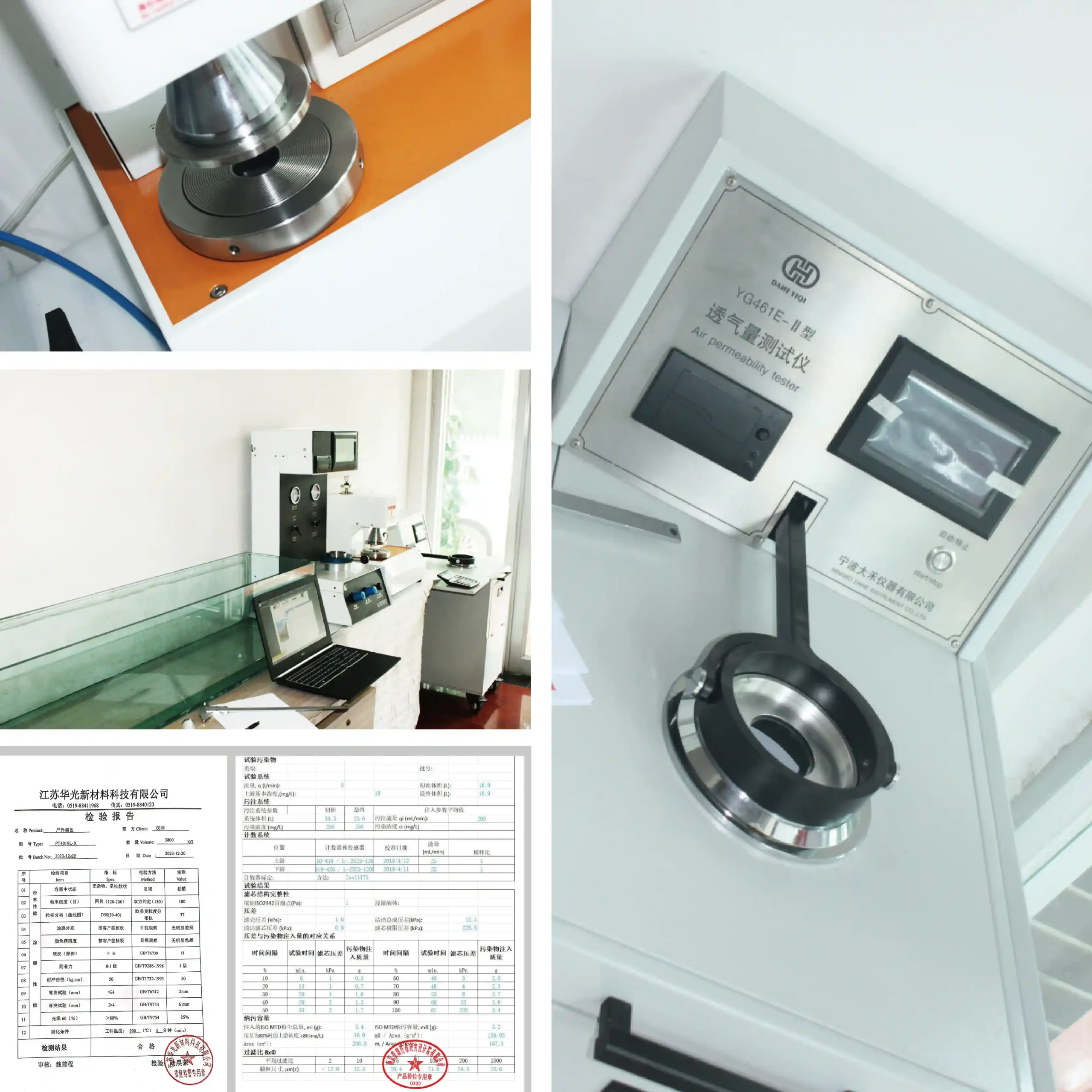
If a supplier writes “high permeability” without conditions, the statement is weak. If the supplier provides permeability under a stated method and can connect it to the selected media, active area and pressure-drop requirement, the data becomes useful.
Standards That Help Frame Permeability Testing
For permeable sintered metal, ISO 4022:2018 specifies a method for determining fluid permeability where porosity is deliberately continuous or interconnected. ISO describes the result in terms of viscous and inertia permeability coefficients. This is highly relevant to sintered metal media, but the test scope and specimen geometry still matter.
For hydraulic filters, ISO 3968:2017 covers differential pressure versus flow characteristics. It is not an air-permeability standard, but it is useful because it reminds buyers that flow comparison depends on defined flow rate, viscosity, temperature, filter assembly and valves in the flow stream.
For fabric-type permeability language, ISO 9237:1995 describes air permeability testing for fabrics, including technical fabrics, nonwovens and permeable made-up textile articles. ASTM D737 is another widely used air-permeability test method for textile fabrics and notes that air permeability is relevant in filtration, while fabric construction and finishing can strongly affect airflow.
These references should not be forced onto every metal filter element. They are best used as discipline: define the method, avoid vague claims and compare only like with like.
Air Permeability vs Bubble Point
Air permeability and bubble point testing should answer different questions.
Air permeability asks: how easily does air pass through the porous structure under a defined pressure difference? Bubble point asks: at what pressure does gas first pass through the largest wetted pore path under a defined wetting condition?
SINFT’s bubble point test guide explains why bubble point supports integrity and largest-pore review, but should not be treated as a complete filtration rating. Air permeability has a similar boundary. It supports media and flow comparison, but it does not prove filtration efficiency.
If you are approving a high-value element, the two tests may complement each other: bubble point can help screen for abnormal large pores or leakage paths, while permeability can help compare flow resistance and cleaning recovery.
Air Permeability vs Pressure Drop
Air permeability is often used as an early indicator of flow resistance, but installed pressure drop is broader. Pressure drop across a real filter depends on the media, active area, pleat spacing, core, guard, housing ports, flow distribution, fluid viscosity, temperature and contaminant loading.
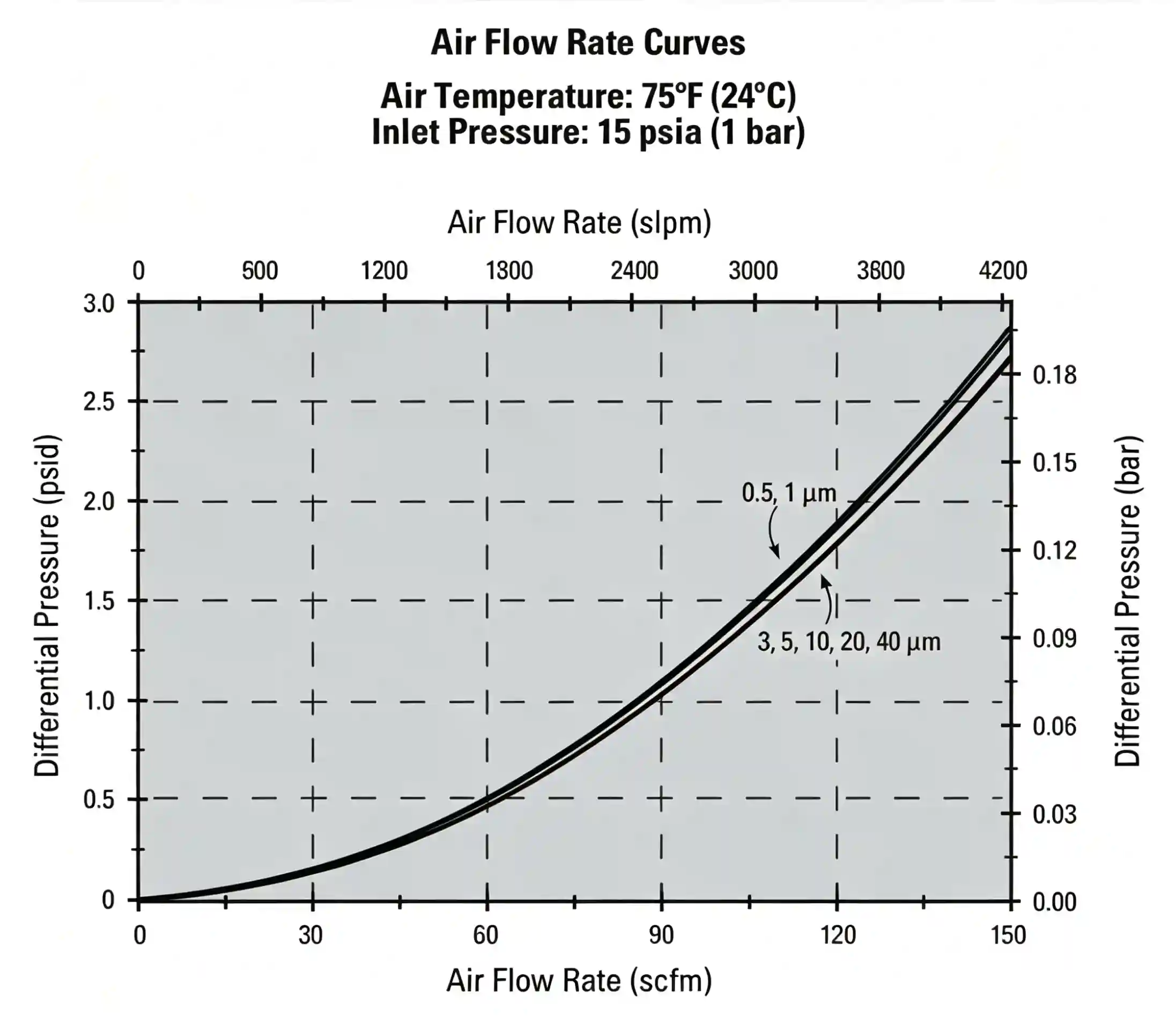
For system sizing, use SINFT’s filter pressure drop vs flow rate guide. For media comparison, permeability can help you ask better questions before the pressure-drop curve is finalized.
How Permeability Changes by Filter Media
Media structure controls both permeability and retention. That is why two filters with similar micron language may behave differently in the same housing.
| Media or construction | Permeability behavior to review | Selection caution |
|---|---|---|
| Sintered mesh | Layer count, control weave, thickness and support layers affect airflow | A strong layered structure may add resistance if the grade is too fine |
| Sintered fiber felt | High porosity can support lower clean resistance and depth loading | Embedded particles may reduce cleaning recovery |
| Pleated metal cartridge | Added area can reduce flow per unit area | Tight pleats, restrictive cores or guards can reduce the area advantage |
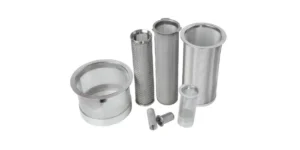
| Woven mesh liner | Open area and wire diameter strongly affect airflow | Mesh count alone does not define permeability |
| Perforated basket | Hole size, pitch, thickness and open area dominate coarse flow | Fine retention usually needs a separate liner |
| Wedge wire or notch wire | Slot width, open area and flow direction control surface flow | Slot size is usually more useful than air permeability for coarse screens |
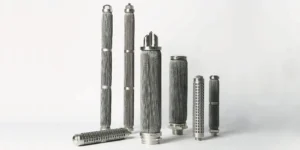
For sintered mesh filter elements, SINFT’s confirmed product information includes multilayer sintered stainless steel woven mesh and common five-layer structures. For sintered fiber felt filters, the product information highlights random metal fiber structure, depth filtration and high porosity depending on grade and structure. Those differences are exactly why permeability data should be tied to the chosen media family.
When Should You Request an Air Permeability Test?
You should request air permeability data when the buying risk is flow resistance, batch consistency, media comparison or cleaning recovery.
It is especially useful when:
- choosing between sintered mesh and sintered fiber felt;
- checking whether a cleaned reusable cartridge has recovered flow capacity;
- comparing two media grades with similar nominal micron ratings;
- qualifying a supplier for repeat batches;
- converting from disposable media to a cleanable metal cartridge;
- reviewing gas, steam, compressed air, hot gas or vent filtration duty;
- investigating high clean pressure drop before installation;
- preparing inspection requirements for OEM filter elements.
For pleated filter cartridges, permeability should be reviewed with pleat area, core design and seal fit. For backwash filter cartridges, also confirm whether retained solids can release during reverse flow or air blowing.
How to Use Permeability Data for Cleaning Decisions
For reusable metal elements, air permeability can help compare a used element before and after cleaning. It gives a practical signal: has enough open flow path been restored for further evaluation?
But it should not be the only acceptance rule. A cleaned element may recover airflow and still have damaged media, corrosion, embedded contaminant, changed pore structure or weak welds. The stainless steel filter cartridge cleaning guide explains why cleaning success should be judged by pressure drop, visible condition, process cleanliness and inspection records together.
If your plant uses repeated cleaning, ask for a baseline from a clean approved element. Then compare later test results against the same method. Changing the test pressure, area or direction can make the before/after comparison misleading.
Application Advice
For polymer melt filtration, permeability matters because viscous flow, gels and fine contaminants can drive pressure drop quickly. A metal fiber felt or staged metal media design may be useful, but the decision should include viscosity, temperature, contaminant behavior, cleaning method and allowable pressure rise.
For hydraulic and lubrication systems, permeability must be balanced with particle-removal performance and collapse resistance. A filter that flows easily but misses the target contaminant can damage components. A filter that is too restrictive may open bypass, shorten service interval or increase energy loss.
For food and beverage filtration or petrochemical filtration, permeability can support material and media comparison, but chemical compatibility, cleanability, passivation, surface condition and documentation may be just as important.
What Buyers Should Confirm Before RFQ
Before asking for permeability data, send enough information for the supplier to match the test to the application:
- filter type: cartridge, disc, tube, candle, basket, panel or custom assembly;
- media type: sintered mesh, fiber felt, woven mesh, pleated metal, perforated plate or slot screen;
- required micron rating and whether it is nominal, absolute or supplier-specific;
- fluid, gas, steam or polymer medium;
- viscosity, temperature and operating pressure;
- normal flow rate and acceptable clean pressure drop;
- terminal differential pressure or cleaning trigger;
- flow direction and any reverse-flow cleaning;
- contaminant type, particle load and plugging behavior;
- old sample, drawing, housing dimensions or part number;
- material requirement, such as SS304, SS316L, FeCrAl or special alloy;
- required documents, such as material certificate, dimensional inspection report, permeability report, pressure test certificate, passivation record or batch traceability records.
If you need a replacement element, do not only send a micron number. Send the old element photos and any service problem: high pressure drop, short life, poor cleaning recovery, media collapse, bypass, corrosion or contaminant leakage.
How SINFT Can Help With Permeability-Sensitive Filters
SINFT manufactures custom stainless steel filter elements and can review permeability together with media selection, element geometry, pressure drop, cleaning method and inspection needs. Confirmed capabilities include air permeability testing, bubble point testing, burst pressure testing, dimensional inspection, material spectrometry, metallographic analysis, pore or slot integrity verification, passivation and surface-cleanliness inspection, batch traceability and inspection documentation.
For media selection, the custom filter manufacturer service is the right starting point when you need made-to-drawing elements, old-sample replacement, special materials, non-standard interfaces or documented inspection. For a current project, send the process details through the contact inquiry form.
The goal is not to maximize air permeability blindly. The goal is to select the most open structure that still protects the downstream process, cleans acceptably and fits the pressure-drop budget.
Frequently Asked Questions
Is air permeability the same as pressure drop?
No. Air permeability measures how readily air passes through media or an element under a stated test condition. Pressure drop is the resistance across a real filter assembly at a defined flow, fluid, viscosity, temperature and loading condition. Permeability can inform pressure-drop selection, but it cannot replace an application-specific pressure-drop curve.
Does higher air permeability mean better filtration?
Not automatically. Higher permeability may mean lower resistance, but it may also mean larger flow paths or less restrictive media. Better filtration depends on the particle target, retention method, efficiency requirement, dirt loading, pressure drop and cleaning strategy. Choose the media that balances retention and flow, not the one with the highest airflow number.
Can air permeability prove micron rating?
No. Air permeability does not prove micron rating or particle-removal efficiency. Two media with similar airflow can have different pore structures and retention behavior. If the micron rating matters, ask how it was defined and whether it is nominal, absolute, bubble-point related, multi-pass tested or based on a supplier-specific method.
Why does test pressure matter in permeability testing?
The reported flow depends on the pressure difference used during the test. If two suppliers test at different pressure drops, their numbers may not be directly comparable. A useful report should state the test pressure, sample area, air condition, media state and method so the buyer can compare results fairly.
Can air permeability testing check cleaning recovery?
Yes, it can help compare airflow before and after cleaning when the same method is used. However, cleaning recovery should not rely on permeability alone. Also check pressure drop, visible damage, corrosion, bubble point or integrity when relevant, and whether the cleaned element still meets the process cleanliness requirement.
Which SINFT products benefit most from permeability review?
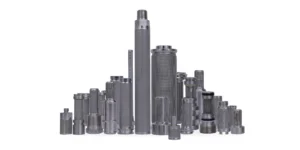
Sintered mesh, sintered fiber felt and pleated metal cartridges often benefit from permeability review because pore structure, thickness, porosity and active area affect flow resistance. Basket, wedge wire and perforated elements are usually better evaluated by opening size, slot width, open area, strength, fit and cleaning access.
What should a permeability report include?
A useful report should identify the part or sample, media type, test area, pressure difference, flow unit, temperature or air condition, test method, result, date and batch traceability. For custom elements, include drawing revision, material grade, element geometry and whether the test was performed on media only or the finished element.
Should I ask for air permeability testing in every RFQ?
No. Ask for it when flow resistance, batch comparison, gas flow, cleaning recovery or media selection is a real risk. For coarse strainers or visible-slot screens, dimensional inspection and open-area review may be more useful. For fine porous media, permeability can be a valuable part of the inspection package.
Final Thoughts
A filter element air permeability test is useful when it answers a specific question: how easily does air pass through this media or element under a defined condition? It becomes risky when used as a shortcut for filtration rating or service life. For custom stainless steel filters, SINFT can combine permeability review with media selection, drawings, pressure-drop limits and inspection records.
Technical References
- ISO, “ISO 4022:2018 – Permeable sintered metal materials – Determination of fluid permeability”: https://www.iso.org/standard/72838.html
- ISO, “ISO 3968:2017 – Hydraulic fluid power – Filters – Evaluation of differential pressure versus flow”: https://www.iso.org/standard/64104.html
- ISO, “ISO 9237:1995 – Textiles – Determination of the permeability of fabrics to air”: https://www.iso.org/standard/16869.html
- ASTM International, “ASTM D737 – Standard Test Method for Air Permeability of Textile Fabrics”: https://store.astm.org/standards/d737