A sintered filter may be specified as though “sintered” describes one predictable pore structure. It does not. Woven wire layers, random metal fibers and compacted metal powder all create different flow paths after bonding. If you choose by micron rating alone, you can miss the pressure-drop, strength and cleaning behavior that controls real operation. The useful starting point is the media structure and the way particles meet it.
Direct Answer: What Is the Sintered Filter Working Principle?
A sintered filter works by passing a liquid or gas through a stable network of interconnected openings or pores while particles are retained at the surface, within the media depth, or in a filter cake that develops during operation. Sintering bonds the metal structure so its wires, fibers or particles do not move like loose media. The exact retention, pressure-drop and cleaning behavior depends on whether the filter is made from sintered wire mesh, metal fiber felt or metal powder.
That distinction is the most important engineering point. “Sintered” describes how a porous metallic structure is consolidated; it does not, by itself, define the pore geometry, filtration rating or service conditions. The purchased specification must still identify the media family, alloy, geometry, flow direction, retention requirement and test basis.
The broad sintered filters category should therefore be treated as a family of technologies rather than one interchangeable product grade.
What Does Sintering Change in a Filter?
Sintering stabilizes a porous metal structure by bonding contact points through a controlled thermal process without relying on polymer binders. In wire mesh, crossover points and adjacent layers become diffusion-bonded. In metal fiber felt, randomly arranged fibers bond where they touch. In powder media, compacted particles bond while leaving connected voids between them.
The result is a structure that can retain its intended geometry more reliably than loose powder, unsupported fiber or an unconsolidated stack of mesh. This stability supports forming, welding, repeated handling and, when the design and contamination permit, cleaning and reuse.
GKD describes sintered mesh as wire mesh consolidated by thermal diffusion into a rigid, dimensionally stable porous structure. It also notes that fine filtration and coarser support layers can be combined in one laminate. For metal fiber media, Bekaert explains that random fibers form a three-dimensional pore network and are then fixed at their contact points by sintering in its article on how metal fiber filter media works.
Sintering does not automatically guarantee that an element is suitable for every pressure, temperature or chemical. Those limits also depend on alloy, media thickness, support structure, element diameter and length, seams, welds, end fittings, seals and load direction.
The Filtration Sequence Inside a Sintered Element
Every sintered filter operates through the interaction of fluid flow, pore structure and contaminant, but the dominant capture mechanism can change during a cycle. A practical sequence is:
- Fluid approaches the filtration face. Its flow rate, viscosity, temperature and gas or liquid state establish the initial hydraulic resistance.
- Fluid enters connected flow paths. These may be visible mesh openings, tortuous spaces among fibers, or pores between bonded powder particles.
- Particles are retained. Depending on media and particle characteristics, capture occurs mainly at the surface, within the depth, or by a combination of mechanisms.
- Deposited solids change the system. A surface cake may improve fine-particle capture while increasing differential pressure. Internal loading can also reduce permeability.
- The cycle reaches a control point. The plant may clean, backwash or replace the element based on differential pressure, flow, time, product quality or another validated limit.
- The element is evaluated for return to service. Cleaning must restore acceptable hydraulic behavior without opening pores, deforming the media or damaging welds and seals.
This is why the filter pressure drop versus flow rate guide is part of sintered-filter selection. A filter can meet a retention requirement yet be unsuitable if its clean resistance or loading rate is incompatible with the process.
How Sintered Wire Mesh Works
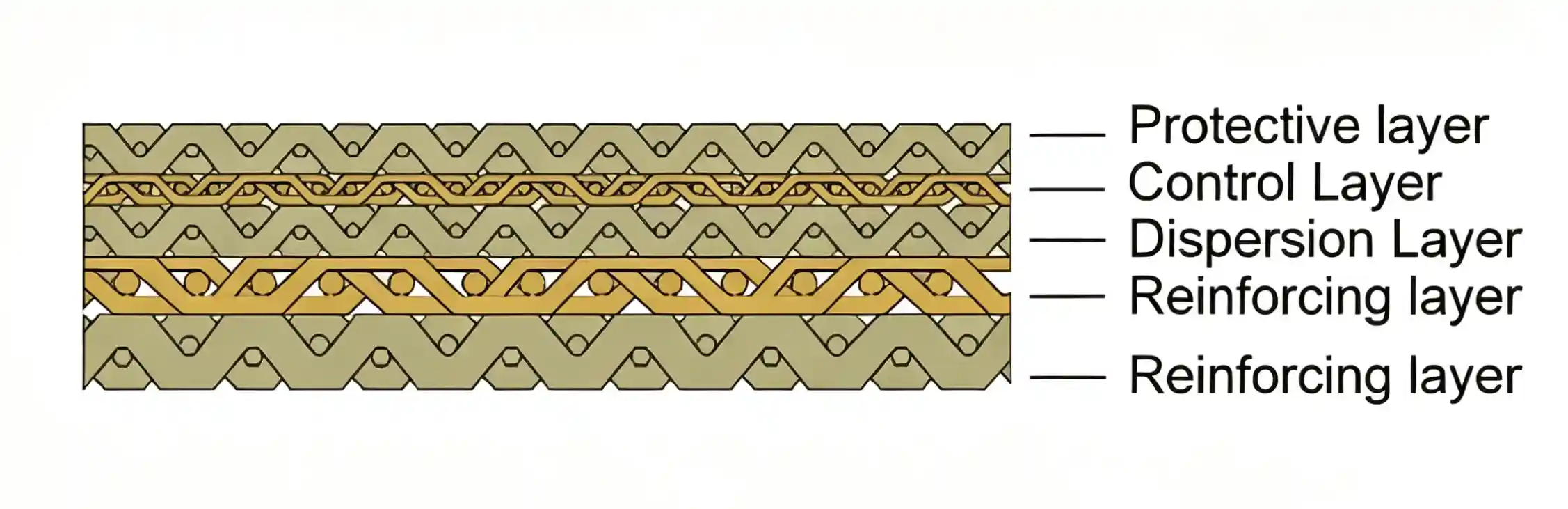
Sintered wire mesh usually behaves as a controlled surface-filtration structure supported by one or more coarser layers. The fine control layer establishes the relevant opening path, while protective, dispersion and reinforcing layers protect it, distribute flow and carry mechanical load. Layer order and filtration direction therefore matter.
In a standard multilayer laminate, particles larger than the controlling passages are retained on or near the filtration face. As solids accumulate, the cake can become part of the effective filtering layer. Because the woven geometry is fixed by diffusion bonding, the laminate can be cut, rolled and welded into cartridges, tubes, discs, cones, panels or custom assemblies without the layers behaving like a loose stack.
The control layer is not the only design variable. Wire diameter, weave type, support openness, total thickness, element geometry and edge sealing influence permeability and strength. The five-layer sintered wire mesh guide explains these layer functions in more detail.
How Sintered Metal Fiber Felt Works
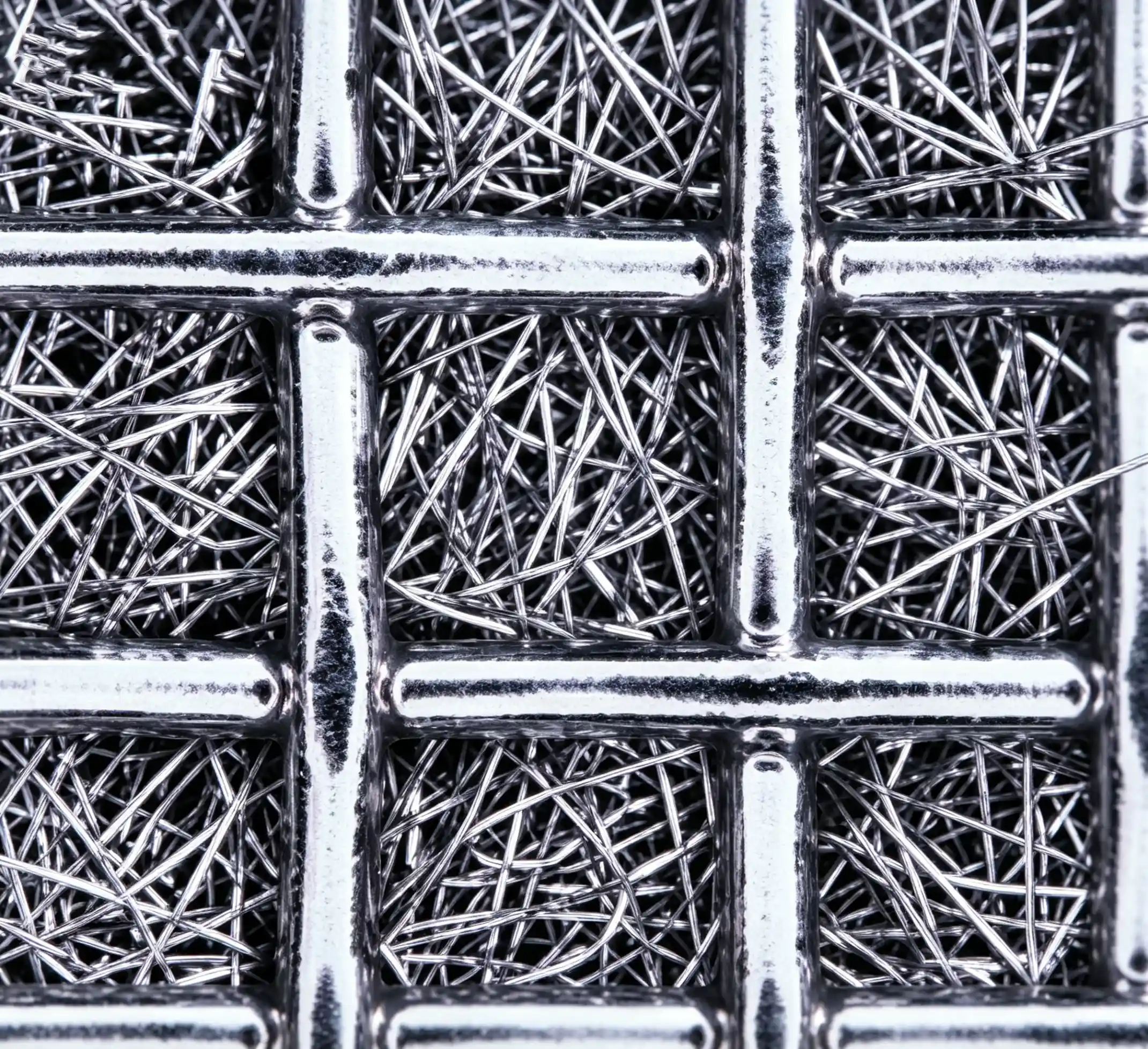
Sintered metal fiber felt creates a three-dimensional network of randomly arranged fibers, giving fluid many connected paths and allowing particles to load within and near the media depth. Fiber diameter, laydown, thickness, grading and supporting mesh determine the resulting permeability, retention and mechanical behavior.
Compared with a woven control layer, the pore paths are less geometrically uniform and more tortuous. This can provide high porosity and dirt-holding capacity, but contamination may penetrate farther into the structure. Cleaning success therefore depends strongly on particle type, depth of loading and cleaning method. A medium selected for high dirt holding is not automatically the easiest one to backwash.
The distinction between surface and depth behavior is not absolute. Media design and operating conditions can shift where particles collect, and a surface cake may still develop. The surface filtration versus depth filtration guide provides the broader decision framework.
How Powder-Sintered Metal Filters Differ
Powder-sintered filters are made by compacting and sintering metal particles, so their pores form between bonded particles rather than between woven wires or long random fibers. They can provide rigid, tortuous porous structures, but their permeability, strength and cleaning response are specific to powder size, compaction, wall thickness, alloy and manufacturing route.
Do not use a powder-filter data sheet to specify a sintered wire-mesh element, or the reverse. Even when two media carry similar nominal micron descriptions, their pore distribution, void fraction, thickness and flow resistance may be different.
SINFT’s confirmed product information covers sintered wire mesh and sintered metal fiber felt. This article discusses powder media to clarify the technology family; it does not claim that SINFT supplies powder-sintered filter elements.
Sintered Filter Media Compared
Choose the media family from the filtration mechanism and maintenance plan, then confirm the grade. The following table is a decision framework rather than a universal performance ranking.
| Media family | Pore structure | Typical capture behavior | Engineering strength | Cleaning consideration | Best question to ask first |
|---|---|---|---|---|---|
| Sintered wire mesh | Bonded woven openings in one or more layers | Mainly surface retention with cake development | Layered support can provide high structural stability | Surface deposits may release by reverse flow or compatible cleaning | Do I need defined geometry, rigidity and repeat backwashing? |
| Sintered metal fiber felt | Random three-dimensional fiber network | Surface and depth loading, depending on design | Requires suitable support and element construction | Deeply embedded contamination can be harder to remove | Do I need high porosity and dirt holding within limited space? |
| Powder-sintered metal | Interconnected pores between bonded particles | Surface and depth effects through a tortuous wall | Rigid monolithic porous structure | Cleaning depends on pore depth, contaminant and wall geometry | Does the supplier’s exact powder grade match my flow and retention basis? |
The word “better” is incomplete here. A rigid, backwashable surface filter may be better for one process, while a high-porosity depth-loading medium may be better for another. The correct answer depends on what must be retained, how much contaminant arrives, how pressure drop is controlled and whether the element must be regenerated.
Why Pressure Drop Rises During Operation
Differential pressure rises because the clean media, element geometry and accumulating contamination resist flow. At a fixed fluid condition, increasing flow generally increases pressure loss. Higher viscosity also increases resistance. As particles block openings, fill pore volume or form a cake, the available flow paths narrow and the differential pressure usually rises further.
A pressure reading has little value without its basis. Record flow, fluid, temperature, viscosity and the locations of the pressure taps. Compare clean and fouled values under similar conditions. If you change the flow rate or fluid temperature between readings, the difference may not represent contamination alone.
Do not assume that a very low clean pressure drop always means the right filter. The media must still meet retention, strength and cleaning requirements. Conversely, specifying an unnecessarily fine grade can consume the available pressure budget and shorten the operating cycle.
Filtration Direction and Support Structure
The strong side of a sintered laminate and the side intended to collect solids are design choices, not assumptions to make during installation. Outside-to-inside and inside-to-outside flow can both be used, but the support layer must resist the differential-pressure direction and the filtration face must remain accessible to the intended cleaning method.
If reverse flow is part of the cleaning cycle, the element must also tolerate the reverse differential load. End fittings, seams and seals are part of that load path. A media sheet with adequate strength can still fail as an assembly if the unsupported span, weld or connection is not designed for the service.
Cleaning Does Not Restore Every Sintered Filter Automatically
A sintered structure can be cleanable, but cleanability depends on where the contaminant is held and whether the cleaning method is compatible with every material in the assembly. Surface cake on sintered mesh may respond well to backwash. Fine particles lodged in fiber felt or powder pores may require ultrasonic, chemical or thermal methods where the process permits them.
Before reuse, verify more than appearance. Compare pressure drop or permeability with an accepted baseline, inspect the media and welds, and use an integrity check when the application requires it. ISO 4003 describes a bubble test pore-size method for permeable sintered metal materials and explicitly frames it as a quality-control test rather than a complete definition of filter grade or pore-size distribution. ASTM E128 similarly covers maximum pore diameter and permeability of rigid porous filters for its stated laboratory scope.
The bubble point test guide explains what a first-bubble result can and cannot confirm. Cleaning procedures should remain specific to the alloy, contaminant, geometry, seals, plant safety rules and acceptance criteria.
How to Select a Sintered Filter
Select the filter in this order: process duty, retention target, media family, hydraulic requirement, mechanical requirement, cleaning plan and element geometry. Starting with a catalog micron number skips the decisions that determine whether the element will work in the housing.
- Define the fluid. State liquid or gas, composition, solids, viscosity, temperature and chemical compatibility concerns.
- Describe the contaminant. Include particle-size distribution, shape, hardness, loading and whether the solids form a removable cake.
- Set the retention objective. Identify the downstream protection or product-quality requirement and the rating/test basis.
- Set the hydraulic basis. Provide normal and maximum flow, acceptable clean pressure drop and terminal differential-pressure logic.
- Choose the filtration behavior. Decide whether controlled surface capture, depth loading or a combination is appropriate.
- Define cleaning. State whether the element will be backwashed, ultrasonically cleaned, chemically cleaned, steamed or replaced.
- Confirm mechanical loads. Include working pressure, differential-pressure direction, pressure cycling, vibration and handling.
- Confirm fit. Provide OD, ID, length, end connections, seals, installation clearances and filtration direction.
- Agree on inspection. Specify required material, dimensional, permeability, bubble-point, pressure, passivation or traceability records.
Application Decisions
Application names do not replace operating data. In hydraulic and lubrication service, stable retention and differential-pressure behavior may be central. In polymer melt filtration, viscosity, gels, thermal exposure and screen-change strategy matter. In water treatment, solids loading, biological fouling and cleaning water can control the choice. Gas service adds compressibility, dust characteristics, cleanliness and possible pulse cleaning.
SINFT provides dedicated guidance for sintered mesh filters in hydraulic and lubrication systems and natural gas and industrial gas filtration. Use those pages as application starting points, then submit the actual process conditions. Do not transfer a pressure, temperature or filtration figure from one application to another without confirming the complete element design.
What to Confirm Before an RFQ
Prepare the following information for a sintered filter inquiry:
- process fluid or gas and its chemical composition;
- contaminant type, particle-size information and solids loading;
- required filtration result and how the rating should be verified;
- normal and maximum flow rate;
- operating and cleaning temperatures;
- working pressure and maximum differential pressure in both directions;
- acceptable clean pressure drop and cleaning/terminal trigger;
- preferred media family, if already selected;
- alloy and seal compatibility requirements;
- element form: cartridge, tube, candle, disc, cone, panel or welded assembly;
- OD, ID, length, wall/media thickness, end connections and critical tolerances;
- normal filtration direction and proposed cleaning method;
- drawing, old sample, housing dimensions or existing part information;
- quantity and required material, inspection, passivation and traceability documents.
How SINFT Can Help
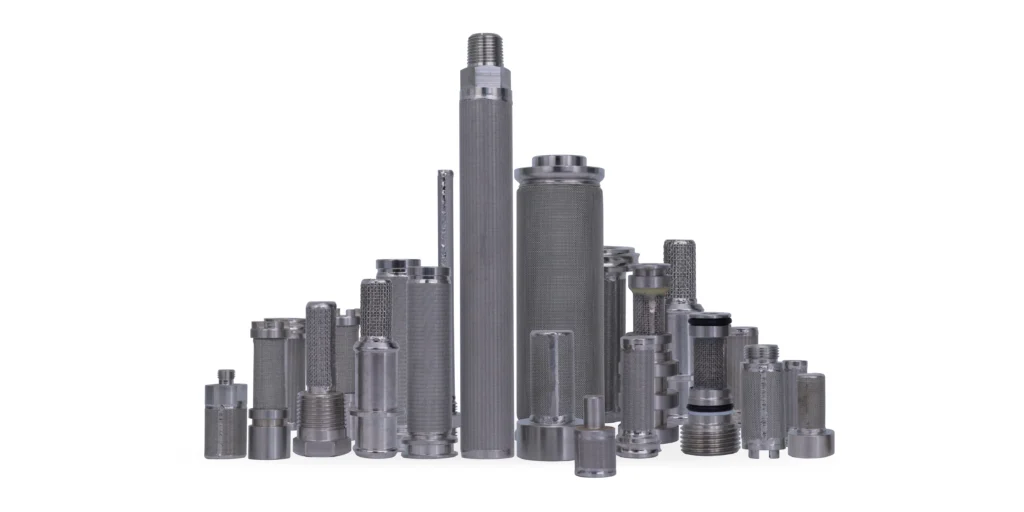
SINFT manufactures custom sintered wire-mesh and sintered metal-fiber-felt elements based on drawings, old samples, housing dimensions and operating conditions. Available forms include cartridges, tubes, candles, discs, cones, panels and welded assemblies, depending on the selected media and design.
Review the confirmed sintered mesh filter elements and sintered fiber felt filters before choosing a construction. For a nonstandard replacement or new assembly, SINFT’s custom filter manufacturer service can review media, material, geometry, interfaces and requested inspection records. Send your drawing, sample details and operating data through the contact inquiry form.
Frequently Asked Questions
Is every sintered filter a depth filter?
No. Sintered metal fiber felt and powder media can capture particles within tortuous pore networks, but sintered wire mesh commonly acts as a controlled surface filter, especially when a fine control layer faces the incoming contamination. Real behavior also changes as a filter cake forms. Classify the media structure and intended filtration direction before calling an element a surface or depth filter.
Does sintering make the pores smaller?
Sintering bonds the existing wires, fibers or powder particles into a stable structure, but the final pore geometry depends on the starting material, layer arrangement, compaction and thermal process. It is not correct to assume a universal reduction in pore size. The finished media should be specified and verified by the supplier’s rating and agreed test method, not inferred from sintering alone.
What determines the micron rating of a sintered filter?
The determining factors differ by media. Wire mesh depends on the control-layer weave and opening path; fiber felt depends on fiber structure, grading and thickness; powder media depends on particle size, compaction and connected pores. The rating must also state whether it is nominal, absolute or based on a particular efficiency or test. A micron number without that basis is incomplete.
Can a sintered metal filter be backwashed?
Many sintered filters can be designed for backwashing because the bonded structure resists media movement, but suitability is not automatic. The contaminant must release from the filtration face, reverse flow needs a discharge path, and the media, welds, seals and support must tolerate reverse differential pressure. Deeply embedded or adhesive contamination may require another compatible cleaning method or element replacement.
What is the difference between sintered mesh and sintered fiber felt?
Sintered mesh uses woven wire layers with comparatively defined geometric flow paths and usually strong surface-filtration behavior. Sintered fiber felt uses randomly arranged fibers that create a three-dimensional pore network with higher depth-loading potential. Mesh is often chosen for rigidity and backwashing; felt is often considered when porosity and dirt holding are important. Final selection still depends on the complete operating data.
How do I know whether cleaning restored the filter?
Compare hydraulic or permeability performance with an accepted clean baseline under the same fluid, temperature and flow conditions. Inspect the media, seams, welds, end fittings and seals, then apply any required pore-integrity or bubble-point check. A brighter surface is not sufficient evidence. If pressure drop remains high or integrity changes, investigate residual internal contamination, deformation or damage before reuse.
What information is most important when requesting a custom sintered filter?
Start with the fluid, contaminant, required retention, flow, temperature, working pressure, differential pressure and cleaning method. Then provide element dimensions, end connections, seals, filtration direction and a drawing or old sample. State the required material and inspection documents. This combination lets the manufacturer assess filtration behavior, mechanical fit and cleanability instead of matching only a micron number or outside diameter.
Final Thoughts
The sintered filter working principle begins with a stable porous metal structure, but the useful engineering answer depends on how that structure is built. Separate wire mesh, fiber felt and powder media before comparing ratings. Then verify flow resistance, load direction, cleaning and element geometry under the real process conditions. SINFT can review drawings, samples and operating data for a custom sintered mesh or fiber-felt element.