When a filter element fails too quickly, the cause is often not the alloy or the brand. The system may be asking one element to do the wrong job: collect heavy debris, protect a pump, polish fine particles, and remain easy to clean. The basket filter vs cartridge filter choice should start from that job, not from a catalog picture.
Direct Answer: Basket Filter vs Cartridge Filter
For industrial service, choose a basket filter when you need reusable coarse-debris collection and easy manual cleanout. Choose a cartridge filter when you need controlled fine filtration, more media area in a compact envelope, or a defined housing connection such as DOE, 222, 226, threaded, flange, or custom ends. Many systems use both: basket first, cartridge downstream.
This guide compares industrial metal filter elements. It does not compare swimming-pool filters, filter bags, or complete pressure-vessel designs.
What Is an Industrial Basket Filter Element?
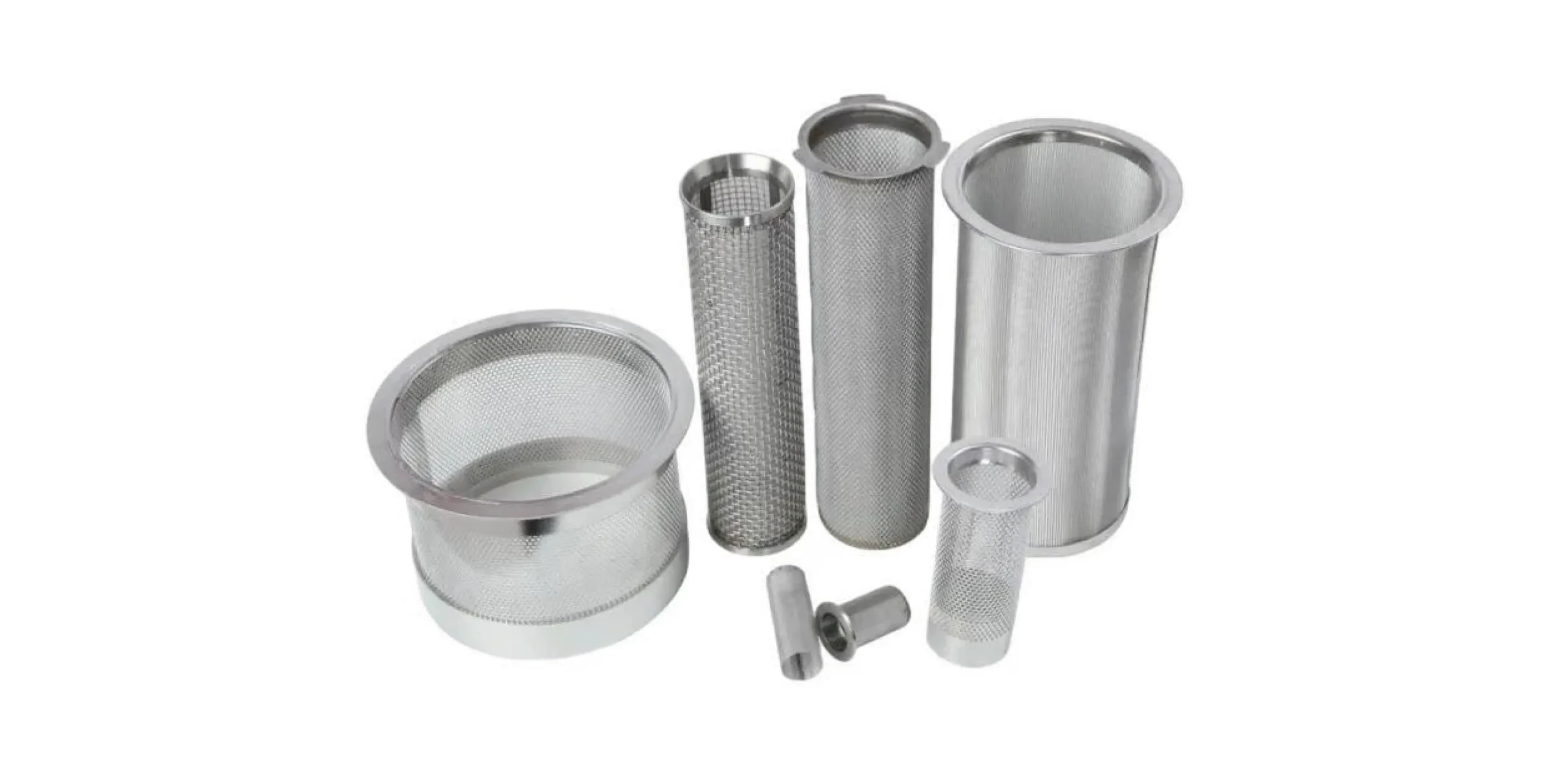
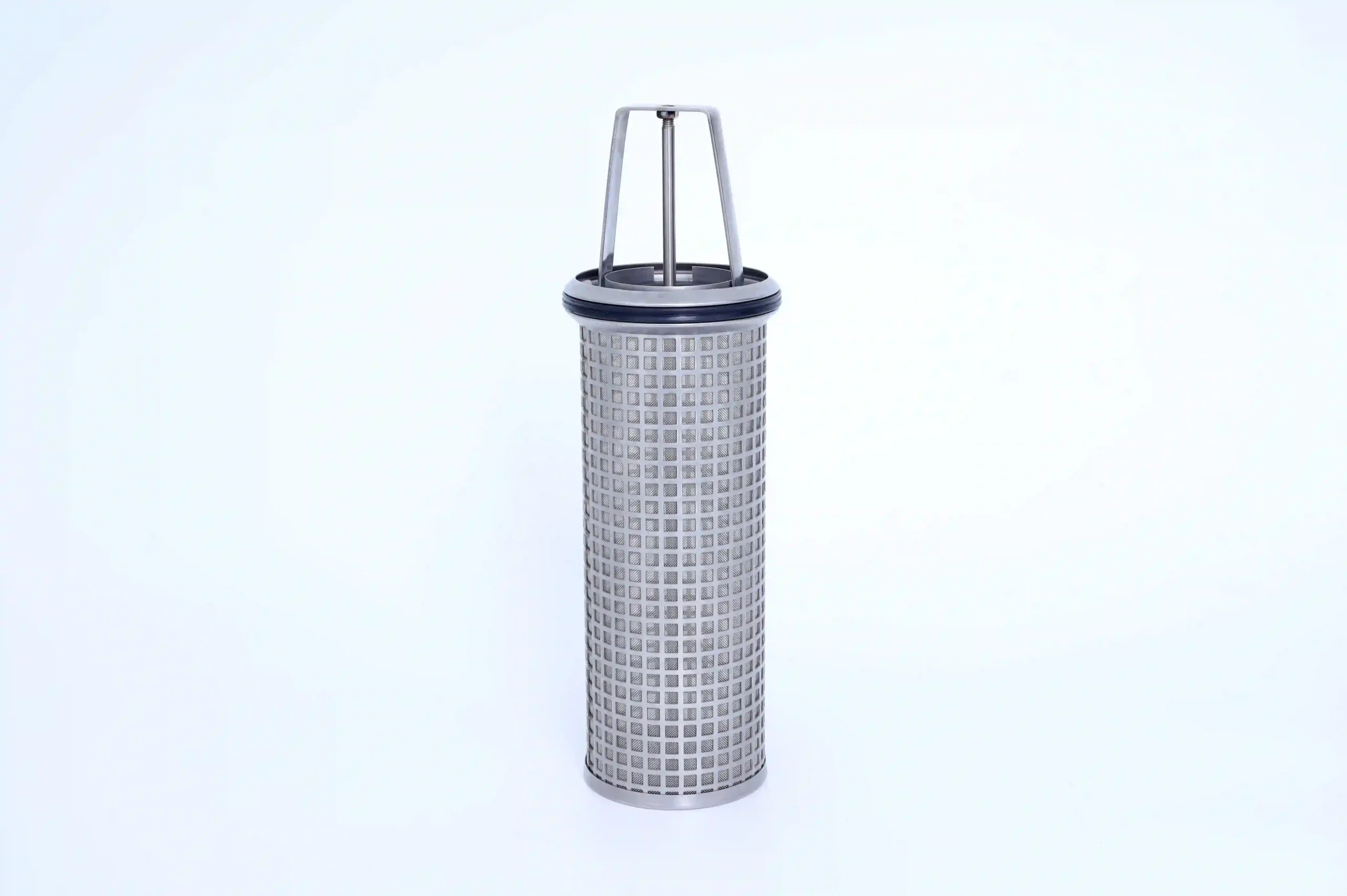
An industrial basket filter element is a removable screen-shaped component that collects solids inside a strainer or filter housing. It is commonly cylindrical or basket-shaped and may include a rim, flange, handle, lifting bar, bottom plate, support cage, and replaceable mesh liner.
The controlling medium can be:
- Perforated metal plate
- Woven wire mesh
- Sintered mesh
- A perforated support with a finer mesh liner
Basket elements are commonly installed upstream of pumps, valves, heat exchangers, meters, spray nozzles, and finer filters. Their role is usually equipment protection or bulk solids removal rather than final product polishing.
If your main problem is pipe scale, gasket fragments, sand, fibers, or other coarse process debris, start the discussion with the basket. SINFT basket filters and strainer elements are made to fit a housing, drawing, or old sample. Available forms include standard baskets, slanted baskets, tubes, flanged tubes, and removable liners. Final dimensions, opening pattern, mesh, rim, handle, and bottom construction must match the actual housing.
What Is an Industrial Cartridge Filter Element?
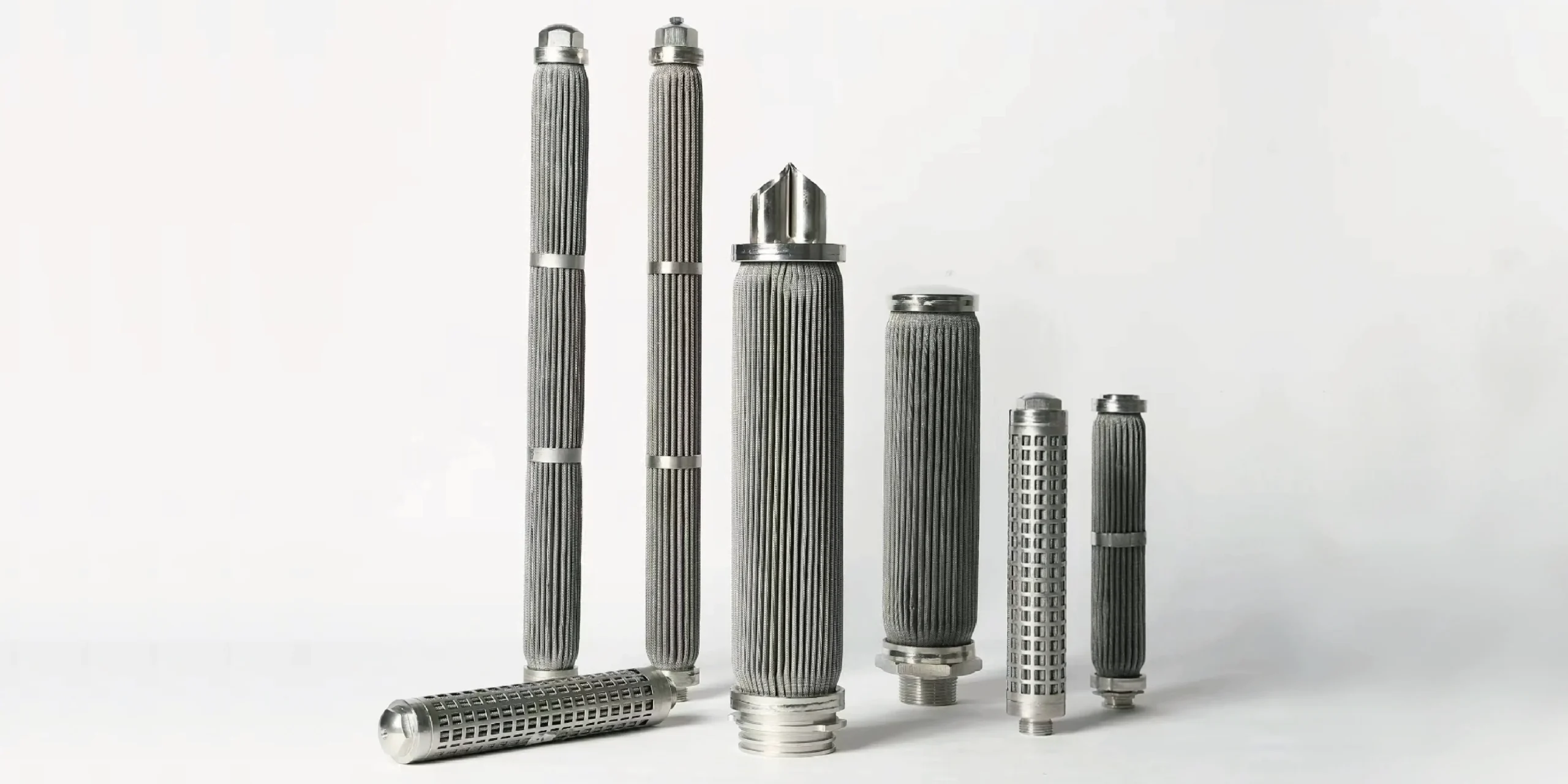
An industrial cartridge filter element is a cylindrical replaceable or cleanable medium designed to seal into a cartridge housing. The medium can be pleated or unpleated and may use woven mesh, sintered mesh, sintered fiber felt, polymeric media, glass fiber, or another process-compatible material.
Pleating increases effective area within a limited housing envelope. Metal cartridges are often selected where temperature, corrosion, pressure differential, repeated cleaning, or media compatibility makes a disposable polymer cartridge unsuitable.
If your main problem is fine particle control, limited installation space, or repeatable cartridge sealing, the cartridge side deserves closer review. SINFT stainless steel pleated filter cartridges can use woven wire mesh, sintered mesh, or sintered metal fiber felt. Common element interfaces include DOE, 222, 226, threaded, flange, and custom welded ends. The correct interface depends on the housing seal arrangement and insertion depth, not only on the cartridge length.
Basket Filter vs Cartridge Filter: Key Differences
Basket and cartridge elements differ most in contaminant duty, media area, retention method, housing interface, and maintenance workflow.
| Selection factor | Basket filter element | Cartridge filter element |
|---|---|---|
| Primary role | Debris removal, prefiltration, equipment protection | Controlled filtration, polishing, or fine equipment protection |
| Typical retained solids | Larger particles, fibers, scale, gasket fragments, sand, process debris | Fine particles, wear debris, aerosols, gels, or a broader particle distribution |
| Common media | Perforated plate, woven mesh, sintered mesh | Pleated mesh, sintered mesh, fiber felt, or other depth/surface media |
| Effective area | Determined by basket geometry and open area | Pleating can add media area inside a compact envelope |
| Loading pattern | Solids collect in or on the basket | Solids load on the surface or through the media depth |
| Maintenance | Remove, empty, wash, inspect, reinstall | Clean and reuse when designed for it, or replace according to condition |
| Housing interface | Rim, flange, handle, basket seat, bottom shape | DOE, 222, 226, thread, flange, seal groove, custom end |
| Inspection | Retained debris and screen are usually easy to inspect | Internal pleats and depth media can be harder to inspect completely |
| Typical system position | Upstream prefilter | Intermediate or final filtration stage |
| Best selection basis | Debris size/load, open area, allowable ΔP, access | Retention efficiency, media area, ΔP, compatibility, connection |
These are typical roles, not fixed limits. A mesh-lined basket can retain smaller particles, and a coarse cartridge can serve as a prefilter. The correct choice comes from process data and a defined performance requirement.
Which Element Is Better for High Solids Loading?
A basket element is usually the better starting point when the process carries visible, relatively large debris that must be collected and removed. Its open geometry provides a physical collection volume, and the operator can inspect the retained material after opening the housing.
This is useful for:
- Pipe scale and weld debris during commissioning
- Leaves, fibers, packaging fragments, or gasket pieces
- Sand or mineral particles ahead of pumps
- Coarse catalyst or process solids
- Cooling-water debris ahead of heat exchangers
However, “high solids loading” is incomplete without particle size and concentration. A high mass of very fine particles may blind a fine basket liner quickly. In that case, a larger filter area, automatic backwash system, staged filtration, or depth-type cartridge may be more appropriate.
Cartridge elements can handle significant contaminant when the media and area are selected for it. Sintered metal fiber felt, for example, distributes particles through a porous depth structure, while pleating increases available area. That does not mean every cartridge has higher dirt-holding capacity than every basket; the complete element and test conditions must be compared.
Which Element Provides Finer Filtration?
Cartridge elements usually offer more options for controlled fine filtration, but the rating method matters more than the format name. A basket opening is commonly described by perforation size, slot width, or mesh. A cartridge may be described by nominal rating, absolute rating, efficiency, beta ratio, or another media-specific test.
Do not compare a 100-mesh basket with a “100-micron cartridge” as if the two labels were equivalent. Confirm:
- The actual aperture or retention definition.
- Whether the value is nominal or absolute.
- The efficiency at the stated particle size.
- The test fluid, flow, viscosity, and contaminant.
- Whether the rating applies to flat media or the finished element.
- Whether bypass leakage through seals or joints was included.
For hydraulic filter cartridges, ISO 16889:2022 defines a multi-pass method for evaluating particle-removal performance, contaminant capacity, and differential-pressure characteristics. Its data apply to the specified hydraulic test and should not be transferred directly to unrelated water, gas, steam, or polymer-melt applications.
How Do Open Area and Filter Area Affect Selection?
Basket open area and cartridge media area are different sizing concepts. Both influence pressure drop and loading, but neither should be judged by external diameter alone.
For a basket element, check:
- Total perforated or mesh-covered area
- Percentage of open area in the selected plate or mesh
- Ratio of available screen area to pipe cross-sectional area
- Area blocked by supports, seams, rims, and the housing seat
- Usable collection volume before debris obstructs flow
For a cartridge element, check:
- Effective media area
- Pleat height, count, spacing, and usable length
- Flow distribution through the support tube
- Area blocked by bonding, welds, end caps, and guards
- Number of cartridges sharing the total system flow
The Eaton manual pipeline strainer technical guide shows why pressure-loss calculations must account for the selected basket or screen, mesh lining, fluid specific gravity, and viscosity. Its numerical correction factors are product-specific and should not be copied to a different manufacturer’s element without validation.
Which Has Lower Pressure Drop?
Neither format always has lower pressure drop. Pressure loss depends on flow, viscosity, density, temperature, clean open area, media permeability, housing geometry, port size, element supports, contaminant loading, and whether multiple elements operate in parallel.
A coarse, clean basket can have low resistance, but ΔP rises as debris covers the available screen. A pleated cartridge may provide large media area, but a fine or thick medium can add resistance. A cartridge housing with several elements may divide the flow and reduce the flow per element.
Compare the same operating condition:
Total clean ΔP = housing loss + element loss + valves or other in-flow component losses
Then check the loaded curve or approved terminal differential pressure. Do not compare a basket-only curve with a cartridge-and-housing curve.
ISO 3968:2017 provides a differential-pressure-versus-flow test framework for hydraulic filter assemblies at different flow rates and viscosities. For other process filters, request equivalent clarity about the test fluid, temperature, clean or loaded condition, element configuration, and included housing components.
Which Is Easier to Clean?
Basket elements are generally easier to empty and inspect when solids remain loose or form a removable surface deposit. The operator can remove the basket, discharge the collected solids, clean the screen, inspect welds and mesh, and reinstall it.
Cartridge cleaning depends on the medium:
- Woven mesh cartridges may be backwashed, ultrasonically cleaned, or chemically cleaned when compatible.
- Sintered mesh cartridges provide a rigid structure for repeated cleaning.
- Sintered fiber felt can be reusable, but deeply embedded particles may be harder to remove.
- Pleated construction requires careful cleaning between pleats without deforming the media.
Cleaning success should be verified using defined acceptance criteria such as restored clean flow or pressure drop, visual integrity, dimensional condition, and an appropriate integrity test. A cartridge that looks clean may still contain internal contaminant.
The complete housing also affects maintenance. Simplex and duplex arrangements are housing-system decisions. A duplex basket strainer or duty/standby cartridge housing can allow one side to be serviced while the other remains in operation, but the element alone does not create continuous service.
When Should Basket and Cartridge Filters Be Used Together?
Use them in series when a coarse, cleanable stage can protect a finer and more expensive downstream stage. A basket upstream removes bulk debris; the cartridge downstream controls smaller particles or provides final polishing.
This arrangement can:
- Extend the useful cycle of fine media
- Prevent large debris from damaging pleats
- Separate easy-to-remove solids before precision filtration
- Reduce unnecessary loading on downstream cartridges
- Make troubleshooting easier by identifying where solids are captured
Typical sequence:
Process inlet → basket prefilter → cartridge filter → protected equipment or product stage
The micron steps must be engineered. If the basket opening is too close to the cartridge rating, the upstream stage may add pressure loss without removing enough mass. If it is too coarse, damaging debris may reach the cartridge.
For water-treatment duties, compare the contaminant load and required downstream quality before selecting a staged system. SINFT’s water treatment filtration page outlines where basket, pleated, sintered mesh, and other metal elements can fit into different treatment steps.
Application Selection Guide
Start with the function required at that location in the process.
| Process need | Preferred starting point | Reason to evaluate it first |
|---|---|---|
| Pump suction protection from large debris | Basket element | Accessible debris collection and coarse screening |
| Heat-exchanger or nozzle protection | Basket or tube element | Removes particles likely to obstruct passages |
| Fine hydraulic wear-particle control | Cartridge element | Retention efficiency can be defined for the required cleanliness target |
| Product polishing or final clarification | Cartridge element | More media and efficiency options |
| Heavy coarse solids with manual cleanout | Basket element | Collection volume and direct inspection |
| High-temperature reusable fine filtration | Metal cartridge | Pleated mesh, sintered mesh, or fiber-felt options |
| Unknown or broad particle distribution | Staged basket plus cartridge | Separates bulk debris before fine retention |
| Continuous operation | Duplex or parallel system | Allows isolation and service when correctly designed |
This table is a starting framework, not a universal sizing chart. The selected element must still match the housing, fluid chemistry, temperature, pressure, differential pressure, and maintenance procedure.
Basket Strainer vs Cartridge Filter Housing
Do not confuse the element decision with the housing decision. A basket, tube, or cartridge must seal and support correctly inside its housing. The housing determines pressure boundary, port arrangement, closure, venting, draining, bypass path, and maintenance clearance.
When replacing only the element, verify:
- Basket rim OD and seating depth
- Cartridge OD, ID, length, and insertion depth
- Flow direction
- Seal position and compression
- Handle or lifting-point clearance
- Bottom support or guide
- Collapse support under differential pressure
- Clearance for removal through the housing opening
If the existing choice is between a basket and a Y strainer rather than a cartridge, use the separate basket strainer vs Y strainer selection guide to compare access, footprint, debris load, and cleaning frequency.
How to Choose Between a Basket and Cartridge Element
Use a basket for recoverable coarse debris and a cartridge for defined fine retention—unless process testing shows otherwise. Apply this selection sequence.
1. Define the contaminant
Provide particle-size distribution, concentration, shape, hardness, fiber content, stickiness, and whether solids settle, agglomerate, or deform.
2. Define the filtration objective
State whether the filter protects a pump, prevents nozzle blockage, controls a cleanliness code, clarifies a product, or protects a downstream membrane.
3. Set the retention requirement
Specify aperture, slot width, nominal rating, absolute rating, or efficiency under a stated test method. Avoid using “mesh” and “micron” as interchangeable terms.
4. Calculate the hydraulic condition
Provide normal, minimum, and maximum flow; viscosity and density at operating temperature; clean pressure drop; terminal differential pressure; and available system pressure.
5. Define maintenance
Confirm shutdown availability, removal clearance, cleaning method, cleaning fluid, disposal requirements, and post-cleaning acceptance criteria.
6. Match the housing
Supply the drawing, old element, sample, photos, or full dimensions. A correct media choice will still fail if the rim, end connection, seal, or insertion depth does not fit.
7. Validate the complete element
For critical service, test the finished element under representative flow, temperature, contaminant, and differential-pressure conditions.
SINFT’s custom filter manufacturing service can review replacement basket and cartridge elements from a drawing, old sample, housing dimensions, or specified interface.
How SINFT Can Help With Basket and Cartridge Selection
SINFT is most useful when you are not buying a standard catalog element, but trying to make the next replacement fit and work correctly. For basket duties, SINFT can manufacture standard baskets, slanted baskets, tubes, flanged tubes, and removable liners with perforated plate, woven mesh, or sintered mesh according to the actual housing. For cartridge duties, SINFT can supply stainless steel pleated cartridges using woven wire mesh, sintered wire mesh, or sintered metal fiber felt.
If you are unsure which format should be quoted, send the old element, housing drawing, installation photos, contaminant description, flow condition, and cleaning plan. SINFT can compare the practical options before recommending a basket, cartridge, or staged basket-plus-cartridge solution. For non-standard dimensions, end connections, handles, rims, seal grooves, or welded assemblies, use the custom filter manufacturer page before sending the final RFQ.
Common Selection Mistakes
Most failures come from incomplete process data rather than the name of the filter type.
Avoid:
- Choosing a basket only by pipe size
- Choosing a cartridge only by length and micron label
- Assuming a finer rating always improves the process
- Ignoring fluid viscosity and cold-start conditions
- Comparing clean ΔP without loaded behavior
- Forgetting removal clearance and handle geometry
- Using a housing pressure rating as the element’s differential-pressure capability
- Assuming every metal element can tolerate the same backwash pressure
- Installing a fine cartridge without upstream debris protection
- Reusing an element without verifying integrity after cleaning
What Buyers Should Confirm Before RFQ
A complete RFQ allows the supplier to compare basket, cartridge, or staged filtration without guessing. Include:
- Working liquid, gas, steam, oil, or chemical.
- Contaminant type and particle-size distribution.
- Solids concentration and expected loading.
- Required aperture, micron rating, or efficiency.
- Nominal or absolute rating requirement.
- Normal, minimum, and maximum flow.
- Operating and design pressure.
- Allowable clean and terminal differential pressure.
- Operating and cleaning temperature.
- Viscosity and density at relevant temperatures.
- Material and corrosion requirements.
- Element OD, ID, length, rim, end connection, and seal position.
- Housing drawing, old element, photo, sample, or part number.
- Cleaning method and required operating cycle.
- Quantity, certificates, and inspection-document requirements.
Frequently Asked Questions
What is the main difference between a basket filter and a cartridge filter?
A basket element primarily collects larger debris for equipment protection and manual cleanout, while a cartridge element provides more media and retention options for controlled or fine filtration. If you are protecting a pump from visible debris, start with a basket. If you are controlling smaller particles, cleanliness, or polishing quality, start with a cartridge or a staged design.
Is a basket filter the same as a filter bag?
No. An industrial basket filter element is a rigid or supported metal screen used inside a strainer or basket housing. A filter bag is flexible media installed inside a bag-filter support basket. They differ in sealing, replacement workflow, cleaning method, pressure-drop behavior, and how the retained solids are removed after service.
Can a basket filter remove fine particles?
Yes, a basket can use a fine woven-mesh liner, but that does not automatically make it the best fine filter. Smaller openings reduce open area, raise pressure drop, and may shorten the cleaning cycle when loading is high. Confirm aperture, particle load, efficiency expectation, and allowable differential pressure before replacing a cartridge stage with a fine basket.
Are stainless steel cartridge filters reusable?
They can be reusable when the medium, contaminant, element construction, and cleaning method are compatible. Woven mesh, sintered mesh, and sintered fiber felt cartridges may be cleaned by suitable methods, but reuse should be judged by restored flow, pressure drop, seal condition, weld integrity, and process acceptance rather than by appearance alone.
Should a basket filter be installed before a cartridge filter?
Often yes. A basket upstream can remove large debris before it blinds or damages a finer cartridge downstream. The two stages should not be chosen casually, though. The basket opening, cartridge rating, element area, pressure-drop budget, and cleaning frequency should be selected so each stage removes a useful portion of the contaminant load.
What should I send when requesting a basket or cartridge filter quote?
Send the working fluid, contaminant description, particle size, flow rate, operating temperature, pressure conditions, allowable differential pressure, cleaning method, and material requirement. For replacements, include the old element, drawing, photos, OD, ID, length, rim or end connection, seal position, and housing details. This helps the supplier avoid guessing from a part name alone.
Can one supplier make both basket and cartridge elements for the same system?
Yes, and that can make staged filtration easier to coordinate. When the basket and cartridge are reviewed together, the upstream opening, downstream rating, media area, material, cleaning method, and housing fit can be checked as one filtration train. This is especially useful for OEM skids, plant replacements, and systems with repeated premature cartridge blockage.
Final Thoughts
The best basket filter vs cartridge filter decision is rarely a winner-takes-all choice. Use the basket where the process needs accessible debris collection and equipment protection; use the cartridge where the process needs controlled retention, compact media area, or finer polishing. When both jobs exist in the same line, a staged design is usually the more practical business decision.
Request an Industrial Filter Element Review
The correct element depends on the process stage, particle distribution, flow, viscosity, temperature, allowable differential pressure, cleaning method, and housing interface. If you already have a drawing, old element, or failed sample, SINFT can review whether a basket filter, pleated cartridge, or custom staged element is the better quote path.
Send your basket or cartridge filter requirements to SINFT for review against a drawing, old element, sample, or complete operating condition.
Technical References
- Eaton, “Manual Pipeline Strainers Technical Support Guide”: https://www.eaton.com/content/dam/eaton/products/filtration-solutions/filter-systems-and-strainers/filters-and-strainers/manual-pipeline-strainers/brochures/Eaton-Manual-Pipeline-Strainer-Technical-Support-Guide-EN-LowRes.pdf
- Eaton, “Baskets and Screens for Manual Pipeline Strainers”: https://www.eaton.com/cr/en-us/catalog/filters-strainers/baskets.html
- Parker Hannifin, “The Handbook of Hydraulic Filtration”: https://www.parker.com/content/dam/Parker-com/Literature/Hydraulic-Filter-Division-Europe/fdhb289uk.pdf
- ISO, “ISO 3968:2017 — Hydraulic fluid power — Filters — Evaluation of differential pressure versus flow”: https://www.iso.org/standard/64104.html
- ISO, “ISO 16889:2022 — Hydraulic fluid power — Filters — Multi-pass method for evaluating filtration performance of a filter element”: https://www.iso.org/standard/77245.html