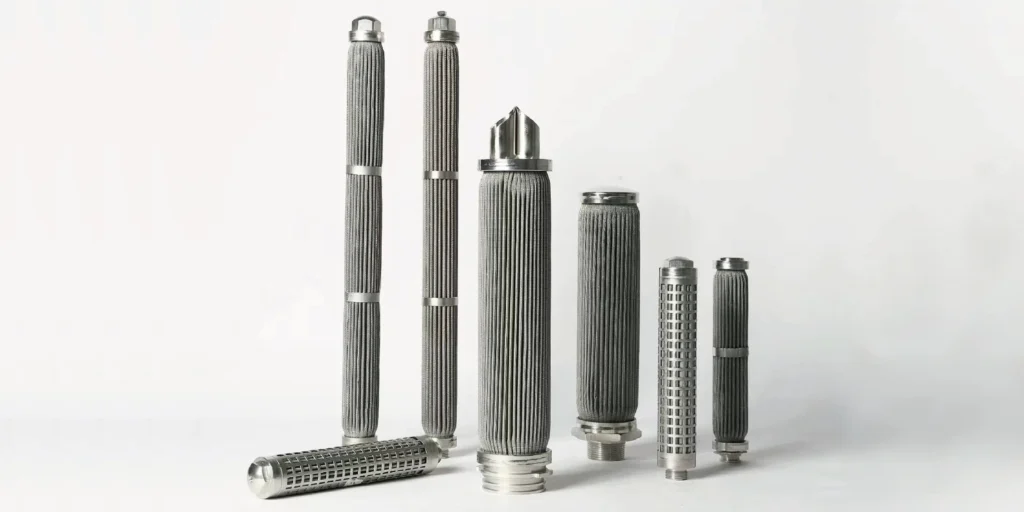
A pleated cartridge is a shape, not a single filter medium. Two elements with the same envelope can use woven wire mesh, sintered mesh or metal fiber felt and behave differently as particles accumulate. For industrial buyers, the question is how the chosen medium works after it is folded, supported, sealed and cleaned. This guide compares those choices and the information needed before requesting a replacement or a new design.
Which Pleated Filter Cartridge Media Should You Choose?
Choose the medium by the required particle-removal performance, the contaminant and the full operating and cleaning duty. Then verify that it can be formed and supported in the required pleated assembly. Woven mesh may provide a surface-screening approach; a suitable sintered mesh provides a bonded multilayer structure; metal fiber felt offers a porous fiber network that can retain particles within its depth. Individual grades and assemblies differ.
The most useful purchasing question is not which material is universally best. Ask which construction meets the removal requirement while fitting the housing, controlling pressure drop, resisting the required differential pressure and supporting the intended cleaning method.
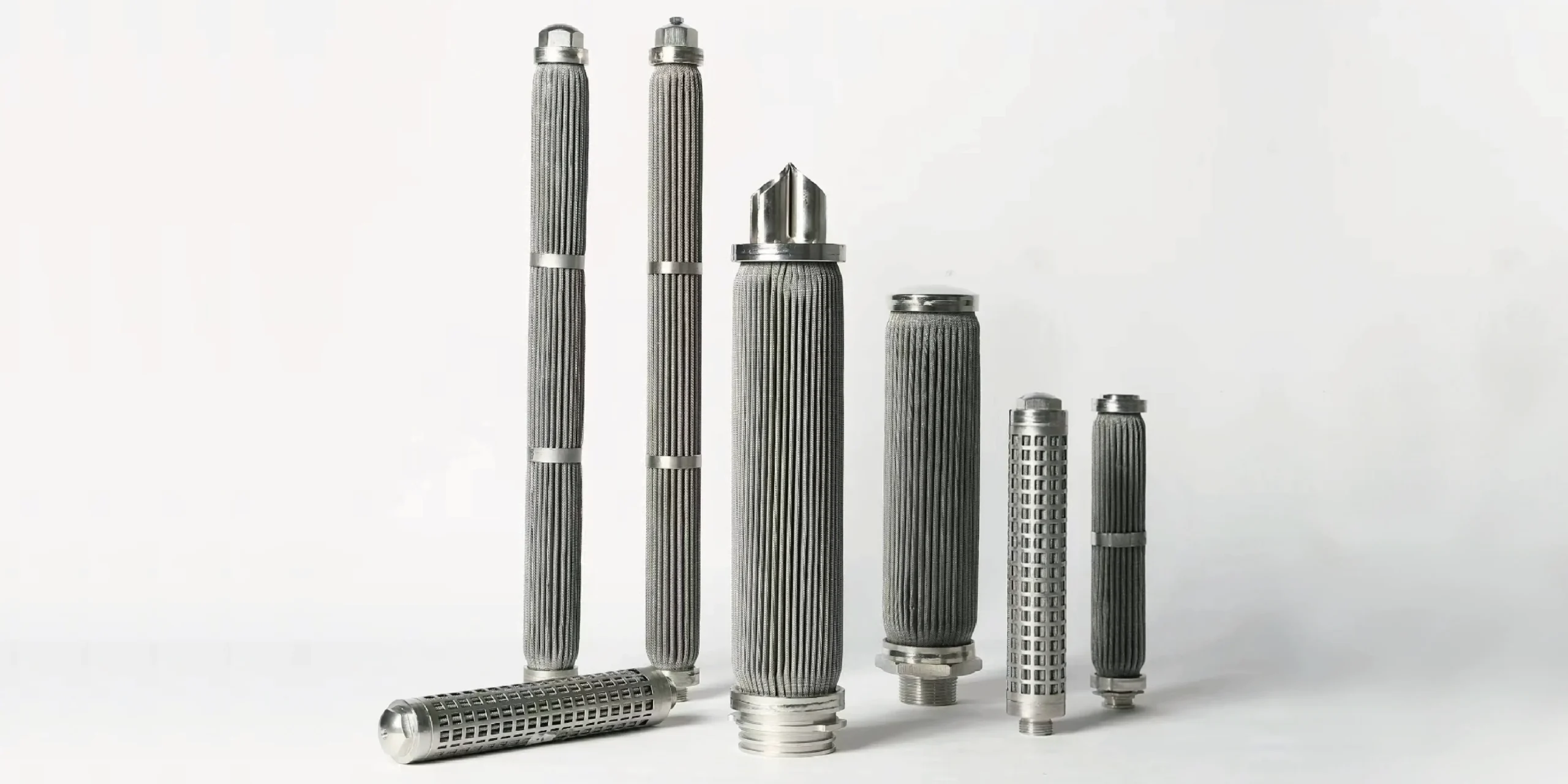
Start With the Assembly, Not the Material Name
Pleats increase the amount of sheet medium that can fit within an element envelope. The filtering medium must still be supported, joined to the end caps and kept accessible to flow. The support layers, inner core, outer guard, seams and end connection all contribute to the finished assembly.
A medium that works as a flat sheet is not automatically suitable for every pleat geometry. Its thickness, stiffness and layer construction influence how it can be formed and supported. Confirm feasibility for the selected grade and dimensions rather than assuming that every sintered mesh or felt can be folded into the same shape.
In an outside-to-inside design, fluid approaches the outer side, passes through the medium and moves toward the inner passage. Other flow arrangements exist. Support and permissible differential pressure must match the actual direction; reverse cleaning adds another loading case. Our pleated cartridge working-principle guide explains the flow path.

Compare the Media in a Pleated Cartridge
| Medium | General behavior | Pleated-assembly question |
|---|---|---|
| Woven wire mesh | Interwoven wires produce openings; surface screening can be important. | Which weave, support and seam arrangement meet the required opening and loading duty? |
| Sintered wire mesh | Bonded mesh layers form a defined multilayer structure. | Can the chosen structure be pleated to the required geometry and adequately supported? |
| Sintered metal fiber felt | Bonded metal fibers form a porous network that can capture particles within its depth. | How will the selected felt, support layers and pleat channels load and be cleaned? |
These descriptions are starting points. Actual pore structure, strength, efficiency, permeability and cleaning behavior vary by grade and construction. A broad material name cannot replace a specification for the finished element.
Woven Wire Mesh: Check the Weave and Support
Woven wire mesh uses interlaced wires and openings determined by the weave. It can provide a useful screening surface for certain particles. However, the visible opening of an outer protective mesh is not necessarily the controlling filtration layer of a multilayer cartridge.
When mesh is pleated, specify the actual filtering layer, any drainage or protective mesh, the pleat geometry and the support on each side. A relatively flexible layer may need additional support against the intended differential pressure. The correct construction depends on the direction of normal flow and any reverse-flow duty.
Ask how the quoted opening or micron value is defined. An aperture measurement, a nominal removal rating and an efficiency measured using a particular test method answer different questions. Do not assume that a familiar micron number alone establishes how particles of different shapes will behave.
Sintered Mesh: Check the Actual Layer Stack
Sintered mesh bonds layers of wire mesh into a multilayer medium. The layers can perform different roles, such as filtration, support and protection. Its mechanical behavior depends on the specific stack and how it is incorporated into the element.
Sintering and pleating describe different things: one concerns how a medium is bonded, and the other describes the cartridge geometry. A suitable sintered mesh can be used in a pleated element; the terms are not mutually exclusive. Ask the manufacturer which construction is being quoted and whether the selected stack can be formed for the required envelope.
Review the location of the controlling layer, joint design, pleat spacing and any added core or guard. The medium's properties alone do not establish the pressure capability of the welded assembly. Confirm normal and reverse differential-pressure duties for the complete element. The sintered mesh product page describes this broader product family.
Metal Fiber Felt: Consider Depth Loading and Recovery
Sintered metal fiber felt is made from a network of bonded metal fibers. Depending on its grade and structure, particles may be retained within the thickness as well as on the surface. Pleating can accommodate additional media area within an element, but the actual benefit depends on the chosen grade, the assembly and the fluid.
Depth capture and surface screening are not fixed labels for every real contaminant. A mixture of hard particles, deformable material and deposits may load differently from an idealized example. Ask for evidence relevant to the filtration requirement and representative duty rather than assuming a fixed service-life advantage.
Porvair's metal-fiber description describes a pleatable sintered fiber medium. Its product-specific specifications do not establish ratings for SINFT elements. SINFT's sintered fiber felt page outlines its own product family; the complete pleated assembly must be specified separately.
Pleat Spacing, Pressure Drop and Loading
More pleats can increase geometric media area, but available area is only useful where fluid can reach it. Closely spaced channels, support contact and deposits can change flow distribution. Sticky or fibrous contaminants may obstruct channels differently from hard particles.
Compare clean pressure drop at the same flow, fluid, temperature, viscosity and measurement boundary. Also ask what is included in the pressure reading: medium alone, the finished cartridge or the complete housing. A cartridge's resistance is influenced by the core, support layers and fittings as well as the medium.
The pleated cartridge pressure-drop guide explains clean and loaded conditions in more detail. No fixed ranking of these three media by pressure drop or service life is valid without comparable grades and operating conditions.
Cleaning: Ask Where the Contaminant Goes
The intended cleaning method is part of media selection. A deposit held mainly on an accessible surface may respond differently from material trapped within a porous depth structure or bridged between pleats. This does not mean every surface medium is easy to clean or that every depth medium cannot be regenerated.
Identify the contaminant, permitted cleaning fluid and temperature, accessibility of the pleats, seals and joints, and the desired acceptance checks after cleaning. A lower pressure drop after cleaning can indicate reduced resistance, but it does not independently prove the medium and seals remain intact. Damage or bypass can also reduce the reading.
Backwashing reverses loading on the medium and support. Confirm whether the complete assembly is designed for the proposed reverse direction and pressure. Do not infer unlimited backwash capability or a cleaning-cycle guarantee from the words stainless steel or sintered. The flow-direction guide discusses support and reverse loading.
Match Rating and Operating Duty
Start with the protected equipment or process requirement and the particles of concern. Then define the rating convention, test method and required efficiency where applicable. The same micron label may be used differently across products; a medium's visible weave or pore description is not a universal efficiency claim.
Record normal and maximum flow, fluid composition and viscosity at the relevant temperature, operating pressure, forward and reverse differential pressures, and the available housing envelope. For a hydraulic application, include cold-start conditions where relevant. Materials, seals and the complete welded assembly must all suit the duty.
Pall's media overview distinguishes wire mesh and metal fiber structures in its own range. Such descriptions help identify engineering questions but do not make one product's pressure, temperature or filtration rating applicable to another supplier.
Questions to Put in Your RFQ
| Question | Information to provide or confirm |
|---|---|
| Required result | Protected equipment, particle concern, rating definition and test basis. |
| Fluid and flow | Fluid, temperature, viscosity where known, normal and maximum flow. |
| Construction | Preferred medium if known, pleat envelope, layers, core and guard. |
| Mechanical duty | Flow direction and forward/reverse differential-pressure requirements. |
| Cleaning | Proposed method, chemical compatibility and post-cleaning acceptance. |
| Fit and records | Drawing, end connection, seal, housing dimensions and required documents. |
For replacement projects, include the old part number and a drawing or sample where available. If the old media or test basis is unknown, identify that gap. Two cartridges that fit the same housing may not provide equivalent removal, resistance or cleaning performance.
SINFT offers pleated filter cartridges using woven mesh, sintered mesh or sintered fiber felt, subject to construction and duty review. For a detailed selection workflow, see the pleated cartridge selection guide. Send drawings and operating data through the custom filter manufacturer page or contact inquiry form.
Frequently Asked Questions
Is pleated sintered mesh different from a pleated wire mesh cartridge?
Sintered mesh is a bonded multilayer mesh construction, while woven mesh describes interlaced wires. Either may be incorporated into a pleated assembly where the selected grade and design permit it. Ask for the actual layer stack, filtering layer, support and joint design. Similar external geometry does not establish the same mechanical capability or particle-removal performance.
Is metal fiber felt always a depth filter?
Its bonded fiber network can retain particles within its thickness, but actual capture and loading depend on the specific grade and contaminant. Surface deposits may also form. Discuss the required removal performance, particle characteristics and cleaning duty with the supplier. Do not infer a guaranteed service life or regeneration result from the general term fiber felt.
Does a smaller micron number guarantee cleaner output?
Not by itself. Establish whether the figure refers to an opening, nominal rating or an efficiency at a stated particle size and test condition. Different methods and test contaminants may produce different claims. Compare evidence on a consistent basis and define the process requirement. A number without its rating convention cannot establish equivalent performance between two quoted media.
Which medium has the lowest pressure drop?
There is no universal winner across all grades and cartridge designs. Media thickness, pore structure, pleat area, support layers, core and fluid conditions all contribute. Compare clean pressure-drop information for the finished element at the same flow, temperature and fluid. Loaded performance also depends on the contaminant and should not be inferred from clean resistance alone.
Can any sintered mesh be folded into pleats?
No. Pleatability depends on the actual layer stack, thickness, material and required geometry. A suitable construction must be evaluated with the end joints and support arrangement for the intended duty. Provide the envelope, rating and mechanical requirements to the supplier. Do not assume that every rigid sheet can be formed into the same fold profile without affecting the assembly.
Is a pleated metal cartridge always reusable?
Metal construction can support cleaning in suitable applications, but reusability depends on the contaminant, media, joints, seals and approved cleaning method. Establish whether deposits can be removed without damaging the element and what post-cleaning checks are required. Neither a metal material nor a low pressure drop after cleaning proves that the cartridge remains intact or fit for further service.
Can the same pleated element be backwashed?
Only when the complete assembly is designed and approved for the proposed reverse-flow duty. Reverse differential pressure changes the load on the media and supports, and cleaning chemicals or temperature may affect the seals and joints. Confirm the permitted method and limits for the specific cartridge. Similar appearance or media type alone does not establish equivalent reverse capability.
What should I send when replacing an unknown cartridge?
Provide the old part identification, housing and end-connection drawings, dimensions, fluid, flow, temperature, filtration objective and cleaning requirements. A sample and clear photographs may help identify construction, but visible appearance does not establish its rating or material. Identify unknowns explicitly so they can be resolved before the replacement drawing and performance requirements are approved.
Final Thoughts
The right pleated medium is the one that meets the removal and operating requirements as part of a supported, sealed assembly. Consider how the selected grade can be pleated, how contaminants will load it and how cleaning will be verified. Send SINFT the fluid conditions, target performance and housing details so the media and complete cartridge can be reviewed together.