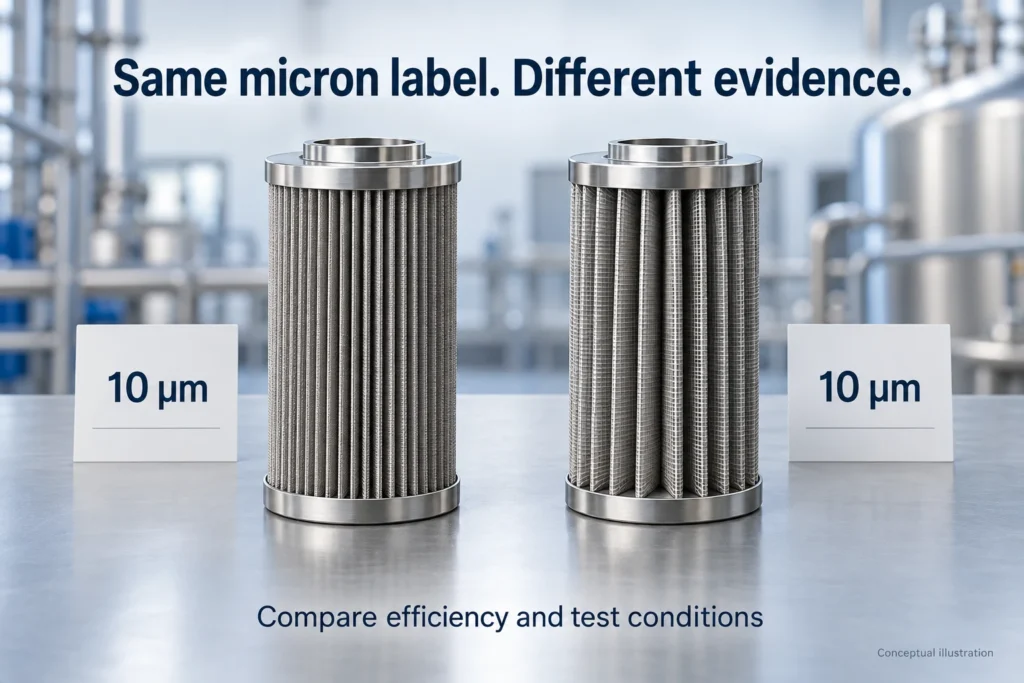
Two quotations both say “10-micron stainless steel filter element.” One costs less, both fit the housing, and neither quotation explains how many particles pass through. Are they interchangeable? Not on that information alone. Comparing filtration efficiency vs micron rating means separating a particle-size label from a measured removal claim—and checking whether the test behind that claim represents the element and duty you intend to buy.
Direct Answer: Filtration Efficiency vs Micron Rating
Micron rating identifies a particle-size reference; filtration efficiency describes the proportion of particles removed at a stated size under defined conditions. A “10-micron” label alone does not establish a removal percentage, test method or service result. Two elements can carry that label but differ in efficiency, construction, reporting basis or installation integrity. Specify the size and efficiency together, supported by a test method and relevant operating conditions.
For purchasing, the useful question is not simply “How many microns?” It is: “What removal performance is required at which particle size, and what evidence supports it?”
What the Rating Tells You—and What It Leaves Unsaid
A micron, or micrometre, is a unit of length. In a filter specification it needs a definition: is the number a particle-retention reference, a nominal label, a measured opening, or another characteristic? Those are not automatically the same measurement. Our industrial filter micron rating chart covers size references; the decision here is whether the accompanying performance evidence is adequate.
Efficiency needs an equally clear basis. “99% removal” is incomplete without a particle size and measurement method. Removal by particle count is not interchangeable with removal by contaminant mass: a few large particles can contribute considerable mass while many smaller particles remain in the fluid. Likewise, a cumulative count at or above a threshold is different from a narrow size interval around that threshold.
The words nominal and absolute also need the supplier's definition. Do not assume every nominal rating means the same percentage, or that every absolute rating guarantees zero passage in service. Pall's liquid-filtration discussion explains why rating terminology and test methods must accompany a removal claim. The practical response is to request the definition, not to compare adjectives. Pall: Understanding Particle Removal Performance in Liquids
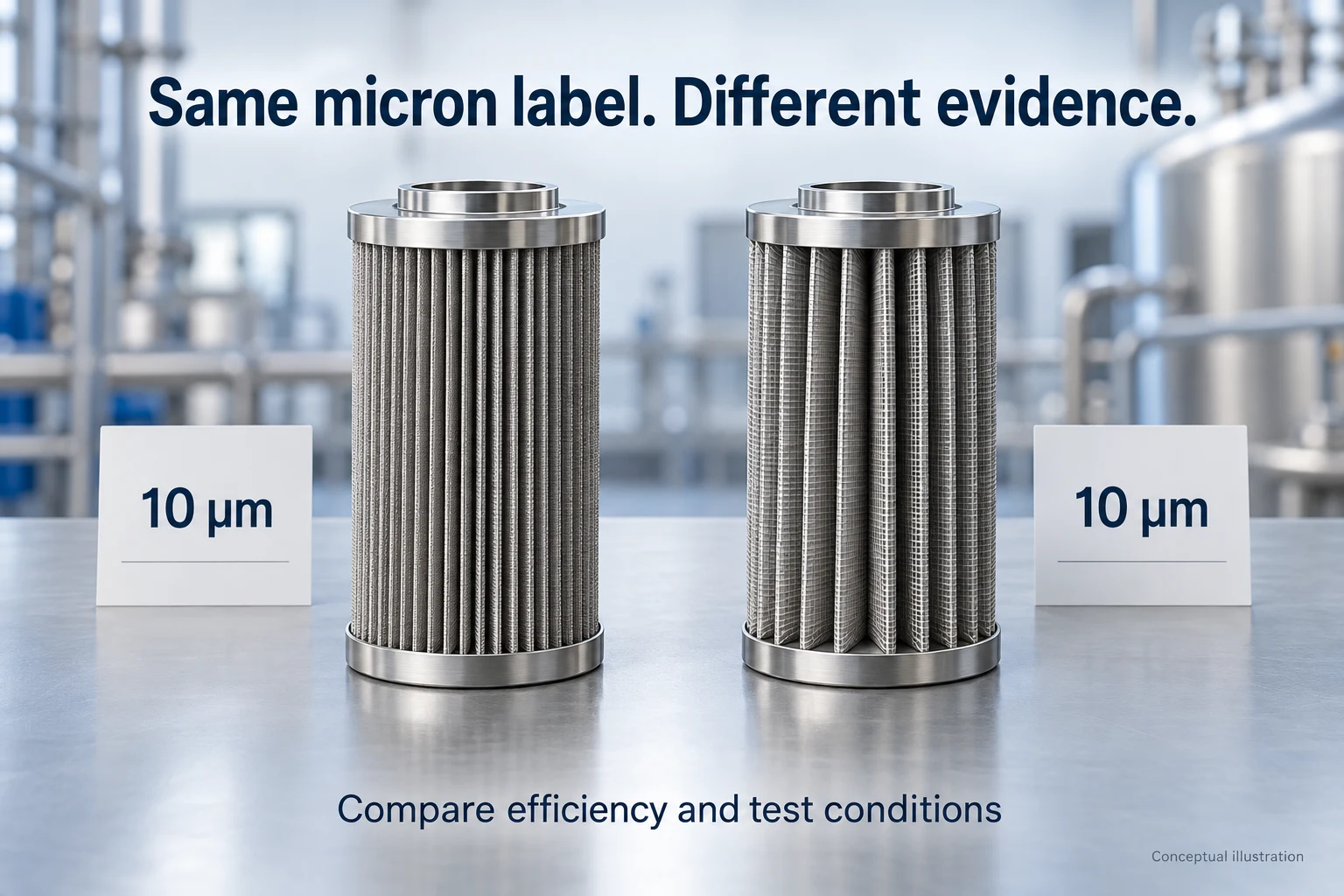
For example, “10 µm nominal” and “10 µm at a stated beta ratio” are not yet equivalent specifications. The first may be an insufficiently defined label; the second provides a numerical relationship, but still needs the test conditions. Neither replaces checking material compatibility, flow capacity, structural support or the seal arrangement.
A Worked Example: Same 10-Micron Label, Different Particle Passage
The beta ratio compares upstream and downstream particle concentrations at the same size threshold. For cumulative counts at or above size x:
βx = upstream particle concentration ≥ x ÷ downstream particle concentration ≥ x
Efficiency at x = (1 − 1 ÷ βx) × 100%
Use compatible sampling intervals and equal sampled volumes, or concentrations correctly normalized to volume. Dividing raw counts from unequal volumes produces a misleading ratio. Donaldson's beta-rating explanation establishes the relationship between size-specific beta and removal efficiency. Donaldson: Understanding Beta Ratings
Consider the following hypothetical teaching example, not SINFT test data. Both filters are evaluated with the same fluid, flow, challenge material, particle-sizing basis and sampling conditions. Counts refer to particles at or above 10 µm per unit volume.
| Comparison item | Illustrative filter A | Illustrative filter B |
|---|---|---|
| Quotation label | 10 micron | 10 micron |
| Upstream particle concentration | 10,000 | 10,000 |
| Downstream particle concentration | 500 | 10 |
| Calculated beta ratio at the stated threshold | 10,000 ÷ 500 = 20 | 10,000 ÷ 10 = 1,000 |
| Calculated removal efficiency | 95% | 99.9% |
| Fraction passing in this example | 5% | 0.1% |
Filter A passes 50 times as many counted particles as filter B in this matched example: 500 ÷ 10 = 50. That does not mean 50 times the equipment wear, 50 times the maintenance cost or a particular service life. It demonstrates why a small-looking difference in percentage efficiency can conceal a much larger difference in particle passage.
Conversely, a high beta number without a particle size is not a complete rating. A result at 20 µm does not establish the same efficiency at 10 µm. Ask for the relevant part of the efficiency curve or size-by-size results rather than extrapolating from the most favorable headline value.
A reported zero downstream count also needs care. A finite sample with no detected particles does not prove that every particle will always be stopped. The report should state how detection limits, counting statistics and any reported lower bound on beta are handled. Do not turn “none detected in this sample” into an unlimited or permanent performance guarantee.
How to Compare Two Supplier Reports Fairly
Put the supporting documents beside the quotations before comparing price. First identify whether each result describes a sheet of media, a prototype, a complete production element or an installed assembly. Evidence from a media coupon can inform material selection, but does not automatically include the seams, end bonds and seals of the finished cartridge.
Then check the reporting basis. A clean-element result, a time-averaged result and a result near the test endpoint describe different states. A single-pass experiment and a recirculating multipass test also expose the filter differently. Neither label alone tells you which report is suitable; the issue is whether the method and reporting interval address your requirement.
| Item to compare | Question for the supplier | Why it affects the decision |
|---|---|---|
| Particle size and counting basis | Is the result cumulative or a size interval? Which sizing/calibration basis is used? | Similar-looking size labels may not represent identical measurements. |
| Removal claim | What efficiency or beta applies at the required size? | A micron label alone cannot quantify particle passage. |
| Method and challenge | Which test method, fluid and contaminant were used? | Results from different challenges may not be directly comparable. |
| Flow and fluid condition | What flow, temperature and viscosity were maintained? | The test must be interpreted against the intended duty. |
| Loading and reporting interval | Is this initial, averaged, endpoint or another defined result? | A selected favorable interval can hide variation during loading. |
| Test article | Which media, dimensions, support, seams and end connections were tested? | The evidence must be connected to the proposed construction. |
| Traceability and limits | Is there a report identifier, revision and stated applicability? | A number without a traceable test basis is difficult to accept contractually. |
Mark genuinely comparable entries first. If one report lacks the information, record it as unconfirmed, not as automatically worse or equivalent. Request clarification before approving a substitution. This keeps the commercial discussion focused: the lower quotation may still be appropriate, but the missing evidence should not be silently converted into a performance assumption.
Particle calibration deserves particular attention when reports use µm(c). Keep that notation and its calibration basis intact instead of silently rewriting it as a different sizing convention. ISO 11171:2022 addresses calibration of automatic particle counters within its stated liquid scope; the “(c)” notation is not an extra efficiency grade. ISO 11171:2022 public abstract
What Standardized Tests Can—and Cannot—Establish
ISO 16889:2022 is a multipass method for hydraulic fluid power filter elements, addressing particle removal, contaminant capacity and differential-pressure characteristics within a defined test scope. A relevant report can provide a structured basis for hydraulic comparisons. It is not automatically a qualification method for every water, gas, chemical or polymer-melt application. ISO 16889:2022 public abstract
Check the edition, applicable size range, test conditions and identity of the tested element. “Tested to ISO” without those details is not enough for technical acceptance. Also distinguish a complete report from a brochure statement summarizing an unidentified product family. This article does not claim that every SINFT element has an ISO 16889 report; test availability and the required acceptance basis must be confirmed for the specific project.
Integrity testing answers a different question. Bubble-point or fabrication-integrity checks can help identify unacceptable openings or construction defects under an appropriate procedure. They should not be converted directly into a particle-removal percentage. ISO 2942:2018 explicitly separates its first-bubble-point determination from estimating filtration rating, efficiency or retention capacity. ISO 2942:2018 public abstract
The same caution applies to air permeability and pressure-drop measurements. They describe flow behavior under stated conditions, not a complete particle-retention result. For the role of each inspection, see our filter element testing methods guide. A sensible acceptance plan uses complementary evidence rather than asking one convenient test to prove everything.
Why the Complete Element Can Perform Differently
Media structure and available filtration area
The media's structure influences how particles encounter and are retained by the filter. A woven or sintered mesh structure and a metal fiber felt structure need not behave identically just because their catalog labels match. Particle shape, distribution and deformability also matter; a spherical laboratory challenge does not reproduce every process contaminant.
Available area is another design variable, but “more area” is not itself an efficiency certificate. Pleat spacing, usable area, support and flow distribution must be considered with the media. A compact element that fits mechanically may expose the media to a different operating condition than the qualified design. Ask whether the proposed dimensions and construction are covered by the supplied evidence.
Seals, joints and bypass paths
Good media cannot compensate for fluid that avoids it. An unsuitable end connection, damaged seal, poorly seated element or defective joint can create a route around the filtration layer. A housing bypass valve, where fitted, introduces another operating condition to understand. The assembly therefore needs both a retention requirement and an installation/integrity check appropriate to its design.
Do not conclude that a low differential pressure proves high efficiency—or that low pressure drop necessarily means a defect. It may reflect appropriate area and a clean element, different fluid conditions, or an unintended flow path. Use the relationship between filter pressure drop and flow rate to interpret resistance separately from particle-removal evidence.
Loading, operating changes and cleaning
A clean-element result is not a promise of unchanged behavior throughout service. Loading can change resistance and particle capture; unstable conditions or damaged construction can change passage. Determine which interval of the test supports the claim and whether relevant changes in actual operation have been considered. Avoid assuming that a growing particle cake is always a reliable way to achieve the required filtration.
For reusable metal elements, restored flow after cleaning is useful but incomplete evidence. A cartridge may flow freely while a seam, filtration layer or seal has been damaged. Define the approved cleaning process and post-cleaning acceptance checks. Routine integrity checks can support continued use, but should not be described as repeating a complete efficiency qualification unless that qualification was actually performed.
Match the Evidence to Your Application
Hydraulic and lubrication systems: Start with the equipment manufacturer's contamination-control requirement and the protected components, not a generic “10-micron” replacement rule. For hydraulic filtration applications, connect the efficiency requirement to the correct system position, actual oil conditions, flow, installation and relevant structural limits. A laboratory retention claim and the system's achieved cleanliness are related, but not interchangeable: contamination ingress and operating conditions still matter.
Polymer melt and high-viscosity processing: Define the defect or contamination problem. Hard particles, soft gels and deformable material may not behave alike. An oil-based particle-count result alone cannot establish performance for a hot polymer process. In polymer melt filtration, media construction, thermal and chemical compatibility, support, cleanability and process-specific acceptance must be considered together. Agree how product-quality results will be evaluated without attributing every downstream defect to the filter.
Water and chemical liquids: State whether the objective is equipment protection, visible-particle control or a specified process quality. Confirm compatibility with the liquid and cleaning chemicals. If a claim is based on gravimetric removal, do not compare it directly with a particle-count efficiency percentage. Where actual contamination differs substantially from the test challenge, a relevant trial or additional qualification may be needed before acceptance.
Gas and contamination-sensitive production: Do not transfer a liquid test result to gas duty without an appropriate technical basis. Define particle type, gas conditions and the relevant performance method. Likewise, a particulate micron label does not establish microbial retention, sterilizing performance or regulatory suitability for food or pharmaceutical production. Those are separate claims requiring their own validation and project-specific requirements.
Choosing a SINFT Metal Filter Construction
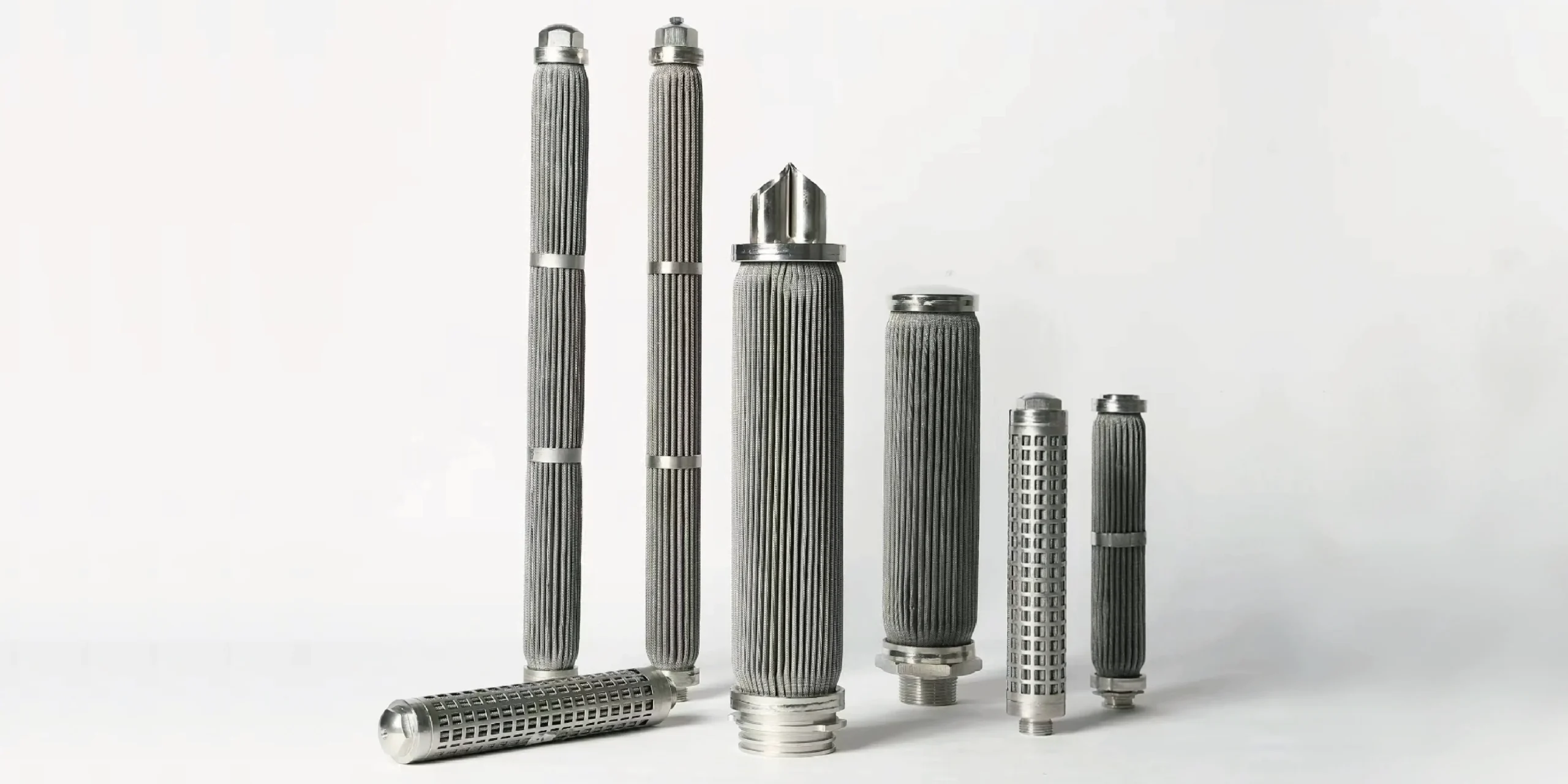
Use the product family to start a design discussion, not as a substitute for a complete specification. Pleated metal filter cartridges are relevant when filtration area must fit within a defined envelope. Confirm the proposed media, support, dimensions, connection and flow conditions rather than assuming every pleated cartridge has the same performance.
Sintered mesh filter elements and sintered fiber felt media offer different structures for discussion with your application requirements. Neither family name alone proves the efficiency at your target particle size. For a replacement, send the existing drawing or sample information together with the performance requirement; copying only outside diameter and length leaves important questions unanswered.
SINFT's custom filter manufacturing service can be the starting point for reviewing a drawing-based element. Confirm the required documents, available test arrangements and acceptance scope during quotation. Do not assume a particular third-party qualification, beta rating or production test is included unless it is explicitly agreed.
Put a Measurable Requirement in the RFQ
Instead of writing only “10 µm stainless steel cartridge,” include the following information:
- Purpose and target: Protected equipment or product-quality objective, relevant particle size and required removal efficiency or beta ratio, agreed with the responsible engineer.
- Measurement basis: Particle count or mass, cumulative threshold or size interval, particle-sizing/calibration convention and required reporting interval.
- Service conditions: Fluid or gas, composition, temperature, viscosity where relevant, normal/maximum flow, pressure conditions and permitted differential-pressure limits from the approved design.
- Construction: Media, material, usable dimensions, support, flow direction, end connection, seals and the drawing revision to be supplied.
- Evidence: Applicable test method and edition, challenge conditions, identity of the test article, report requirements and limits on extrapolation to other constructions.
- Supply and reuse: Routine inspection, traceability, packaging, approved cleaning conditions and post-cleaning acceptance where relevant.
A useful quotation instruction is:
State the proposed particle-removal performance at the specified size, including efficiency or beta ratio and its measurement basis. Identify the supporting method, conditions and tested construction. List any differences between the tested element and the quoted design, and confirm which qualification and production documents are included. Obtain written agreement before changing the approved media or construction.
This wording deliberately does not invent a universal efficiency target. The appropriate target belongs to the application, equipment requirements and agreed validation plan. If that target is not yet known, identify the uncertainty and resolve it before treating competing quotations as technically equivalent.
From Qualification to Incoming Acceptance
Keep design qualification separate from routine shipment checks. Qualification establishes evidence for the agreed design and duty; production controls help verify that delivered items match that design. Not every shipment needs every qualification test, but the inspection plan should say which checks apply, which documents are supplied and what changes trigger review.
At receiving, reconcile the purchase order, approved drawing, part identification and agreed reports. A report for another media grade or element length should prompt a technical review of applicability, not automatic acceptance. Record deviations and approvals so the next replacement order does not repeat the uncertainty.
After installation, use the approved startup and monitoring plan. Unexpected downstream particles require investigation of sampling, contamination introduced during maintenance, upstream changes and possible bypass or damage. A field particle count is valuable evidence, but a single reading does not by itself isolate the cartridge's intrinsic efficiency.
If you need help defining a replacement or new metal element, send SINFT your drawing, operating conditions and filtration requirement. Include the existing performance documents where available. That makes it possible to discuss construction and evidence together, rather than quote an apparently matching micron label with an undefined acceptance standard.
Frequently Asked Questions
Is a 10-micron filter guaranteed to stop every particle larger than 10 microns?
No. The label alone does not establish that guarantee. Ask what the rating means, what removal percentage applies at the stated size, and which test supports it. Even a strong media result does not eliminate assembly bypass or installation defects. Evaluate the complete element and its operating conditions, rather than treating the label as an impermeable size boundary.
What is the difference between beta ratio and filtration efficiency?
They express related particle-removal information on different scales. Beta is the upstream-to-downstream particle concentration ratio at a stated size; efficiency is the corresponding removed fraction. Calculate efficiency as (1 − 1/β) × 100%. Always retain the particle-size threshold and reporting basis: beta values at different sizes or under incompatible tests are not automatically comparable.
Does an absolute micron rating always mean 100% efficiency?
Do not assume so. Ask the supplier to define the term and provide the associated removal criterion and method. Rating terminology varies, and a finite laboratory result is not an unlimited field guarantee. For a purchase specification, a defined particle size, efficiency, test basis and construction reference are more useful than the word “absolute” on its own.
Can bubble point prove a cartridge's filtration efficiency?
Not by itself. An appropriate bubble-point or fabrication-integrity procedure can support checking the integrity of a wetted porous structure, but its result is not a direct particle-count efficiency measurement. Keep the two requirements separate in the acceptance plan. If removal performance matters, request relevant retention evidence rather than converting a bubble-point pressure into an unsupported efficiency percentage.
Is a higher-efficiency filter always the better purchase?
Only if it meets the complete duty. The required particle control must be considered with flow, resistance, loading, material compatibility, strength, fit and maintenance. A higher headline percentage does not excuse an unsuitable connection or inadequate flow capacity. Compare technically suitable designs against the application's agreed requirement before deciding whether additional removal performance justifies its overall cost.
Can I use a hydraulic beta report for polymer melt or gas service?
It may provide background information, but it does not automatically qualify those duties. Check the method's scope, test fluid, contaminant and operating conditions against your application. Polymer deformability and gas conditions can require a different evaluation. Ask the responsible engineer and supplier to agree what additional evidence is necessary instead of transferring an oil-test claim without justification.
Does cleaning restore the original micron rating and efficiency?
Cleaning can remove deposits, but recovered flow alone does not prove restored particle retention. Media, joints, support or seals may have changed or been damaged. Use the approved cleaning procedure and agreed post-cleaning checks. If the application requires renewed efficiency qualification, state that explicitly; do not describe a routine integrity or flow check as equivalent to a complete retention test.
What should I send when requesting a replacement filter quotation?
Send the drawing or sample details, material, dimensions, connections, seals, flow direction and operating conditions. Also include the required particle size, removal efficiency or beta ratio, and supporting report requirements. If the old documentation says only “10 micron,” flag that uncertainty. It is better to resolve the performance basis during quotation than discover after installation that the replacement was specified only by appearance.
Final Thoughts
A micron label is a starting point, not a complete performance specification. Compare the relevant particle size, removal efficiency, test conditions and construction before treating two elements as equivalent. Then verify fit, integrity and operating suitability. For industrial purchasing, the strongest specification is one that connects the contamination-control objective to traceable evidence—and clearly states what remains unconfirmed before the order is placed.