Two suppliers quote a 10 µm sintered mesh cartridge. One attaches a report for a flat mesh sample. The other sends a report for a finished cartridge, but the model number differs from the one on the quote. You still have two open questions: what the number means and which part the evidence covers. Answer both before you decide whether the proposed filters are equivalent.
What Does a 10 µm Sintered Mesh Filter Micron Rating Mean?
A 10 µm rating describes a filtration grade on a stated basis. Ask whether it refers to an opening or pore-size measurement, a supplier's nominal grade, or a stated particle retention result. For a retention claim, request the method, reported efficiency or ratio, test conditions, and identification of the specimen. A grade label alone does not supply those details.
On sintered wire mesh, the fine control layer is the starting point. To judge the replacement, also check whether the offered laminate has the same construction and whether the finished element gives the fluid a path around the media. The general filtration efficiency guide explains the numerical basis for comparing removal claims.
The Control Layer Sets the Starting Point
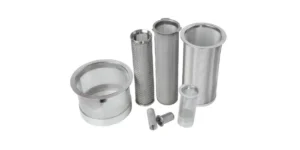
A multilayer sintered mesh can combine a fine woven control layer with layers that protect it, distribute flow, or provide mechanical support. The outer layer you can see on a cartridge may have comparatively large openings. A photograph can show the general construction, but it may not show the fine layer that determines the intended filtration grade.
Ask which layer controls the rating and which side faces the incoming fluid in the proposed assembly. If you are replacing an element, record the old drawing revision and flow direction. A change in stack orientation, supporting structure, or effective area can affect how the replacement behaves even if the quoted grade stays the same. The five-layer sintered wire mesh guide shows the functions that different layers can serve.
Why weave matters more than a mesh count alone
For a simple square weave, both wire diameter and spacing matter. With a Dutch weave, the flow passes through a more complex path between wires, so a face view or mesh count alone does not describe the controlling passage. When the supplier gives a mesh count, ask for the weave designation and how it relates to the quoted filtration grade. Request the grade for the finished laminate rather than trying to derive it from the visible support layer.
A drawing can specify the layer arrangement and the direction of flow. It may not need to disclose every manufacturing detail for the buyer to verify the offer. A controlled media grade or laminate code, tied to the correct drawing revision and supporting report, gives both sides a consistent reference for future orders.
Read the Evidence in the Right Order
First ask what was measured. Then ask which part was tested. Finally check whether the test conditions and acceptance requirement match the purchase. Several documents can be useful on the same order because each answers a different question.
| Evidence on the quote | What it can help confirm | What to ask next |
|---|---|---|
| Media data sheet or weave specification | Which laminate grade and control layer the supplier proposes | Is the rating a measured opening, a nominal grade, or a retention claim? |
| Bubble test on a mesh specimen | A pore-related quality control result under the stated procedure | Which liquid, method, specimen, and acceptance limit were used? |
| Integrity check on a finished element | Whether the tested assembly met the agreed check under its test conditions | Which joints and seals were in the test boundary, and which assembly was tested? |
| Particle retention report | The reported removal performance of the specimen in that test | Is the offered build covered, and are the fluid, particle size basis, and duty relevant? |
| Material certificate | Alloy and traceability information for the material described | Which records establish the media grade and filtration result? |
The ISO 4003 abstract describes a bubble test for permeable sintered metal materials as a quality control method, with limits on what it establishes about filter grade and pore-size distribution. A bubble result and a removal efficiency answer different questions. An element integrity check can also help identify an abnormal path when the procedure and acceptance criteria are appropriate. See the bubble point testing guide for how to read the report.
For a hydraulic element, the ISO 16889 abstract gives an example of a multi-pass performance test under defined conditions. Ask the supplier which method is relevant to your service. A hydraulic test report may be useful within its scope, but gas service or a viscous process fluid can call for a different qualification approach.
Trace the Evidence to the Offered Element
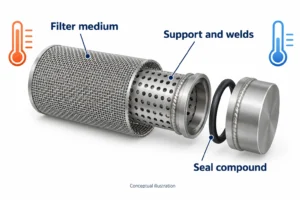
A flat coupon can establish a reference for the laminate as supplied. The finished cartridge adds formed media, edges, welds, end fittings, and sometimes a seal. Ask which of these were included in the test. A coupon report cannot show whether fluid can bypass the mesh at a joint or mounting interface on the complete assembly.
Consider two hypothetical offers. Quote A gives a 10 µm grade code and a bubble test record on a flat coupon. Quote B includes a finished element retention report for another model in the same product family. Start by asking A for the definition of the grade and the agreed check on the assembly. Ask B to identify what is shared between the tested model and the offered one, including the laminate, geometry, joints, and intended flow direction. Either quote may turn out to have relevant evidence once those links are established.
Also confirm whether the report is a qualification test, a batch record, or an individual unit check. A qualification report can help justify a design. An incoming inspection or batch record serves a different purpose. Specify which documents must accompany delivery and how they should be linked to the part number or drawing revision.
What to Confirm Before Requesting a Quote
Send the original part number, drawing or sample details, and the problem the replacement must solve. In a hydraulic or lubrication system, describe the component being protected and where the element sits in the circuit. Include the process fluid, normal and peak flow, temperature, viscosity if known, flow direction, and allowable differential pressure. Add the cleaning method if the element is reused.
| RFQ item | What to put in writing |
|---|---|
| Retention requirement | Target particle size and required evidence, or the original grade and its documented basis |
| Laminate | Known weave or grade code, stack orientation, and any required support configuration |
| Assembly | Drawing revision, connection and seal details, and normal and reverse flow if applicable |
| Test evidence | Method, tested item, acceptance criteria, and which records must ship with the order |
| Open questions | Missing data and which decisions require buyer approval before manufacture |
When the original part is marked only “10 µm,” include the label as a reference and tell the supplier how it was obtained. Agree the performance requirement for the new element before converting that marking into an acceptance criterion. For an older housing, confirm fit separately with the replacement measurement guide and the approved drawing.
How SINFT Can Help
SINFT supplies sintered mesh filter elements and reviews custom filter replacement requests based on the drawing, sample, and operating conditions. If the grade basis is unclear, include the original quote or data sheet with the information available on the installed part. Confirm the proposed laminate, element construction, and applicable documentation during quotation. Send the specification for review.
Frequently Asked Questions
Does 10 µm mean the same thing on every sintered mesh quotation?
Suppliers can use the same number for different grade definitions. Ask whether it describes a pore or opening measurement, a supplier classification, or a measured retention result. For a performance claim, request the test method, result, and identification of the tested item. Compare quotes only after you have established that the numbers use a comparable basis.
Can I identify the grade from the outside weave?
The visible layer may serve as protection or support. Its openings may look larger than the passages in the control layer inside the laminate. Identify the control layer through the drawing, laminate grade code, or supplier documentation. A clear photograph is useful for recognizing the element construction, but the grade still needs supporting evidence tied to that construction.
Do two filters with the same control layer perform identically?
The control layer can be common while the supports, active area, flow direction, joints, or seal arrangement differ. Those features affect the flow path and can influence the performance of the finished assembly. Ask which construction was tested and whether the proposed element uses the same build or has separately agreed evidence for its intended service.
Can a bubble test establish the retention efficiency at 10 µm?
A bubble test observes gas passage through a wetted specimen under defined conditions. It can support a pore-related quality check or an agreed integrity assessment. A claim about particle removal at 10 µm needs evidence that addresses particle retention. Ask what the test measured and whether it was performed on a laminate specimen or on a finished assembly.
Is a test report for a flat sample useful when buying a cartridge?
Yes, when it identifies the laminate and the reported result is relevant to the specification. It can support a media grade check before fabrication. For a finished cartridge, review how the supplier will address the seam, end joints, and sealing interface. Confirm which document applies to each part of the purchase and what must be verified at delivery.
How do I specify a replacement if the old filter has no report?
Share the old part number, drawing or sample, and any marking on the element. Add the fluid, flow, operating conditions, and the particle size or downstream requirement you need to meet. Ask the supplier to propose a grade and explain its evidence. Agree the finished assembly and acceptance criteria before releasing the order for manufacture.
Does a finer grade always require changing the housing?
The answer depends on clean and loaded pressure drop, available area, flow, and the construction that fits the housing. A finer grade can require more area or a different laminate to meet the same duty. Compare the proposed element at your operating conditions and verify the existing clearances, connections, and sealing arrangement before committing to the change.
Which documents should accompany the first order?
Agree the documents that support the actual acceptance requirement. These may include the approved drawing, a media grade reference, material traceability, or a test record with the method and specimen identified. If a qualification report is used, ask how it applies to the offered build. Identify what must be supplied with each batch versus what is needed once for the design.
Final Thoughts
For a 10 µm sintered mesh quote, establish what the grade represents, which item the evidence covers, and how that item relates to the finished filter. Ask for the control layer or laminate reference and agree the checks that matter to your application. Send the old part details and service conditions together so the replacement review can cover both filtration and fit.