When a buyer asks for “sintered mesh vs pleated filter,” the RFQ may already contain a hidden mistake. One term describes a bonded metal medium; the other describes a folded cartridge shape. Before you compare price, pressure drop, or service life, you need to know whether the real decision is rigid support, added area, or a pleated sintered-mesh combination.
Direct Answer: Sintered Mesh vs Pleated Filter
Sintered mesh is a diffusion-bonded metallic filter medium or structural laminate; pleated filter describes a geometry that folds a medium to increase area inside a cartridge envelope. If the real comparison is a rigid sintered-mesh element versus a pleated metal cartridge, choose rigid sintered mesh for pore stability, mechanical support, reverse-flow cleaning, or custom shapes. Choose pleated construction for more effective area inside a compact housing.
Sintered Mesh and Pleated Filters Are Different Design Dimensions
Sintered mesh identifies how a metallic medium is constructed; pleating identifies how a medium is formed into an element.
This distinction prevents a common specification error:
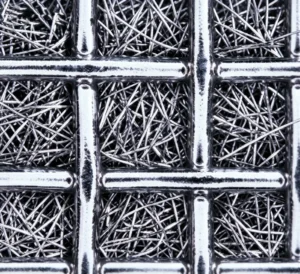
- Sintered mesh: multiple woven-wire layers are bonded by diffusion at their contact points to form a stable porous laminate.
- Pleated filter: a sheet of filter medium is folded into repeating pleats and assembled around a support core.
- Sintered-mesh pleated cartridge: diffusion-bonded mesh is formed into pleats, then supported and joined into a cartridge.
Pall’s Rigimesh sintered metal mesh cartridge is a clear manufacturer example: its sintered stainless steel mesh medium is pleated to create a high-capacity cartridge. Haver & Boecker likewise describes POROSTAR diffusion-bonded wire mesh constructions intended for cylinders, pleated filter cylinders, high-flow service, and reverse-direction loading.
Therefore, a useful engineering comparison must state both:
- Medium: woven mesh, sintered mesh, sintered fiber felt, or another material.
- Element geometry: smooth cylinder, pleated cylinder, disc, cone, panel, candle, or custom assembly.
What Is a Sintered Mesh Filter?
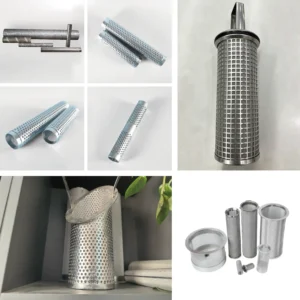
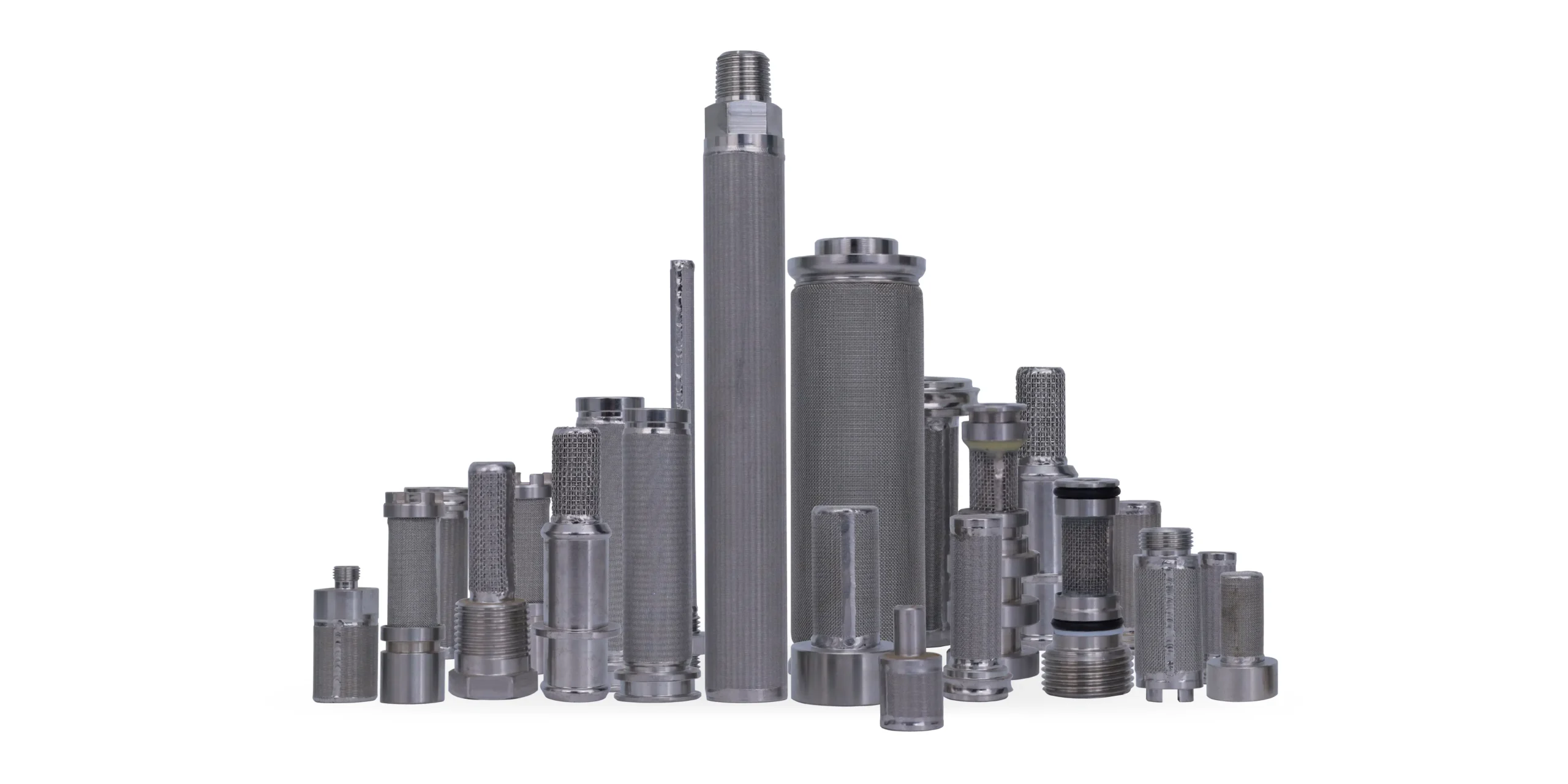
A sintered mesh filter uses layers of woven metal wire that are diffusion-bonded into a rigid, porous structure.
The layers can perform different functions: protecting the control layer, setting the pore structure, distributing flow, and providing mechanical support. The finished laminate can be fabricated as a smooth tube, cartridge, disc, cone, sheet, basket, or welded assembly.
SINFT sintered mesh filter elements can use 2–7 layers, with the standard five-layer structure being a common option. The confirmed product range includes SS304, SS316, SS316L, Hastelloy, Monel, and Inconel options; 1–200 µm filtration ratings; and DOE, 222, 226, threaded, flanged, and custom welded ends. These ranges describe the product family, not every possible element.
The main selection value of sintered mesh is structural control. Bonded layers resist relative wire movement and can provide a repeatable support framework for surface filtration, cleaning, and fabrication into shapes that a conventional pleat pack may not suit.
What Is a Pleated Filter Cartridge?
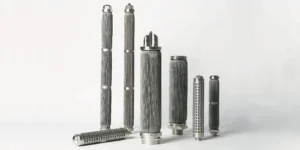
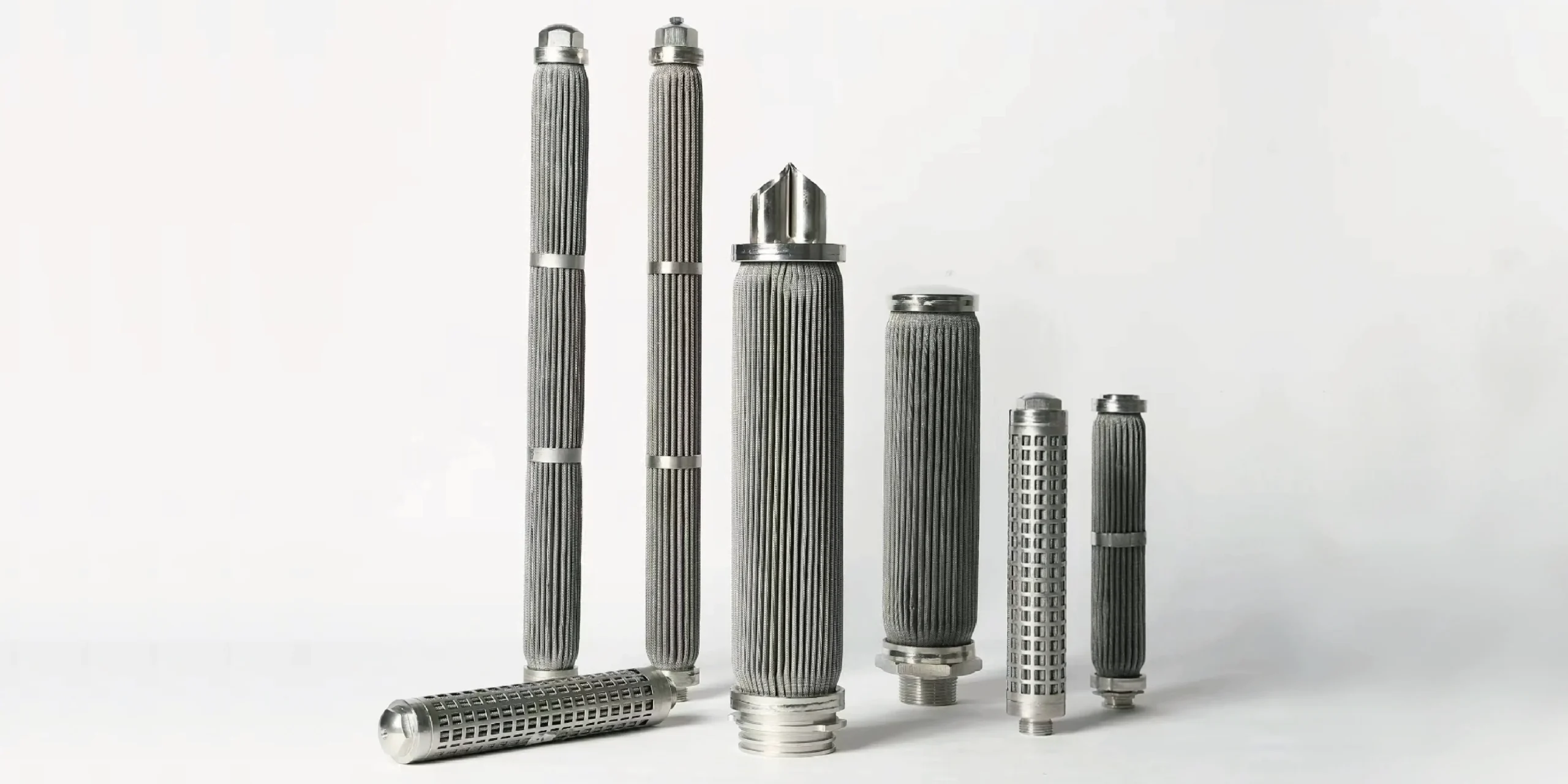
A pleated filter cartridge folds the selected medium to place more filtration area inside a defined cartridge diameter and length.
The pleat pack normally works with a center core, outer guard or restraint, end caps, welds or other joints, and a housing-specific sealing interface. Pleat height, count, spacing, usable length, media thickness, and blocked area at joints all affect effective area and flow distribution.
SINFT stainless steel pleated filter cartridges can use woven wire mesh, sintered wire mesh, or sintered metal fiber felt. This means “pleated” does not establish whether the element is a surface filter, depth filter, rigid bonded mesh, or unsupported woven screen. The medium must still be specified.
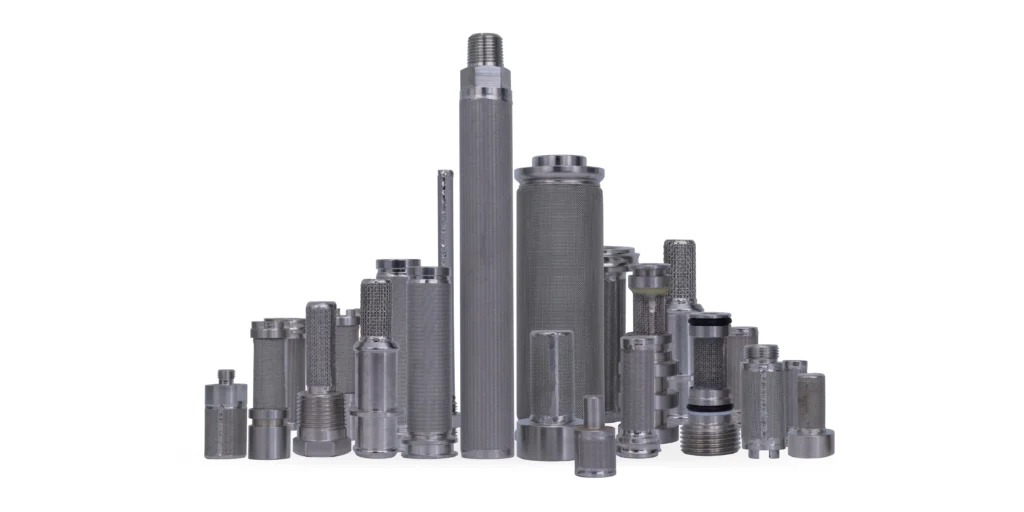
The pleated product family is available in confirmed 5, 10, 20, 30, and 40 inch or custom lengths, with DOE, 222, 226, threaded, flanged, and custom interfaces. Seal material and construction can become the limiting factors even when the metal medium itself suits the process.
Sintered Mesh vs Pleated Filter: Key Differences
When buyers use these terms as alternatives, they usually mean a rigid smooth sintered-mesh element versus a pleated metal cartridge.
| Selection factor | Rigid cylindrical sintered-mesh element | Pleated metal cartridge |
|---|---|---|
| Primary design advantage | Stable bonded structure and shape control | Increased media area inside a compact envelope |
| Geometry | Smooth tube, cylinder, disc, cone, panel, basket, or custom form | Folded cylindrical pleat pack around a support core |
| Possible media | Sintered woven-wire mesh | Woven mesh, sintered mesh, fiber felt, or another compatible medium |
| Area | Based on element surface and laminate configuration | Increased by pleat height, count, spacing, and usable length |
| Structural behavior | Bonded layers provide inherent media stability | Depends on medium, pleat support, core, guard, and joints |
| Loading pattern | Commonly surface loading when a screen-type control layer is used | Surface or depth loading, depending on the selected medium |
| Cleaning | Often selected for backwash and repeated cleaning | Cleanable when medium and pleat construction support the method |
| Inspection | Smooth external surfaces can be easier to see and access | Pleat valleys and internal layers can be harder to inspect completely |
| Housing fit | Can be built for custom tube or element geometries | Efficient for standard or custom cartridge housings |
| Best starting use | Strength, stable pores, reverse-flow duty, custom forms | High area, compact housing, controlled cartridge interface |
This table compares typical finished constructions. It does not prove that every smooth sintered element is stronger or that every pleated element has lower pressure drop. Those claims require the actual design and test conditions.
Which Has More Filtration Area?
A pleated element normally provides more media area than a smooth cylinder of similar outer diameter and length, but only usable pleated area should be compared.
Nominal sheet area can overstate performance if:
- Pleats are packed too tightly for the fluid and contaminant.
- Adjacent pleats touch or bridge under differential pressure.
- End welds, seams, adhesive zones, or spacers block part of the medium.
- The core or outer guard restricts open flow.
- Viscous fluid cannot distribute evenly into deep pleat valleys.
- Contaminant bridges across narrow channels before the full area loads.
A rigid smooth cylinder has less geometric area but may offer more direct flow paths and easier surface cake release. For some backwash, slurry, polymer, or high-viscosity duties, accessible area can matter more than maximum calculated area.
Haver & Boecker notes that pleating can increase filter area within the same external dimensions, while different diffusion-bonded mesh constructions are designed for factors such as high flow or reverse-direction load. The takeaway is to specify both geometry and laminate construction, not “more area” alone.
Which Has Lower Pressure Drop?
Neither construction always has lower pressure drop. Pleating reduces flow per unit media area when the added area is fully active, but pressure loss also depends on pore structure, laminate thickness, fluid viscosity, temperature, support open area, housing ports, flow distribution, and contaminant loading.
Compare pressure drop at the same:
- Fluid and viscosity
- Temperature
- Flow rate
- Filtration rating and efficiency definition
- Element length and number of elements
- Clean or loaded condition
- Housing and valve configuration
A fine, thick sintered laminate can add more media resistance than a coarse woven pleat. A fine pleated medium can still have a low clean differential pressure if it provides enough active area. Conversely, tightly packed pleats or a restrictive core can erase the theoretical area advantage.
ISO 3968:2017 specifies a method for evaluating differential pressure versus flow in hydraulic filters at different flow rates and viscosities, including relevant parts of the filter assembly. For non-hydraulic processes, the same engineering discipline applies: ask what fluid, viscosity, temperature, element, housing, and valves were included in the curve.
For a deeper treatment of this relationship, use the published filter pressure drop vs flow rate guide.
Which Provides More Stable Filtration Performance?
A bonded sintered mesh can provide stable pore geometry under mechanical and reverse-flow stress, but the finished element and rating method still determine performance.
Sintering bonds wire contact points and adjacent layers, reducing the risk of weave movement compared with an unsupported mesh. A rigid laminate also gives the fabricator a stable material for welding, forming, and adding perforated support.
Pleating does not automatically make filtration less stable. A pleated cartridge can use sintered mesh and combine fixed pore structure with added area. Stability then depends on:
- Medium type and layer construction
- Pleat geometry and restraint
- Core and guard open area
- Welded seam and end-cap integrity
- Forward and reverse differential pressure
- Pulsation and vibration
- Seal compression and bypass control
Do not infer micron rating from appearance, wire count, pleat count, or bubble point alone. ISO 2942:2018 explains that the first bubble point can support fabrication-integrity checking and identification of the largest pore in hydraulic elements, but it is not a functional filtration rating, efficiency, or retention-capacity measurement.
Which Is Better for Dirt Holding?
Pleated geometry can provide more surface area, but dirt-holding capacity depends on the capture mechanism and contaminant—not simply whether the element is pleated.
A pleated surface screen spreads a cake across more area. A pleated fiber-felt medium can capture particles through a porous depth structure. A rigid sintered-mesh cylinder commonly retains particles at or near the control surface, which can favor release during backwash.
Choose by the actual foulant:
| Contaminant behavior | Construction to evaluate first | Reason |
|---|---|---|
| Hard particles forming a removable surface cake | Rigid sintered mesh or pleated surface mesh | Stable screen and cleanable surface loading |
| Fine particles with broad size distribution | Pleated high-area medium or depth medium | More active area or depth loading may extend the cycle |
| Sticky gel or deformable particles | Open pleat geometry or accessible smooth surface, validated by testing | Narrow channels may bridge; surface release may control |
| High solids requiring frequent reverse cleaning | Rigid backwashable construction | Mechanical support and accessible cake release can dominate |
| Low solids with a compact cartridge housing | Pleated cartridge | Added area can reduce media face velocity |
If the real decision is between surface-loading sintered mesh and depth-loading metal fiber felt, the published surface filtration vs depth filtration guide is the more accurate comparison.
Which Is Easier to Clean and Inspect?
A smooth sintered-mesh cylinder is often easier to access and inspect, while a pleated cartridge offers more area but creates narrow valleys that require a controlled cleaning process.
Rigid sintered mesh is commonly selected for reverse flushing or backwash when the support and flow direction are designed for it. Pleated metal cartridges can also be backwashed, ultrasonically cleaned, chemically cleaned, or steam cleaned when the medium, joints, seals, and contaminant are compatible.
For either format, define:
- Normal and reverse flow direction
- Allowable forward and reverse differential pressure
- Cleaning fluid and chemical compatibility
- Cleaning temperature and cycle
- Method for removing released solids
- Post-cleaning flow or differential-pressure acceptance
- Visual, dimensional, and integrity checks
Do not assume a smooth cylinder is infinitely backwashable or that all pleats are fragile. Request the allowable reverse load for the finished element, not the raw medium alone.
When Should You Choose a Rigid Sintered-Mesh Element?
Start with a rigid sintered-mesh element when stable bonded media and structural control are more important than maximum pleated area.
Typical reasons include:
- Repeated reverse-flow or backwash duty
- Pressure pulsation or mechanical loading
- A smooth tube, disc, cone, panel, basket, or unusual fabricated shape
- Surface cake release and direct visual inspection
- Need for a perforated-metal-supported laminate
- Limited tolerance for media movement
- High-temperature or corrosive service requiring an all-metal construction
This does not establish a universal pressure or temperature rating. SINFT’s sintered mesh product family lists product-specific ranges and materials, but the permissible condition for an individual element depends on diameter, wall construction, supports, joints, seals, flow direction, and housing.
For continuous hydraulic and lubrication duties where stiffness and housing fit are important, review the hydraulic filter element application page together with the actual system cleanliness and differential-pressure requirement.
When Should You Choose a Pleated Cartridge?
Start with a pleated cartridge when fitting more effective area into an existing cartridge housing is the main design need.
Typical reasons include:
- Limited housing diameter or length
- High flow relative to the available cartridge envelope
- Need to reduce flow per unit media area
- Fine filtration where a larger active surface helps control clean pressure drop
- Longer loading cycles in a relatively low-solids stream
- Standard DOE, 222, 226, threaded, or custom cartridge interface
- Replacement of an existing pleated element without redesigning the housing
Pleat count should not be maximized without considering contaminant and viscosity. Deep, narrow pleats can restrict cleaning and flow distribution. A lower pleat density with open channels may outperform a tightly packed design in viscous or heavily loaded service.
The published industrial basket filter vs cartridge filter guide can help determine whether a cartridge is the right system stage at all, or whether a basket prefilter should remove bulk debris first.
When Should You Use Pleated Sintered Mesh?
Use a pleated sintered-mesh cartridge when the process needs both bonded pore stability and increased media area inside a cartridge envelope.
This combined construction can be appropriate when:
- An unsupported woven mesh lacks sufficient stability.
- A smooth sintered cylinder does not provide enough active area.
- The process requires a reusable all-metal cartridge.
- Reverse-flow capability is required within defined design limits.
- A fixed housing interface must be retained.
The trade-off is design complexity. The sintered laminate must be formable at the selected thickness, pleats must remain open, seams and end joints must be reliable, and the support structure must carry forward and reverse loads without blocking excessive area.
Pall’s Rigimesh manufacturer data is useful evidence that the combination is commercially established, but its product ratings and construction must not be copied to a different cartridge. Specify the required result and validate the supplied element.
How Should Micron Rating Be Compared?
Compare filtration efficiency under the same test method, not just two micron labels.
Ask whether the stated rating is:
- Nominal
- Absolute
- Based on an efficiency percentage
- Based on a beta ratio
- An aperture, pore-size, or media-grade designation
- Measured on flat media or the finished element
For hydraulic filter elements, ISO 16889:2022 defines a multi-pass method for evaluating contaminant capacity, particle-removal performance, and differential-pressure characteristics. Results from that hydraulic test should not be transferred automatically to steam, gas, water, food, or polymer filtration.
Use the published filter micron rating chart to separate mesh opening, nominal rating, absolute rating, efficiency, and beta-ratio terminology before comparing supplier data.
Common Selection Mistakes
Most errors come from comparing labels without defining the medium and finished construction.
Avoid:
- Treating “sintered mesh” and “pleated” as mutually exclusive materials
- Assuming every pleated cartridge uses disposable polymer media
- Comparing micron numbers based on different test methods
- Selecting the highest pleat count without checking channel spacing
- Comparing element-only pressure drop with a complete housing curve
- Applying raw-media strength to the finished cartridge
- Ignoring reverse-flow differential pressure during cleaning
- Selecting only by OD and length while missing end connection and seal position
- Assuming stainless steel grade alone determines chemical compatibility
- Reusing performance data from another manufacturer’s cartridge
Selection Checklist for Engineers and Buyers
Define the filtration duty first, then choose medium, geometry, and interface as separate decisions.
1. Define the process
Provide liquid, gas, steam, oil, or polymer type; chemistry; viscosity; operating temperature; and corrosion risk.
2. Define the contaminant
Provide particle-size distribution, concentration, shape, hardness, stickiness, fibers, gels, and whether a surface cake forms.
3. Define retention performance
Specify nominal or absolute rating, efficiency, beta ratio, aperture, or a relevant test method. Do not submit “10 micron” without a definition.
4. Define hydraulic conditions
Provide minimum, normal, and maximum flow; clean pressure drop; terminal differential pressure; system pressure; pulsation; and available pressure margin.
5. Choose the capture medium
Decide whether woven mesh, sintered mesh, or sintered fiber felt best fits surface release, pore stability, depth loading, and cleaning.
6. Choose geometry
Compare smooth cylinder, pleated cartridge, disc, cone, panel, basket, or custom assembly based on usable area, space, access, and loading.
7. Define cleaning and reuse
State backwash direction, cleaning fluid, ultrasonic or chemical method, cleaning frequency, and post-cleaning acceptance criteria.
8. Match the housing
Provide OD, ID, length, insertion depth, flow direction, DOE/222/226/thread/flange, seal position, and removal clearance.
SINFT’s custom filter manufacturing service can review a drawing, old sample, photos, housing dimensions, medium, pleat geometry, welded ends, and inspection requirements. For an application review, send the process conditions and drawings.
If a coarse upstream strainer is part of the filtration train, the basket strainer vs Y strainer guide explains how debris capacity, access, orientation, and maintenance affect that earlier stage.
How SINFT Can Help With Sintered Mesh and Pleated Filter Selection
SINFT can help when your specification needs to separate the medium, element geometry, and housing interface before the RFQ is finalized. For rigid shapes, SINFT manufactures sintered mesh filter elements in multi-layer constructions with different materials, end connections, and custom welded forms. For compact high-area cartridges, SINFT manufactures stainless steel pleated filter cartridges using woven wire mesh, sintered wire mesh, or sintered metal fiber felt.
If you are replacing an existing element, send the old sample, OD, ID, length, end connection, seal position, flow direction, and photos of fouling or damage. If you are designing a new system, send the fluid, contaminant, filtration target, flow, pressure-drop limit, cleaning method, and housing envelope. SINFT can then review whether a rigid sintered mesh, pleated cartridge, or pleated sintered-mesh construction is the better business and engineering choice.
Frequently Asked Questions
Is a sintered mesh filter always unpleated?
No. Sintered mesh can be formed into a smooth cylinder, disc, cone, panel, or pleated cartridge. “Sintered mesh” describes the bonded metallic medium; “pleated” describes the geometry. If your supplier treats the two terms as mutually exclusive, ask whether the actual option is smooth sintered mesh, pleated woven mesh, or pleated sintered mesh.
Can a pleated filter cartridge use sintered mesh?
Yes. A pleated cartridge can use sintered wire mesh when the laminate is suitable for forming and the pleat, core, guard, weld, and end-cap design support the operating loads. This can combine bonded pore stability with higher media area, but the finished element still needs pressure-drop, cleaning, and mechanical review under the actual process conditions.
Is sintered mesh stronger than a pleated filter?
Not as a universal statement. Sintered mesh provides bonded structural stability, but a finished pleated cartridge may also use sintered mesh and reinforced supports. Compare the complete element’s qualified forward and reverse differential-pressure limits, not the media name alone. End-cap welds, core support, guard open area, and seal fit can decide whether the element survives service.
Does a pleated cartridge always have lower pressure drop?
No. Added active area can lower flow per unit area, but total pressure drop also depends on media permeability, pleat spacing, core and guard open area, viscosity, temperature, flow distribution, housing, and loading. A tightly packed pleat can perform poorly in viscous or sticky service if the channels bridge or fail to clean.
Which construction is better for backwashing?
A rigid sintered-mesh element is often a strong starting point for repeated backwash because of its bonded structure and accessible surface. A pleated metal cartridge can also be backwashed when its medium and support structure are qualified for reverse flow. Ask for the allowable reverse differential pressure and cleaning direction for the finished element, not just the raw medium.
Which information is needed for a custom quotation?
Provide fluid, contaminant, filtration rating and definition, flow, pressure, allowable differential pressure, temperature, viscosity, material, dimensions, connection, seal, flow direction, cleaning method, housing drawing or sample, quantity, and required inspection documents. If you are unsure whether to request sintered mesh or pleated construction, send the duty and housing constraints first.
Final Thoughts
The correct sintered mesh vs pleated filter decision separates medium from geometry. Choose rigid sintered mesh when bonded structure, shape stability, surface access, and reverse-flow duty control the design. Choose a pleated cartridge when compact high area and housing compatibility control the design. Ask SINFT to review both when your process may need a pleated sintered-mesh cartridge instead of a false either-or choice.