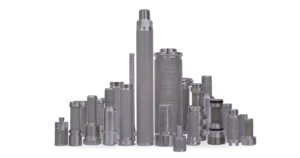
A pleated metal cartridge can look cleaner after washing and still be unsuitable for another service cycle. Compressed pleats, a distorted support, a damaged sealing shoulder or an unresolved integrity result can matter even when flow resistance improves. This guide explains when to replace a pleated filter cartridge and how to separate a cleaning opportunity from a reuse decision that the available evidence cannot support.
When to Replace a Pleated Filter Cartridge
Replace the element, or hold it for an authorized technical disposition, when it cannot meet the agreed requirements after permitted cleaning or when its condition makes reliable reuse uncertain. Review the medium, pleat geometry, supports, joints, end interfaces and seals together. Cleaning a metal cartridge does not automatically restore its original condition.
This guide concerns industrial pleated metal elements. Disposable and non-cleanable constructions follow their specified replacement procedure. For a cleanable assembly, distinguish the event that triggers maintenance from the evidence needed to return the element to service.
The differential-pressure replacement-limit guide addresses service triggers. Here, the practical question is what the removed or cleaned pleated cartridge reveals about its continued fitness.
Cleaning Is an Action; Reuse Is an Acceptance Decision
Before repeating a cleaning cycle, establish whether the medium, bonds, joints, support and seals are compatible with that method. A procedure that removes deposits may still be inappropriate for a particular assembly. Follow the supplier's approved conditions and the site's handling requirements.
A useful reuse decision connects three kinds of evidence: physical condition, restored flow behavior under comparable conditions, and the applicable integrity or performance verification. None should silently stand in for the others.
Pall's metal-media overview describes constructions intended for cleaning in its polymer-processing range. This supports asking about construction-specific cleanability; it does not establish a lifetime, cleaning count or reuse criterion for a SINFT cartridge.
Use the stainless steel cartridge cleaning guide for the broader cleaning workflow. Avoid repeatedly washing an element without understanding why it failed the acceptance review.
Inspect Pleats and Supports Together
Inspect accessible folds along the length and around the circumference. Compare their spacing and shape with the approved design or a suitable reference. Look for permanent compression, spreading, tears, displacement and interference between parts. Distinguish actual deformation from intentional variations in the original design.
An outer guard can conceal the finer medium. A clean-looking exposed surface does not establish that hidden layers are undamaged. Record restricted access and determine whether the agreed verification provides sufficient coverage. Do not force tools between folds or dismantle the cartridge merely to obtain a better view.
Assess the core, guard and any support or drainage layers with the pleats. A distorted core or displaced support can change local loading and flow even if no tear is visible. The medium and supports form an assembly; changing one part's shape can affect another part's behavior.
If the pleats have permanently contacted one another, do not assume that separating them by hand restores the intended pore structure, support or geometry. Obtain a supplier-approved disposition. Informal straightening may hide the symptom without establishing a suitable repaired condition.
Distinguish Deposits From Construction Damage
Deposits can bridge channels, remain in recessed areas or load the medium internally. A persistent obstruction may explain poor recovery, but appearance alone cannot identify its composition or determine whether another cleaning method is compatible.
Loose wires, frayed edges, separated layers, damaged seams or material loss require a construction review rather than another routine wash. An unexplained stain is not automatically corrosion, but it should not be dismissed where it conflicts with the required condition or accompanies visible deterioration.
Record observations before altering the evidence. Clear photographs, part identification, location and cleaning history help the supplier review the concern. Do not describe an unmeasured opening as an exact pore enlargement or diagnose corrosion chemistry from an image alone.
For different media, the visibility and significance of a concern differ. A protective mesh may not be the controlling layer of a sintered assembly, while a fiber medium can retain material within its thickness. The pleated media guide explains these construction differences.
Check End Joints and Sealing Interfaces
Inspect accessible end-cap joints, seams, fittings and the surfaces that position and seal the cartridge. Review looseness, cracks, deformation, damaged threads or changes that prevent correct seating. A defect in this region can create a bypass path around otherwise acceptable media.
Evaluate the seal separately. A seal may require replacement under the approved maintenance procedure without requiring the metal element itself to be discarded. Conversely, fitting a new O-ring does not correct a damaged groove, shoulder or mating housing surface.
Confirm the specified replacement seal and its compatibility. A used seal may have changed dimensions or condition and should not automatically become the master for ordering another one. Check both the cartridge and the mating interface when a seating problem recurs.
The pleated cartridge dimensions guide covers measurement references and housing fit. Do not compensate for an unresolved mismatch by forcing the assembly closed, stacking unapproved gaskets or altering retention parts.
Compare Cleaning Recovery Under Matched Conditions
Compare resistance using the approved method, fluid, flow, temperature, direction and measurement boundary. A reading obtained at a lower flow or with a less viscous fluid can look improved even if deposits remain. A housing inlet-to-outlet measurement can also include losses outside the cartridge.
Persistent excess resistance after authorized cleaning calls for review of residual contamination and the construction. It does not justify progressively more aggressive cleaning without checking compatibility and disposition requirements.
An unexpectedly low reading also needs context. It may indicate good recovery, but a lower flow, instrument issue, damaged medium or bypass can produce a similar observation. Restored pressure drop cannot independently prove retained filtration performance.
The pleated cartridge pressure-drop guide explains comparison conditions. Do not apply an arbitrary recovery percentage or universal differential-pressure number to all metal elements.
| Observation after permitted cleaning | Review before release |
|---|---|
| Clean appearance and acceptable comparable resistance | Confirm physical condition and all other required acceptance evidence. |
| Resistance remains outside the agreed range | Check conditions, residual contamination and construction; obtain a disposition. |
| Resistance falls unexpectedly | Review flow, instrumentation, sealing and integrity before assuming success. |
| Channels remain obstructed | Identify the concern and compatible options rather than repeatedly applying an unverified process. |
| Pleats, supports or joints have changed | Hold for technical review; cleaning alone does not establish restoration. |
Integrity Evidence Has a Defined Scope
Use the verification agreed for the medium and service. An inspection method should answer the required question and be suitable for the complete assembly. Do not substitute a familiar test for missing evidence if it does not establish the relevant characteristic.
For hydraulic filter elements, the public abstract of ISO 2942:2018 describes a bubble-point approach to fabrication integrity. It also states that first bubble point cannot be used to estimate filtration rating, efficiency or retention capacity. An integrity result and a filtration-performance claim therefore need their own appropriate basis.
Ask what the method covers, which surfaces or parts were examined and how the result is compared with the applicable requirement. A passed test on one identified sample does not automatically approve every item in a batch or every later cleaning cycle.
If the necessary verification cannot be obtained, identify the gap and obtain an authorized disposition. Do not invent a pass criterion or release the element solely because it looks clean.
When Another Cleaning Cycle Is Not the Answer
Repeated rapid fouling can arise from the process, contaminant, upstream separation, operating conditions or an unsuitable construction. Replacing the element with an identical part may repeat the problem if the underlying duty has changed.
Review the service history, contaminant behavior, flow and temperature, cleaning method and how long acceptable performance lasted after each cycle. Separate a damaged or irrecoverably obstructed element from a process that is overloading an otherwise suitable element.
Where supports or pleats deform repeatedly, review the actual direction and differential-pressure cases, including cleaning. Forward filtration and backwashing can load the assembly differently. Do not infer reverse capability from the metal grade or reusable description.
There is no universal number of cleaning cycles after which every pleated metal cartridge must be replaced. Use agreed condition and performance requirements, the documented history and any manufacturer-defined service limits.
Record a Clear Disposition
| Disposition | What the record should establish |
|---|---|
| Accept for reuse | All required checks met; identity, conditions and approval are recorded. |
| Replace the specified seal | The seal action is authorized and the remaining element/interface requirements are satisfied. |
| Hold for investigation | The affected item and unresolved concern are identified; release awaits technical disposition. |
| Approved cleaning or repair review | Method and responsibility are defined, with subsequent acceptance checks. |
| Replace the cartridge | The element cannot meet the required condition or replacement is the approved disposition. |
Keep the part number, drawing revision where available, batch or serial reference, service and cleaning history, inspection findings, test conditions and decision together. Photographs should be associated with the correct element and observation location.
Do not perform informal mesh patching, welding or straightening on a critical element. A repair changes the assembly and may require renewed assessment of dimensions, cleanliness, integrity and performance. Any permitted repair and release process needs an appropriate technical basis.
What to Send With a Replacement Inquiry
Provide the failed requirement and available observations, rather than only asking for a longer-lasting filter. Include the fluid, operating temperature, flow range, particle-removal requirement, forward/reverse differential-pressure duties and the intended cleaning method.
Send the drawing, end photographs, dimensions and housing interface information. Identify which old-sample features are damaged or uncertain. A worn sample can help a review but should not automatically define the intended new geometry.
SINFT supplies pleated metal filter cartridges and drawing-based replacement assemblies. For hydraulic applications, include relevant oil and startup conditions. Use the custom filter manufacturer page and contact inquiry form to submit the duty and replacement package. Confirm the required inspection and documentation scope for the actual order.
Frequently Asked Questions
Does a lower pressure drop after cleaning prove the cartridge is reusable?
No. It shows reduced resistance only under the stated comparison conditions. Changes in flow, temperature, instrumentation, sealing or medium condition can also affect the result. Review physical condition and the applicable integrity or performance evidence alongside resistance. The release decision should cover every required acceptance criterion, rather than treating a single improved reading as proof of suitability.
Should flattened pleats be straightened and reused?
Do not assume that manual straightening restores the original medium or support condition. Permanent deformation can affect spacing, joints and local loading, including areas that are not visible. Record the condition and obtain a supplier-approved disposition against the design requirements. A cartridge should not be released merely because its external shape can be made to look more regular again.
Does a damaged O-ring always require a new cartridge?
Not necessarily. The specified seal may be replaceable under the approved maintenance procedure if the cartridge, groove, fitting and mating housing surface remain acceptable. Identify the correct seal and its compatibility, then complete the remaining checks. A new O-ring does not resolve damaged metal geometry or establish that the medium and joints are suitable for another service cycle.
Can another cleaning method remove a stubborn deposit?
It may be an option only after compatibility and the intended acceptance basis are reviewed. A more aggressive chemical, temperature or mechanical action can affect media, bonds, seals and joints. Identify the contaminant and current condition, then obtain an approved method or disposition. Repeatedly changing the cleaning process without that review can remove evidence and introduce another unresolved condition.
How many cleaning cycles can a metal cartridge withstand?
There is no universal count across all media, constructions and applications. Service conditions, contamination, cleaning exposure and the assembly's design affect its condition over time. Follow any specified service limits and use the agreed inspection and verification requirements at each applicable interval. A general reusable description is not a guarantee of unlimited cycles or continued performance after every cleaning event.
Does a passed bubble-point test establish the filtration rating?
No. A fabrication-integrity result has a defined method and scope, and it is not interchangeable with filtration efficiency or retention-capacity evidence. The public ISO 2942 abstract specifically limits what first bubble point can establish. Confirm which question the required test answers, the applicable acceptance reference and any additional evidence needed for the medium and intended service before deciding on reuse.
Why does the element foul quickly again after cleaning?
Possible causes include remaining deposits, a changed process load, fluid or flow conditions, inadequate upstream separation or a construction poorly matched to the contaminant. Compare matched-condition records and inspection findings rather than assuming one cause. A replacement may be necessary, but repeating the same element specification without reviewing the duty can reproduce the same short interval between maintenance events.
What should a replacement supplier receive besides an old sample?
Provide the operating duty, filtration objective, dimensions and housing interface, materials if known, flow direction and cleaning requirements. Include the observed problem and available records or photographs. Mark damaged or unknown features explicitly so they are not copied as intended design details. Agree the new assembly definition and required evidence before manufacture instead of relying only on a worn element's appearance.
Final Thoughts
Cleaning is useful when it restores an acceptable assembly, but reuse needs evidence that the pleats, supports, joints, interfaces and filtration function remain suitable. Compare recovery under matched conditions and resolve damage or uncertainty before release. For a replacement, send SINFT the duty, housing details and observed failure so the proposed element can be reviewed against the actual service requirements.