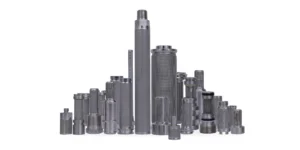
When a wedge wire screen is ordered by slot size alone, the part may look correct but fail in service. It can plug too quickly, restrict flow, miss deformable particles, or fit poorly in the housing. Before you confirm the slot, you need to connect the opening with the particle target, open area, cleaning method, flow direction, and final element geometry.
Direct Answer: Wedge Wire Screen Slot Size
Wedge wire screen slot size should be selected from the largest particle that can safely pass downstream, the smallest particle that must be retained, the allowable pressure drop, the open area, and the cleaning method. A wedge wire screen is not specified like woven mesh. Its filtration opening is a continuous slot formed by triangular profile wire and support rods, so the buyer should specify slot width, profile geometry, flow direction, material, element size, connection, and inspection requirement.
SINFT wedge wire filters use SS316L triangular profile wire and support rods as the main construction, with SS304, SS316, SS316L, Titanium, and Hastelloy available for specific applications. The confirmed product information lists slot widths from 0.1 mm to 3 mm with custom options, open area up to 60%, working temperature up to 600°C, differential pressure up to 50 bar, and lengths from 50 mm to 6000 mm, depending on structure and service conditions.
Those are product-family references, not a universal promise that every slot, diameter, length, alloy, connection, flow direction, temperature, and pressure condition can use every maximum at the same time. This guide explains how engineers and buyers should specify wedge wire screen slot size before requesting a custom element.
Quick Selection Rule
Start with the protected equipment or process requirement, then work backward to the slot width. A smaller slot can improve particle retention, but it can also reduce open area, increase pressure drop, plug faster, or require a larger screen area.
| Selection question | What it controls | Why it matters |
|---|---|---|
| What particle size must be stopped? | Slot width or staged filtration | The slot should be related to the downstream tolerance, not chosen from a generic chart |
| How much solids load is expected? | Screen area, slot width, cleaning interval | High debris load may need more area rather than only a finer slot |
| Is the contaminant hard, soft, fibrous, or sticky? | V-slot suitability and cleaning method | Deformable particles can bridge, smear, or lodge differently from hard grains |
| What pressure drop is allowed? | Slot width, open area, element diameter and length | Fine slots in a small element can create excessive resistance |
| How will the screen be cleaned? | Flow direction, profile orientation, support design | Backwash, brushing, scraping, or manual washing each favors different details |
| Does it fit an existing housing? | OD, ID, length, thread, flange, seal and end cap | Wrong fit can cause bypass even if the slot width is correct |
For most industrial RFQs, the best first specification is not “make the slot as small as possible.” It is “select the coarsest slot that protects the downstream equipment while maintaining flow, cleaning access, and mechanical strength.”

What Slot Size Means
Wedge wire screen slot size is the clear opening between adjacent profile wires at the screening surface. It is usually specified as a width, such as 0.1 mm, 0.2 mm, 0.5 mm, 1 mm, or another custom value.
This is different from:
- mesh count, which describes woven wire cloth;
- nominal micron rating, which may describe a filtration result under a supplier method;
- perforated plate hole diameter, which describes round, square, or slotted punched openings;
- absolute rating, which requires an efficiency definition and test method.
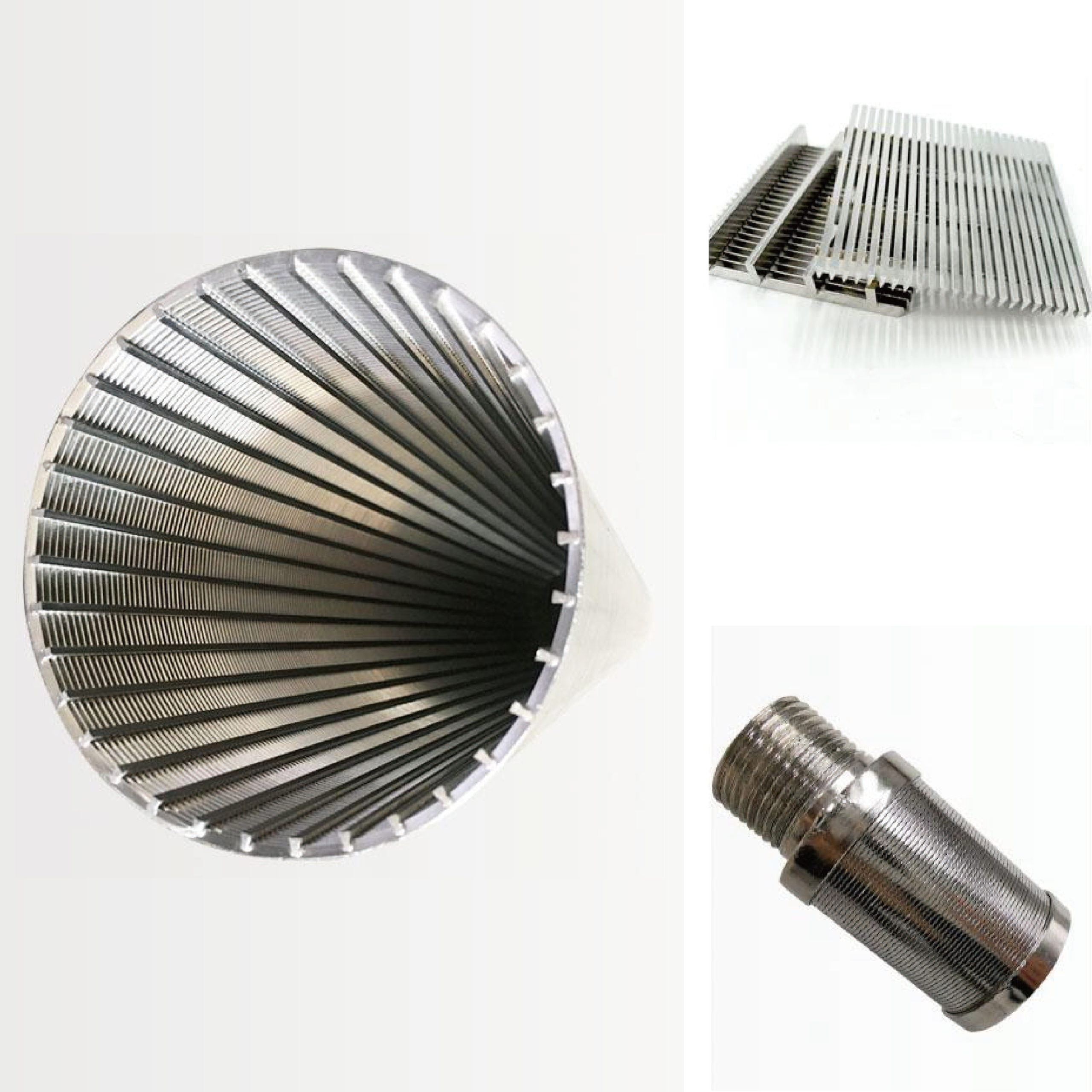
In wedge wire, the slot is continuous along the screen length or circumference. The triangular profile creates a V-shaped opening that is narrower at the inlet surface and wider behind the slot. That geometry can reduce particle wedging when the flow direction and particle behavior are compatible.
The slot size should be written clearly in the RFQ:
slot width: 0.5 mm;material: SS316L;flow direction: outside to insideorinside to outside;element OD, ID and length;connection: threaded, flange, welded ring or custom;application fluid and contaminant;cleaning method and allowable pressure drop.
If a drawing exists, the drawing should define where the slot is measured and whether the tolerance applies to the entire screen, only the active filtration area, or a critical zone.
V-Slot Geometry and Anti-Clogging
The V-slot shape is one of the main reasons wedge wire is selected instead of ordinary perforated plate or woven mesh. The opening is narrow at the top and wider behind the surface, so particles that pass through the narrowest point are less likely to become trapped deeper in a parallel-sided hole.
This does not mean wedge wire is clog-proof. It means the geometry can help reduce plugging for suitable particle shapes and cleaning methods. Performance still depends on:
- slot width compared with particle size;
- wire profile shape;
- support rod spacing;
- surface finish;
- flow direction;
- fluid velocity;
- solids loading;
- particle hardness, shape, and deformability;
- cleaning method and cleaning frequency.
Hard granular particles may behave differently from fibers, gels, biological material, polymer deposits, scale, slurry, or oil-coated solids. A slot that works well for sand-like particles may not work for sticky deposits that smear across the screen surface.
For a broader mechanism comparison, see SINFT’s surface filtration vs depth filtration guide. Wedge wire is normally selected as a surface screening structure, while sintered fiber felt is normally selected for depth loading.
Slot Size, Open Area and Pressure Drop
Slot size and open area must be considered together. A finer slot usually reduces open area for the same screen geometry. Lower open area can increase clean pressure drop and can make the screen reach its cleaning point faster as solids accumulate.
SINFT’s confirmed Wedge Wire product information lists open area up to 60%, depending on design. This value should be treated as a design reference, not a fixed number for every slot size or screen element. A short small-diameter screen with a fine slot can have a different open area and pressure-drop behavior from a large intake cylinder or long basket-style screen.
Clean pressure drop depends on:
- total active screen area;
- slot width and slot length;
- wire profile and support rod spacing;
- blocked area from end rings, welds, flanges, cores or support structures;
- fluid viscosity and density;
- flow rate;
- flow direction;
- housing ports and transitions.
Operating pressure drop also depends on retained solids. A screen with generous clean open area can still blind quickly if the contaminant forms a mat, bridges across the slots, or is not removed by the cleaning cycle.
ISO 3968 is commonly referenced for evaluating differential pressure versus flow characteristics of hydraulic filter elements. It is not a replacement for application testing, but it illustrates an important engineering principle: pressure-drop comparison needs defined flow, fluid, temperature, and test conditions.
For more sizing context, see SINFT’s filter pressure drop vs flow rate guide.
Slot Size vs Micron Rating
A wedge wire slot width is a physical opening; it should not be casually converted into a generic micron rating. A 0.1 mm slot is 100 micrometers as a length conversion, but that does not mean the screen behaves like every “100 micron” filter.
Particle retention depends on:
- the smallest slot opening at the screening surface;
- particle shape and orientation;
- whether particles are rigid or deformable;
- flow direction and velocity;
- surface loading and cake formation;
- whether multiple screens or downstream filters are used.
A long fiber can pass or bridge depending on orientation. A soft particle can deform through a slot smaller than its original shape. A flat particle can pass if aligned with the slot. Fine particles can also form a surface cake that changes apparent retention during operation.
ISO 2194 is relevant to industrial screen opening designation and size language, and ISO/TC 24/SC 8 covers test sieves, sieving and industrial screens. The practical takeaway for procurement is simple: define the opening type and measurement basis. Do not use mesh count, micron rating, slot width, perforation diameter, and efficiency as interchangeable terms.
SINFT’s filter micron rating chart explains these differences across metal filters, woven mesh, sintered media, basket strainers, and wedge wire elements.
Common Slot Size Ranges in SINFT Products
SINFT’s confirmed Wedge Wire product information lists 0.1-3 mm slot width with custom options. The right value depends on the application, not just the product family.
| Slot range discussion | Typical selection logic | Caution |
|---|---|---|
| Finer slot end of the range | Used when downstream protection requires smaller openings | Can raise pressure drop and require more screen area |
| Middle slot range | Often considered for balancing retention, flow and cleaning | Confirm particle behavior, not only particle size |
| Coarser slot end of the range | Used for high-flow coarse screening and debris removal | May not protect fine downstream clearances |
| Custom slot size | Used when existing housing, process target or OEM drawing requires it | Tolerance, inspection method and drawing details should be agreed before production |
Do not copy a slot size from another system unless the flow, contaminant, fluid, pressure-drop limit, cleaning method, and screen area are comparable. Two screens with the same 0.5 mm slot can perform differently if one has more active area, different wire profile, different flow direction, or a different solids load.
Application-Based Slot Size Decisions
Choose the slot from the failure mode you need to prevent. The same wedge wire construction can be used for water treatment, slurry screening, solid-liquid separation, resin traps, hydraulic reservoir inlet protection, petrochemical service, steam, food fluids, or backwash systems, but each application loads the slot differently.
| Application condition | Slot-size priority | Engineering caution |
|---|---|---|
| Water intake or process water screening | Protect downstream equipment while keeping high open area | Biological growth, fibers and scale may control cleaning interval |
| Hydraulic reservoir inlet or lubrication prefilter | Low pressure drop and coarse debris protection | Oil viscosity and suction conditions can make fine slots risky |
| Petrochemical or hydrocarbon service | Robust surface screening and chemical compatibility | Confirm alloy, temperature, solids shape and cleaning method |
| Resin trap or bead retention | Slot smaller than bead size with enough open area | Broken resin fines may require a downstream polishing stage |
| Slurry or solid-liquid separation | Surface release and abrasion resistance | Abrasive particles, velocity and support strength must be reviewed |
| Backwash or self-cleaning system | Slot compatible with reverse flow, scraping or cleaning cycle | Particles must release from the slot rather than wedge or smear |
For hydraulic and lubrication systems, see SINFT’s hydraulic oil filtration page. For water service, see the water treatment filters page. For automated cleaning comparisons, see the backwash filter vs cartridge filter guide.
Flow Direction and Cleaning Method
Slot size should be chosen together with the intended flow direction and cleaning method. A wedge wire screen can be designed for outside-to-inside flow, inside-to-outside flow, or a special arrangement depending on housing and process layout.
Cleaning may include:
- reverse flow;
- air blowing;
- brushing or scraping;
- flushing;
- manual removal and washing;
- automated backwash in a filter system.
The V-slot is most useful when the retained particles stay on the screening surface and can release during cleaning. If solids are soft, sticky, fibrous, or likely to deform into the slot, the design may need a larger slot, larger screen area, staged filtration, different flow direction, or a different medium.
SINFT backwash filter cartridges can use stainless steel mesh, reinforced basket, or slot structures for reverse-flow, air-blowing, and automated backwash service. Their confirmed product-family data lists 25-500 um for mesh constructions and 0.1-3 mm for slot structures, with the final selection dependent on the backwash system and contaminant.
Mechanical Strength and Construction
A correct slot width does not guarantee a strong screen. Mechanical reliability also depends on profile wire, support rods, weld quality, diameter, length, end fittings, collapse or burst expectation, flow direction, and handling during cleaning.
SINFT wedge wire filters can be customized with flange, threaded, welded, and custom connections. The product information lists 50-6000 mm length options and custom dimensions. Those dimensions should be reviewed with pressure, flow, support, shipping, installation, and cleaning requirements.
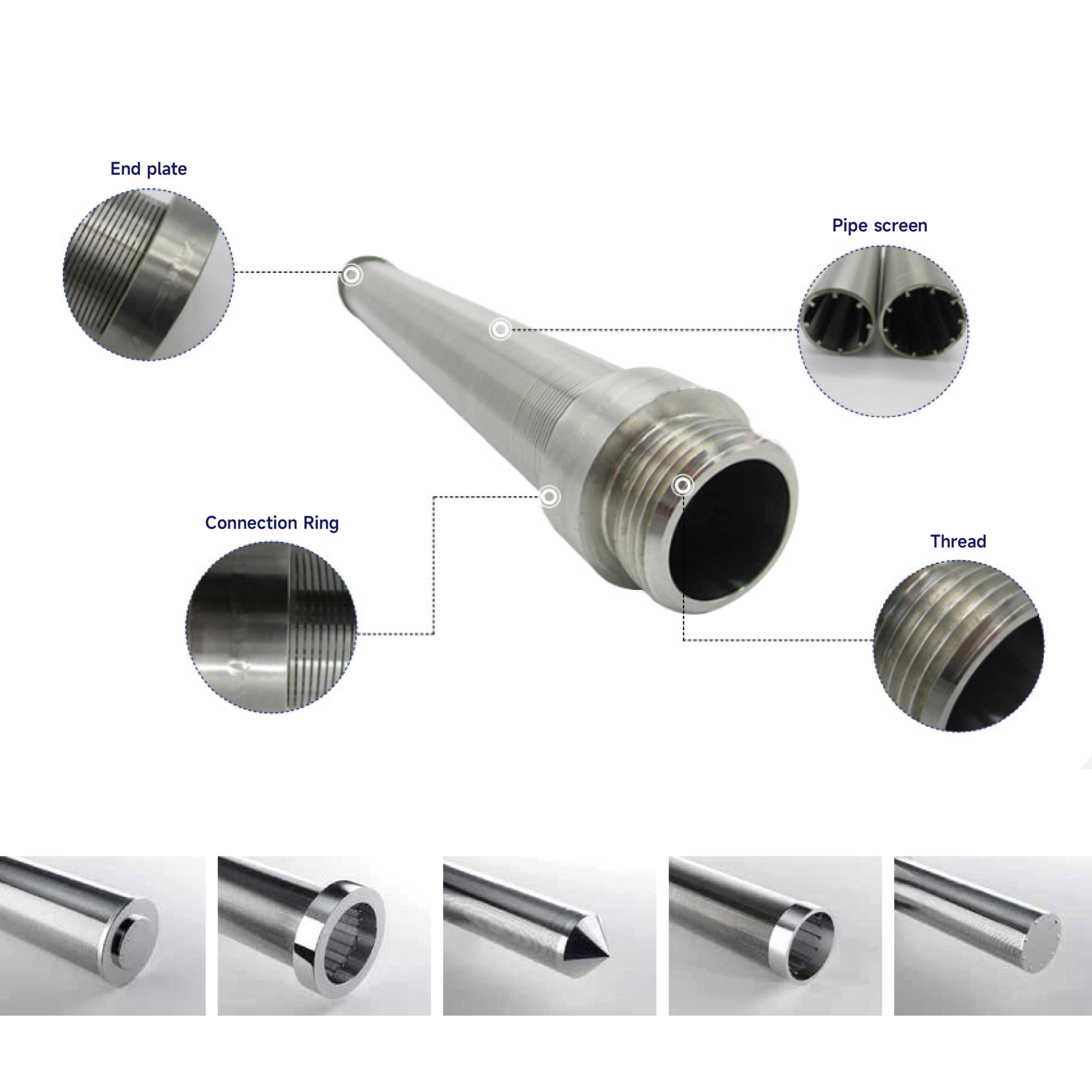
For custom screens, confirm:
- OD, ID, length and active screen area;
- profile wire size and support rod spacing if defined by drawing;
- slot width and tolerance;
- end cap, ring, flange or threaded connection;
- seal or seating surface;
- flow direction;
- maximum operating pressure and differential pressure;
- temperature and thermal cycling;
- cleaning method and handling loads;
- inspection requirements before shipment.
Wedge Wire vs Perforated Plate or Woven Mesh
Wedge wire is usually selected when continuous slots, surface release, open area and cleanability are more important than a simple punched hole or woven mesh count. That does not make it the best choice for every filter.
| Medium | Better starting point | Limitation |
|---|---|---|
| Wedge wire | Continuous slot screening, surface cleaning, intake screens, resin traps, coarse separation | Not ideal when very fine retention or depth loading is required |
| Perforated plate | Robust coarse debris protection and simple hole geometry | Coarse holes may pass fine particles; small holes can reduce open area |
| Woven mesh | Finer openings, flexible liner, removable basket support | Mesh count alone does not define aperture or strength |
| Sintered mesh | Stable pore structure and stronger multi-layer media | May add pressure drop and cost where simple slot screening is enough |
| Sintered fiber felt | Depth loading and fine-particle holding | Embedded particles may be harder to release by simple backwash |
For basket assemblies that combine perforated plate and woven liners, see SINFT’s basket strainer mesh size guide. It explains why mesh size, perforation, open area and cleaning access must be specified as a complete basket element.
How SINFT Can Help With Wedge Wire Screen Selection
SINFT can help when the business question is not only “what slot size can you make?” but “what screen should I quote for this process?” SINFT supplies wedge wire filters using triangular profile wire and support rods, and can review custom dimensions, material, connection, flow direction, cleaning method, and housing fit through its custom filter manufacturer service.
If your system uses reverse-flow cleaning, SINFT can also compare wedge wire with backwash filter cartridges that use stainless steel mesh, reinforced basket, or slot structures. For applications where fine retention or depth loading matters more than surface release, compare the design with SINFT’s sintered mesh and sintered fiber felt product families before finalizing the RFQ.
Mistakes to Avoid
Most wedge wire screen problems start from an incomplete slot specification. The buyer may specify a slot width but omit the particle behavior, open area, differential pressure, flow direction, or cleaning method.
Avoid these mistakes:
- specifying only “100 micron” without saying whether it means slot width, mesh aperture, nominal rating or test result;
- choosing the smallest available slot without checking pressure drop;
- ignoring open area after support rods, rings, welds and housing restrictions;
- assuming V-slot geometry will prevent all clogging;
- copying a slot size from water service into viscous oil, slurry, resin or polymer service;
- ignoring whether the slot is measured on the inlet surface;
- omitting flow direction in a self-cleaning system;
- using wedge wire where fine depth filtration is actually required;
- approving a drawing without slot tolerance, active area and connection dimensions.
RFQ Checklist for Wedge Wire Screen Slot Size
A good RFQ lets the manufacturer connect slot width with the actual duty. SINFT can review drawings, old samples, housing dimensions, end connections, material requirements, support structure, seal location, flow direction, and custom welded assemblies through its custom filter manufacturer service.
Send these details:
- Required slot width or particle retention target
- Whether the value is slot width, micron rating, mesh aperture or perforation size
- Fluid, gas, slurry, resin, oil, water or chemical name
- Flow rate per screen or total system flow
- Operating pressure and allowable differential pressure
- Operating temperature
- Viscosity or density if available
- Contaminant type, particle size distribution and solids load
- Flow direction through the screen
- Cleaning method: backwash, air blowing, brushing, scraping, flushing or manual washing
- Material requirement: SS304, SS316, SS316L, Titanium, Hastelloy or other alloy
- OD, ID, length and active screen area
- End connection: flange, threaded, welded ring, collar or custom end
- Seal or seating requirement
- Drawing, old sample, housing photo or installation space
- Required inspection record, slot check or documentation
To discuss a custom screen, submit the operating data through SINFT’s contact form.
Selection Summary
The best wedge wire screen slot size is the coarsest slot that protects downstream equipment while keeping pressure drop, open area, cleaning and strength within the system limit. Finer is not always better. A fine slot in a small screen may clog or restrict flow, while a larger screen area, staged filtration or different cleaning method may solve the problem more reliably.
Use slot width as one part of the complete specification:
- slot width and tolerance;
- V-slot/profile wire design;
- screen area and open area;
- material and corrosion resistance;
- flow direction;
- pressure and temperature;
- contaminant behavior;
- cleaning method;
- end connection and housing fit;
- inspection requirement.
When the process requires high-flow surface screening, cleanability and custom geometry, wedge wire can be a strong option. When the duty requires fine depth loading, absolute-rated retention or polishing filtration, compare it with sintered mesh, sintered fiber felt or pleated cartridge constructions before finalizing the design.
Final Thoughts
Wedge wire screen slot size is a business-critical specification because it affects flow, cleaning interval, replacement reliability, and downstream protection. If you are matching an old screen, upgrading a backwash element, or designing a custom intake or separation screen, send SINFT the slot target, process data, drawing or sample photos, and connection details so the screen can be reviewed as a complete custom filter element.
FAQ
What is wedge wire screen slot size?
Wedge wire screen slot size is the clear opening between adjacent profile wires at the screening surface. It is usually specified as a width, such as 0.1 mm, 0.5 mm, 1 mm, or another custom value. For purchasing, the slot value should be tied to the particle target, flow direction, tolerance, active screen area, and inspection requirement rather than written as a loose reference.
Is wedge wire slot size the same as micron rating?
No. Slot size is a physical opening, while micron rating may describe an opening, a nominal rating, an absolute rating, or tested filtration performance under a defined method. A 0.1 mm slot equals 100 micrometers as a length conversion, but that does not make the screen equivalent to every “100 micron” filter. State the measurement basis clearly in the RFQ.
What wedge wire slot sizes does SINFT list?
SINFT’s confirmed Wedge Wire product information lists 0.1-3 mm slot width with custom options. This is a product-family reference, not a promise that every maximum condition can be combined in one screen. The final slot should be selected from the retained particle target, flow rate, open area, pressure drop, cleaning method, material, connection, and screen geometry.
Does a smaller slot always filter better?
Not always. A smaller slot may retain smaller particles, but it can also reduce open area, increase pressure drop, clog faster, and require a larger screen. In many industrial systems, the better commercial decision is the coarsest slot that safely protects the downstream process while keeping flow and cleaning interval acceptable. If fine retention is required, staged filtration may work better.
Why does wedge wire have a V-slot shape?
The triangular profile wire creates a slot that is narrow at the screening surface and wider behind the opening. This shape can reduce particle wedging and improve surface cleaning when the flow direction and contaminant behavior are suitable. It is helpful for many surface-screening duties, but it does not make the screen clog-proof. Sticky, soft, fibrous, or deformable solids still need review.
When should I choose wedge wire instead of woven mesh?
Choose wedge wire when continuous slots, surface release, high open area, robust intake-screen construction, resin retention, or self-cleaning behavior are priorities. Woven mesh may be better when a removable liner or finer aperture range is needed. Sintered mesh or sintered fiber felt may be better when stable pore structure, depth loading, or finer filtration performance is more important than open slot screening.
What information is needed for a custom wedge wire screen quote?
Send the slot width or retention target, fluid name, flow rate, operating pressure, allowable differential pressure, temperature, contaminant type, solids load, cleaning method, flow direction, material, OD, ID, length, connection type, seal details, drawings, housing photos, or old samples. These details let SINFT review slot size together with open area, strength, fit, and manufacturability.