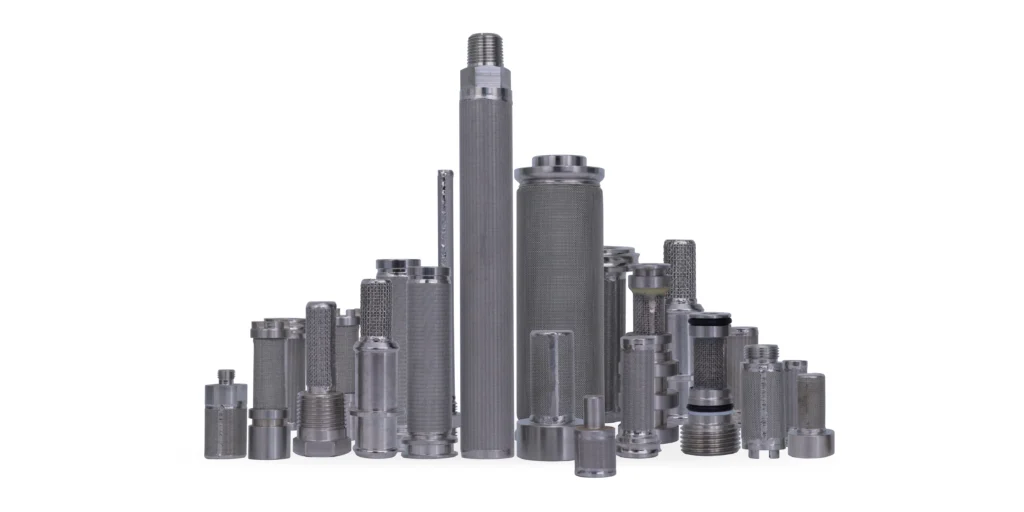
Industrial filter elements may look similar from the outside while behaving very differently in service. A pleated cartridge, sintered mesh cylinder, metal fiber felt element, basket strainer and wedge-wire screen can all fit inside a housing, but they do not retain the same contaminants, tolerate the same load or clean in the same way. The useful first step is to classify the filtration duty before choosing the shape.
Direct Answer: What Are the Main Industrial Filter Element Types?
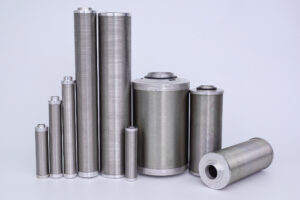
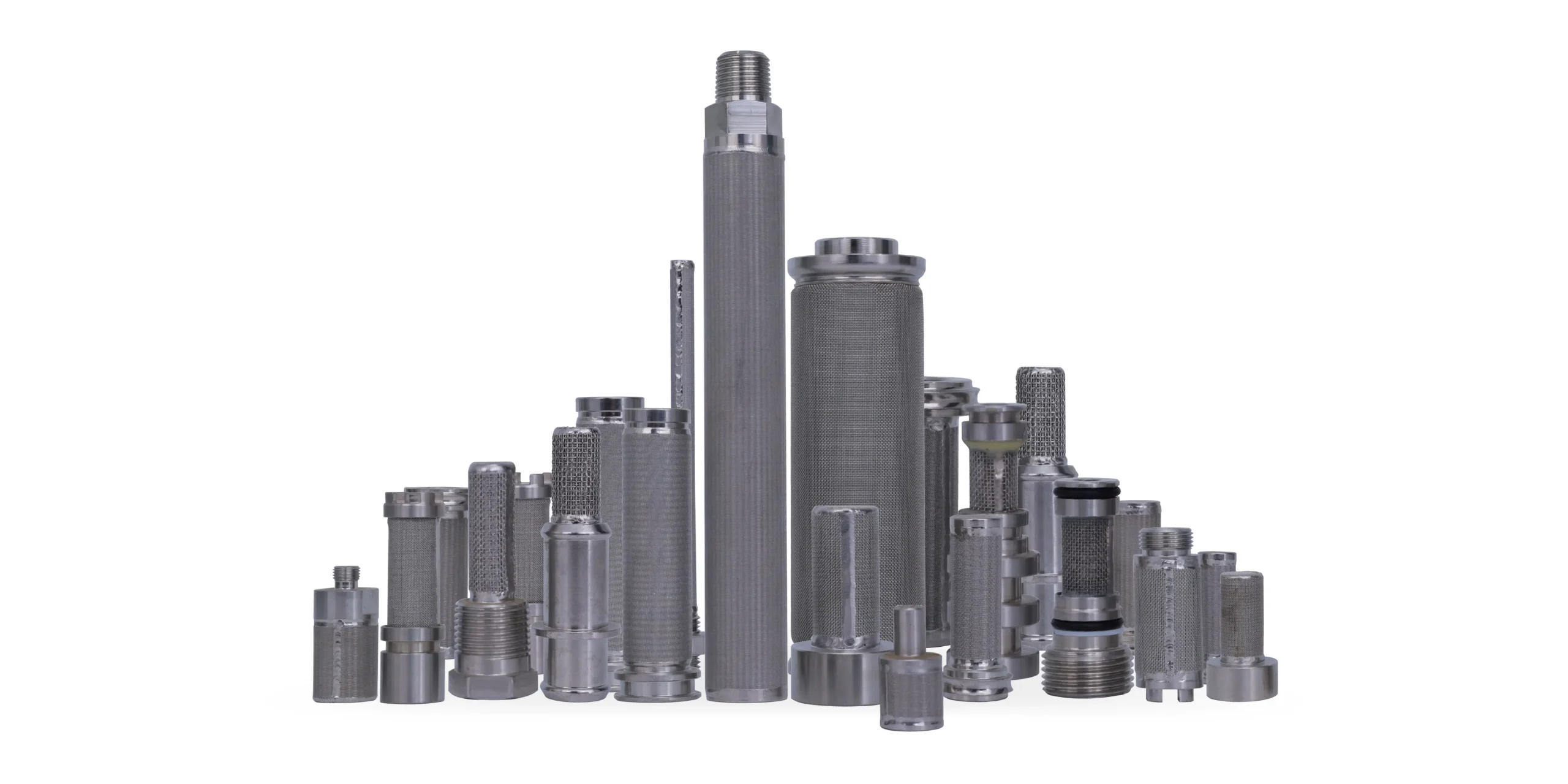
The main industrial filter element types are pleated cartridges, cylindrical or tubular elements, sintered mesh elements, sintered metal fiber felt filters, basket strainers, backwash elements, wedge-wire or notch-wire screens, and flat forms such as discs, cones and panels. These names describe different aspects of a filter: its geometry, media, support structure or cleaning function.
For engineering selection, classify an element in five layers:
- Geometry: cartridge, tube, candle, basket, disc, cone or panel.
- Filter media: woven wire mesh, sintered wire mesh, sintered metal fiber felt, perforated plate, wedge wire or another validated material.
- Capture behavior: mainly surface filtration, mainly depth filtration or a designed combination.
- Maintenance method: disposable, removable and washable, backwashable, mechanically cleaned or clean-in-place where validated.
- Duty: fluid, contaminant, retention requirement, flow, temperature, pressure, differential load and housing fit.
This framework prevents a common purchasing error: treating a micron rating or familiar cartridge shape as a complete specification. It is not. Two elements with the same nominal rating can have different efficiency, pressure drop, dirt-holding behavior, strength and cleaning response.
Industrial Filter Element Types at a Glance
Use the table as a shortlist, not as a universal ranking. The correct choice still depends on the complete operating condition and an agreed rating or test basis.
| Element family | Typical construction | Main filtration behavior | Main reason to consider it | Key point to verify |
|---|---|---|---|---|
| Pleated metal cartridge | Pleated mesh, sintered mesh or metal fiber felt with support and end fittings | Surface or depth, depending on media | More filtration area within a cylindrical envelope | Pleat stability, clean pressure drop and end connection |
| Sintered mesh element | Diffusion-bonded woven mesh layers formed into tube, cartridge, disc, cone or panel | Usually controlled surface filtration | Stable pore geometry, rigidity and cleanability | Control layer, support orientation and flow direction |
| Sintered fiber felt element | Random metal fibers sintered to each other, often with support mesh | Depth and combined loading | High porosity and dirt-holding potential | Grade, support, loading depth and cleaning recovery |
| Basket or tube strainer | Perforated support with wire mesh, or robust screen construction | Coarse surface screening | High flow and easy removal of larger debris | Open area, perforation/mesh relation and sealing rim |
| Backwash filter element | Mesh, reinforced basket or slot structure designed for reverse cleaning | Surface capture with periodic cake release | Reduced manual replacement in continuous systems | Backwash direction, release behavior and reverse load |
| Wedge-wire element | Profile wires welded to support rods to form continuous slots | Surface separation | Defined slot, open area and resistance to plugging | Slot direction, particle shape and cleaning method |
| Notch-wire element | Helically wound or arranged profiled wire creating calibrated openings | Surface separation | Robust metallic slot structure for specific duties | Notch geometry, slot tolerance and flow direction |
| Custom disc, cone or panel | Selected metal media cut, formed, framed or welded | Depends on media and assembly | Fits nonstandard equipment and limited installation space | Edge sealing, support, flatness, dimensions and load path |
1. Pleated Filter Cartridges
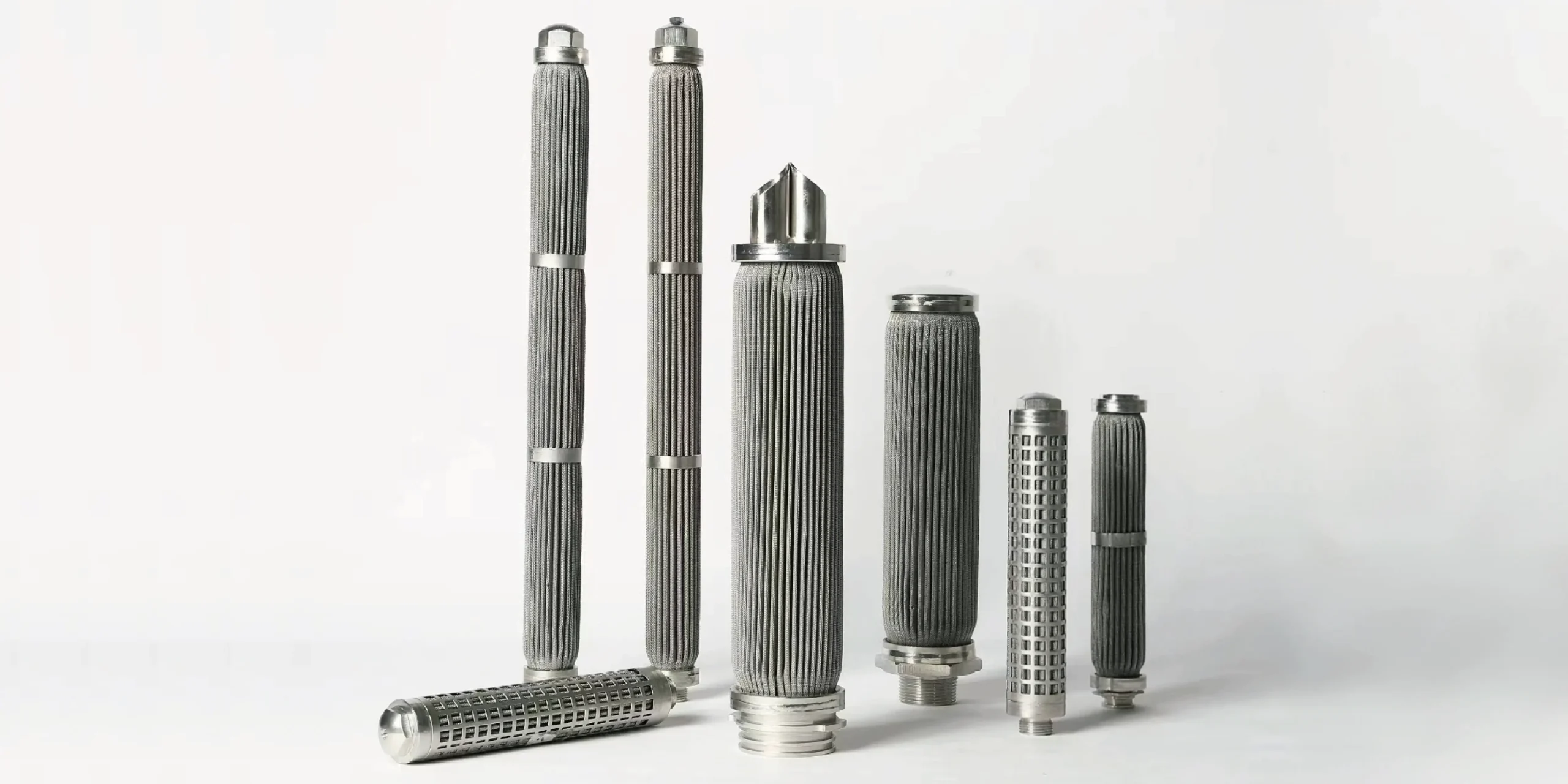
Pleated filter cartridges increase media area by folding a sheet into a compact cylindrical envelope. The media may be woven wire mesh, sintered wire mesh or sintered metal fiber felt. Support and drainage layers keep the pleats separated and help transfer differential load to the core and outer guard.
Pleating is useful when the housing envelope is fixed but the process needs more effective area than a plain cylinder can provide. More area can reduce face velocity and clean pressure drop, or extend the loading interval, but only if the pleat geometry remains open and the contaminant does not bridge the channels immediately.
Do not specify a pleated cartridge by length and micron rating alone. Confirm the media, pleat depth and spacing, flow direction, clean differential pressure, maximum differential load, end connection, seal material and cleaning method. DOE, 222, 226, threaded and custom welded ends are not interchangeable simply because the outside diameter appears similar.
SINFT’s stainless steel pleated filter cartridges use confirmed metal media options for liquid, gas, steam, oil and chemical duties. The guide to selecting a pleated filter cartridge explains the specification sequence in more detail.
2. Sintered Wire-Mesh Filter Elements
Sintered mesh elements use woven metal layers that are diffusion-bonded into a stable laminate. A fine control layer can be combined with protective, flow-distribution and reinforcing layers. The laminate can then be cut, rolled and welded into cartridges, tubes, discs, cones, panels or custom assemblies.
This type is often considered when stable opening geometry, mechanical support and repeated cleaning are more important than maximum depth-loading capacity. It commonly behaves as a surface filter: contaminants collect on or near the filtration face and may form a removable cake. The real result still depends on weave, layer order, thickness, support and flow direction.
The sintered mesh filter element page covers SINFT’s confirmed multilayer constructions. Use the five-layer sintered wire mesh guide when you need to understand what each layer does. Do not transfer ratings from a media sheet to a finished assembly without considering unsupported span, welds, end fittings and the direction of differential pressure.
3. Sintered Metal Fiber Felt Filters
Sintered metal fiber felt uses a three-dimensional network of randomly laid metal fibers. The connected, tortuous paths can provide high porosity and allow contaminants to load within the media depth. Fiber diameter, laydown, thickness, grading and support mesh determine the actual filtration and mechanical behavior.
Fiber felt is useful when the duty benefits from depth loading, high dirt-holding potential or relatively low resistance for a given retention target. Those advantages do not mean it is automatically easier to clean. Fine or adhesive contamination can penetrate into the structure and may not release as readily as a surface cake on sintered mesh.
Review SINFT’s sintered fiber felt filters when the process involves gas, steam, polymer melt, hydraulic oil or another duty suited to metal fiber media. The comparison of metal fiber felt versus wire mesh helps separate depth-loading needs from surface-filtration and backwash needs.
4. Basket Strainers and Tube Filters
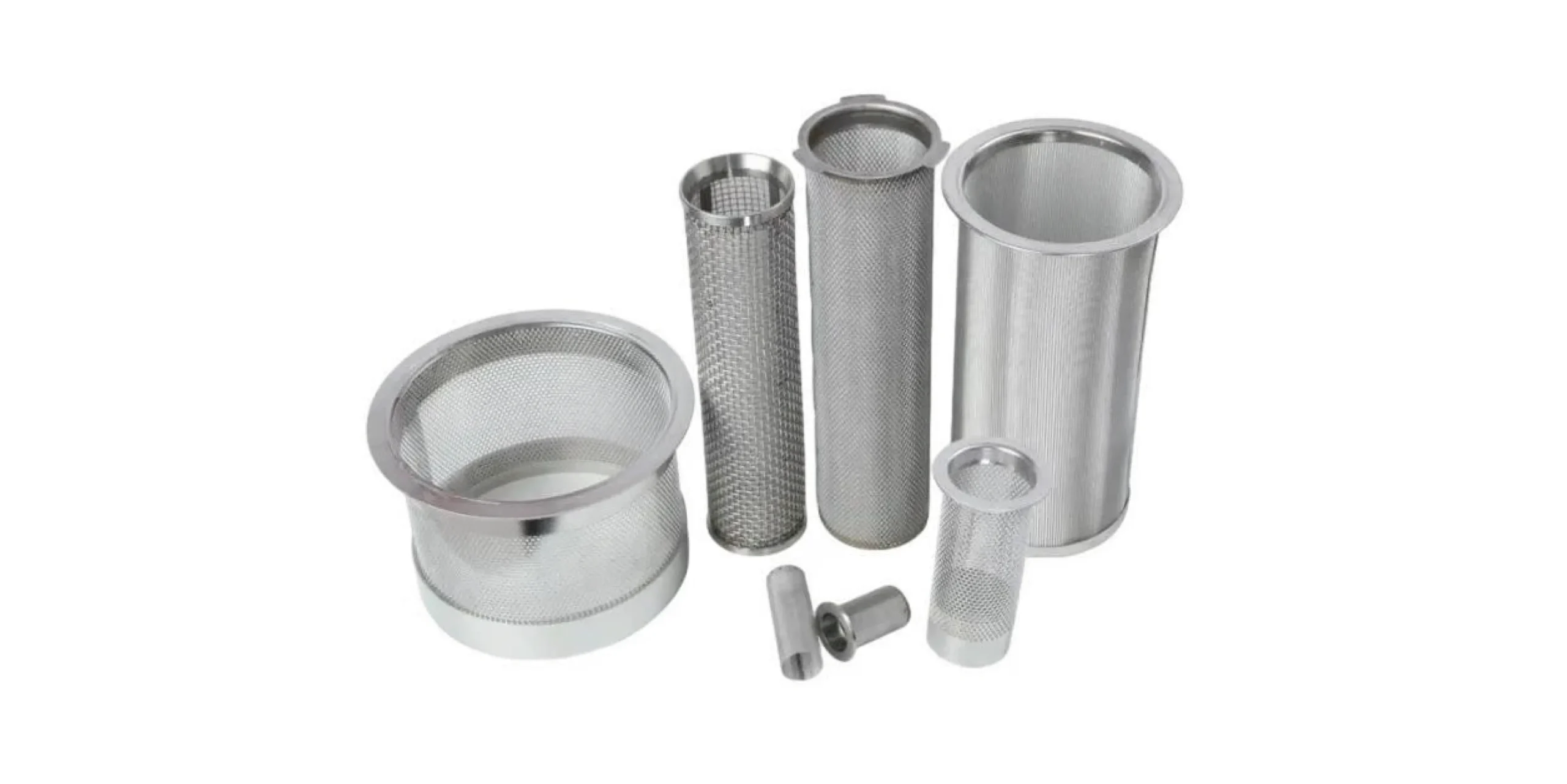
Basket and tube elements are robust removable screens commonly used to protect equipment from larger debris or to provide prefiltration. A perforated metal support may carry a woven-mesh liner, or the element may use another supported screen construction. The handle, rim, flange, seal and bottom closure are part of the working assembly.
The primary sizing issue is not only mesh count. Open area, hole or opening size, basket diameter and length, fluid viscosity, solids loading and allowable differential pressure determine whether the element can pass the required flow without an impractical cleaning interval. If the perforated support is coarser than the filtration layer, the relationship between the two affects both strength and effective area.
SINFT’s basket filters and tube strainers are relevant for equipment protection, coarse filtration and custom replacement. Use the basket strainer mesh-size guide to distinguish mesh, opening size and the actual contaminant-control requirement.
5. Backwash Filter Elements
Backwash elements are designed so accumulated solids can be released by reverse flow, gas assist or another validated cleaning cycle. The media may be stainless steel mesh, a reinforced basket or a slot structure. “Backwashable” describes the operating function; it does not identify one universal media.
A successful backwash depends on more than element strength. The contaminant must form a releasable layer, reverse flow must reach the fouled surface, the drain path must carry released solids away, and the assembly must tolerate reverse differential pressure. Sticky, deformable or deeply embedded particles may not release well even when the element survives the cleaning load.
The backwash filter cartridges page is the commercial entry point. The backwash filter working-principle guide explains differential-pressure triggering, reverse flow and the checks needed before returning an element to service.
6. Wedge-Wire and Notch-Wire Elements
Wedge-wire filters use shaped profile wire and support rods to create continuous slots, while notch-wire elements use profiled wire geometry to form controlled openings. Both are surface-separation structures, but their slot formation, open area, support and cleaning behavior differ.
Wedge wire is often evaluated where high open area, robust construction and resistance to blinding are important. Its V-shaped slot can help particles release from the narrow surface opening toward the wider internal passage. Notch wire can suit duties that need a strong metallic element with a defined notch or gap geometry. Neither should be selected from a nominal slot value alone: particle shape, orientation, deformability and bridging behavior matter.
See SINFT’s wedge-wire filters and notch-wire filters for the confirmed product boundaries. When slot size is the key variable, use the wedge-wire screen slot-size guide rather than converting mesh count mechanically.
7. Discs, Cones, Candles, Panels and Custom Assemblies
Disc, cone, candle and panel describe form, not a complete filtration technology. A disc may be cut from woven mesh, sintered mesh or fiber felt; a candle may be cylindrical or pleated; a panel may include a rigid frame and support. The chosen media still controls the retention and hydraulic behavior.
These forms are valuable when a standard cartridge will not fit the equipment or flow path. They also make edge sealing and support especially important. A filter disc can bypass at its rim even when the center media is correct. A cone can deform if its support and differential-load direction are wrong. A panel can flex across a large unsupported span.
For a custom form, provide a drawing or sample and identify the filtration face, flow direction, support, edge treatment, sealing surface, installation method and acceptance criteria. SINFT’s custom filter manufacturer service covers cartridges, tubes, candles, discs, cones, panels, baskets and welded assemblies without implying that one set of ratings applies to every shape.
Filter Media Types: Why Geometry Is Not Enough
The same cartridge geometry can contain media with very different pore structures. Pall’s filter-cartridge classification separates depth, pleated and pleated-depth cartridges by how the media is built and how it holds contamination. Porvair’s chemical-process filtration range similarly lists metal mesh, sintered metal fiber, sintered powder and mesh-composite media in cylindrical and pleated forms. These supplier classifications support a practical rule: always write the geometry and media as separate lines in the specification.
For SINFT’s confirmed range, the main metal-media choices are:
- Woven wire mesh: defined woven openings; may need support depending on weave, diameter and load.
- Sintered wire mesh: bonded multilayer structure; often chosen for rigidity, stable geometry and cleaning.
- Sintered metal fiber felt: random fibrous depth structure; considered for porosity and dirt holding.
- Perforated metal: robust support or coarse screening surface; opening pattern and open area matter.
- Wedge wire: continuous slot formed by profile wire; useful for robust surface separation.
- Notch wire: profiled-wire opening system for specific slot-filtration duties.
Do not assume a media name determines the alloy. Material compatibility must be checked independently. SS304, SS316 and SS316L differ in corrosion behavior; special alloys may be considered only when the process chemistry, temperature and fabrication route justify them.
Surface Filtration vs Depth Filtration
Surface filters retain most contamination on or near the incoming face, while depth filters allow particles to load within a three-dimensional pore network. Sintered mesh, wedge wire, notch wire and many basket screens are primarily surface structures. Metal fiber felt has stronger depth-loading behavior. Pleated construction may use either category of media.
Surface filtration is often preferred when the process expects cake formation and release by washing or backwash. Depth filtration can provide greater dirt-holding capacity for a broad particle distribution, but contamination embedded within the media may be harder to remove completely. The choice affects pressure-drop development, cleaning validation and service strategy.
The surface filtration versus depth filtration comparison provides a more detailed mechanism-based guide.
Cleanable vs Disposable Elements
A metal element is not automatically economical to reuse, and a disposable element is not automatically inferior. Reuse makes sense when the media and assembly tolerate the process, contamination can be removed safely, and the plant has an acceptance method after cleaning. Replacement may be better when contamination is hazardous, cleaning cannot restore flow, integrity is uncertain or downtime costs exceed the element value.
For a cleanable element, define:
- the allowed cleaning methods and chemistry;
- the terminal differential pressure or other cleaning trigger;
- the inspection of media, welds, end fittings and seals;
- the baseline used to judge flow or permeability recovery;
- any bubble-point, integrity or pressure test required before reuse;
- the rejection criteria and number of permitted cycles, if validated.
Eaton’s industrial filter-element information shows why the complete element matters: media, differential-pressure resistance, flow direction, seals and element design are specified together. A cleaning label cannot replace those details.
Choosing by Application
Application names are useful for narrowing the options, but they do not replace process data. Use the following tendencies as screening questions:
- Hydraulic and lubrication: retention efficiency, collapse resistance, clean pressure drop, fluid compatibility and housing fit are central. Start with the hydraulic filter element application and then confirm the actual system values.
- Water treatment: larger debris may favor baskets or wedge wire, while finer duties may use mesh, sintered media or cartridges. Cleaning method and solids loading often drive the choice. Review the water-treatment filter application.
- Chemical and petrochemical: alloy compatibility, temperature, seals, contamination type and cleaning safety must be confirmed together.
- Gas and steam: permeability, condensate or aerosol behavior, temperature and support against differential load require special attention.
- Polymer melt: high viscosity, gels, thermal exposure, pack configuration and screen-change strategy can dominate the design. Pall’s polymer-processing element range illustrates how candle, disc and pack-disc forms coexist with different pleat and support details.
- Food and beverage: cleanability, surface condition, material documentation and process hygiene requirements must be defined by the buyer’s system.
No application automatically selects one product. The same water-treatment plant may use a coarse basket upstream, wedge wire in a self-cleaning stage and a finer cartridge downstream.
A Practical Selection Workflow
Select the element by eliminating unsuitable mechanisms before optimizing dimensions. A useful sequence is:
- Define the fluid: liquid or gas, composition, viscosity, temperature and compatibility concerns.
- Define the contaminant: particle-size distribution, shape, hardness, concentration, deformability and whether a cake forms.
- Define the outcome: equipment protection, clarification, final product quality, catalyst retention or another measurable requirement.
- State the rating basis: nominal or absolute rating, efficiency curve, slot/opening size or an agreed test method.
- Set the hydraulic limit: normal and maximum flow, acceptable clean pressure drop and terminal differential pressure.
- Choose capture behavior: surface, depth or a combined structure.
- Choose the maintenance strategy: discard, manual wash, ultrasonic or chemical cleaning, backwash, steam or another validated method.
- Check mechanical duty: system pressure, differential-pressure direction, reverse load, cycling, vibration and handling.
- Confirm geometry: OD, ID, length, end connections, seals, clearances, support and filtration direction.
- Define acceptance: material certificate, dimensional report, permeability, bubble point, pressure test, passivation or traceability as required.
If a supplier receives only “10-micron stainless steel cartridge,” several critical choices remain unknown. If the supplier receives the data above, the element family can be reviewed against the real duty.
What to Confirm Before an RFQ
The fastest way to obtain a useful quotation is to provide both process data and fit data. Include:
- fluid or gas composition and compatibility concerns;
- normal and maximum operating temperature;
- normal flow and viscosity at operating temperature;
- working pressure and differential-pressure direction;
- contaminant description, loading and target retention;
- rating or efficiency basis;
- cleaning method and desired reuse strategy;
- element OD, ID, length and installation clearance;
- end connections, seal dimensions and seal material;
- housing drawing, existing part number, old sample or clear dimensional sketch;
- quantity and required inspection or traceability documents.
For a replacement, record the old element before disposal. Photograph both ends, measure the sealing interfaces, note the installed flow direction and inspect where deformation or leakage occurred. These details are often more valuable than a worn label.
How SINFT Can Help
SINFT manufactures industrial stainless steel filter elements from drawings, samples, housing dimensions and operating conditions. The confirmed range includes pleated cartridges, sintered mesh elements, sintered fiber felt filters, backwash cartridges, wedge-wire and notch-wire elements, baskets, tubes and custom welded forms.
The manufacturing review can cover media family, material, filtration structure, dimensions, end connection, seal interface and requested inspection records. Treat this guide as a screening tool, then send the process and fit data through the contact inquiry form for a product-specific assessment.
Frequently Asked Questions
What is the difference between a filter and a filter element?
A filter system may include a housing, cover, seals, valves, drains, pressure instruments and one or more replaceable elements. The filter element is the component that contains the filtration media and fits inside the housing. When requesting a replacement, identify whether you need only the element or a complete housing assembly. SINFT’s confirmed scope focuses on filter elements and custom filter assemblies, not every complete process system.
Is a cartridge a media type?
No. A cartridge is mainly an element format. It can contain woven mesh, sintered mesh, metal fiber felt, polymer depth media or another material. “Pleated cartridge” adds a geometric detail but still does not identify the media, alloy, rating basis or end connection. A useful specification names both the format and the filtration media.
Which industrial filter element has the lowest pressure drop?
There is no universal winner. Clean pressure drop depends on media permeability, rating, thickness, area, pleat geometry, support, element size, fluid viscosity and flow. A coarse basket may have low resistance but cannot replace a fine cartridge. Compare supplier data at the same fluid, temperature, flow, element geometry and retention requirement.
Which type holds the most dirt?
Depth media such as metal fiber felt can provide high dirt-holding potential, while a pleated structure can add area and a basket can hold a large mass of coarse debris. The answer changes with particle-size distribution, loading, cake behavior and terminal differential pressure. Dirt-holding capacity should be compared under a defined test or operating basis, not from media names alone.
Are stainless steel filter elements reusable?
Many are designed for cleaning and reuse, but reuse must be validated. The contaminant must be removable, the cleaning method must be compatible with media, welds and seals, and the element must meet the required flow and integrity checks afterward. Deep contamination, corrosion, deformation or damaged seams can make replacement safer than another cleaning cycle.
What is the difference between micron rating and mesh size?
Micron is a length unit; mesh count describes the number of openings per linear inch under a particular wire arrangement. One mesh count does not convert to one universal micron rating because wire diameter and weave affect the opening. Sintered fiber media and complex multilayer structures also cannot be specified by mesh count alone. Use the supplier’s actual opening or validated rating basis.
When should I choose wedge wire instead of woven mesh?
Consider wedge wire when the duty benefits from a robust continuous slot, high open area and a surface that can release solids by scraping or backwashing. Consider woven or sintered mesh when finer opening structures or a different support arrangement are required. Particle shape, deformability, slot orientation and cleaning method should decide the choice—not only the nominal opening.
What information is essential for a custom replacement element?
Provide the fluid, contaminant, retention basis, flow, temperature, pressure, differential load and cleaning method. Add OD, ID, length, end connections, sealing dimensions, flow direction and any support requirements. A drawing is best; an old sample and housing measurements can also support reverse engineering. State the required material and inspection documents before manufacturing begins.
Final Thoughts
Industrial filter element types are best understood as combinations of geometry, media, filtration behavior and maintenance strategy. Start with the contaminant and process duty, then verify hydraulic limits, mechanical load and housing fit. That sequence narrows the options more reliably than selecting by appearance or micron rating alone. SINFT can review drawings, samples and operating data for a custom metal filter element or replacement.